Wind and Thermals on an Appalachian Ridge
If you've spent any time hunting the sprawling, rugged hills of Appalachian Ohio, you know the frustration. One minute, your scent checker is drifting perfectly down a hollow, and the next, it's swirling back in your face, mocking your carefully planned approach. Understanding the intricate dance between wind and thermals in this challenging terrain isn't just an advantage; it's often the difference between seeing a mature buck and them scent-checking you long before you ever lay eyes on them. This guide aims to demystify these air currents, helping you become a more effective and stealthy hunter in Ohio's hill country.
Understanding the Basics: Wind Versus Thermals
Before we dive deep into hunting strategies, let's get a solid grasp on what we're actually dealing with out there. Many hunters use "wind" as a catch-all term, but in the hills, it's a tale of two very different, yet constantly interacting, phenomena.
True Wind and Its Influence
True wind is what the meteorologists report – the prevailing air movement caused by atmospheric pressure differences. On a flat landscape, it's relatively straightforward. You check the forecast, and you generally know which way your scent is headed. But throw in a patchwork of deep ravines, steep ridges, and timbered slopes, and that simple forecast becomes more of a suggestion than a hard rule.
In Appalachian Ohio, the true wind often gets channeled and redirected by the topography. A southwest wind might hit a major ridge line and be forced to sweep around it, creating swirling eddies on the lee side, or it could be funneled directly up or down a main hollow. On a ridge top, you might get a fairly consistent true wind, but as soon as you drop even a few feet off the side, it can change dramatically. This is why a strong, consistent wind is often a hunter's friend in flat farm country, but it can be an unpredictable beast in the rugged terrain of places like Wayne National Forest or Shawnee State Forest. When you're trying to execute a perfect ambush, this unpredictability can be maddening, making it incredibly difficult to pinpoint exactly where your scent is traveling.
The Phenomenon of Thermals
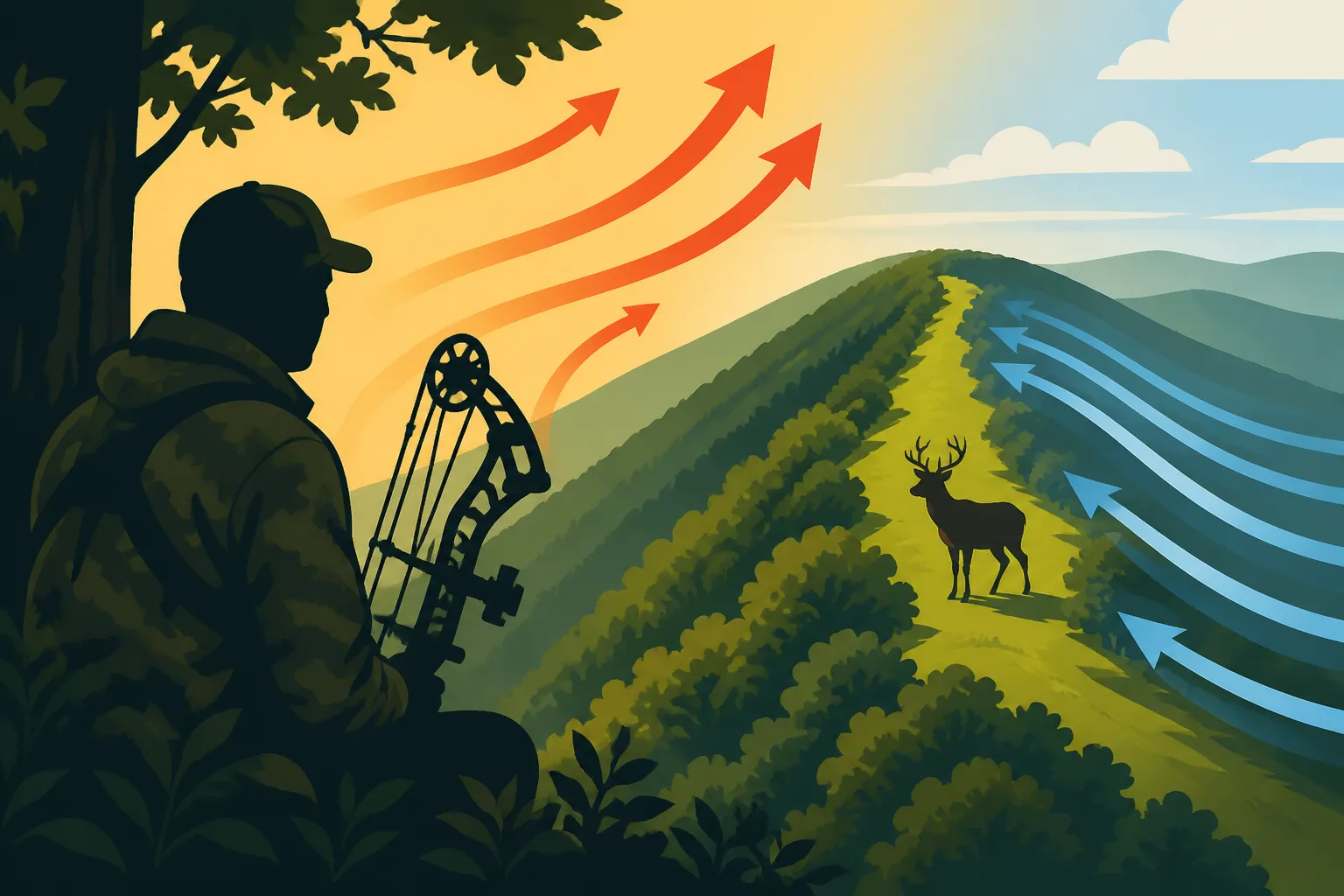
Thermals are the local, localized air currents driven by temperature changes. Think of them as mini convection currents. They are far more predictable than true wind, operating on a relatively consistent schedule, which makes them incredibly important for hill country hunters. As the sun rises and warms the earth, the air on the slopes begins to heat up. Hot air rises, so these thermals will pull air (and your scent) up the hillsides and hollows. This "updraft" is dominant during the morning hours, often starting an hour or so after sunrise and continuing until midday, or until the sun's intensity starts to wane.
Conversely, as the sun begins to set in the afternoon, the earth cools down, especially in the shaded hollows. The air cools, becomes denser, and starts to sink, pulling your scent down the hillsides and into the valley floors. This "downdraft" typically kicks in mid-to-late afternoon and continues through the evening and night.
The critical thing to remember is that thermals can override or blend with the true wind. On a calm day, thermals are king, dictating almost all local air movement. On a windy day, the true wind might dominate on exposed ridge tops, but deep in a secluded hollow, the thermal might still be strong enough to pull air up or down, creating complex swirling patterns. Recognizing this interplay is fundamental to effectively Reading a Ridge for Southeast Ohio Deer and planning your approach.
Reading the Terrain: Appalachian Ridge Dynamics
The unique topography of Appalachian Ohio isn't just pretty; it's a major player in how wind and thermals behave. Understanding these dynamics is like having a secret weapon in your hunting arsenal.
Ridge Tops and the False Sense of Security
You might climb to a high ridge, feel a steady breeze, and think you're golden. But ridge tops in the Ohio hills, while offering great vantage points, can be surprisingly tricky for scent control. While the true wind might be more consistent up high, the edges of these ridges are where the true wind often interacts violently with rising or falling thermals. You might have a steady wind on one side of the ridge, but just a few yards over the crest, a thermal could be pulling your scent in an entirely different direction.
Saddles – those dips or low spots along a ridge line – are especially notorious for swirling winds. They act like funnels, channeling air currents from both sides of the ridge. A saddle might look like a perfect ambush point, and it can be for deer, but your scent can become incredibly unpredictable there. Imagine a deer moving through a saddle; they are expecting air currents to shift, and they use that to their advantage. For a hunter trying to remain undetected, this means extra caution and a deep understanding of how air moves through these natural corridors. Setting up a Treestand Setup in Appalachian Ohio Hardwoods in a saddle requires a nuanced understanding of wind patterns.
Valley Floors and Hollows: Thermal Superhighways
If ridge tops are the wrestling rings for wind and thermals, then the deep hollows and valley floors are the thermal superhighways. These low-lying areas, especially the ones with steep sides, are where thermals are most pronounced and predictable. In the morning, as the sun hits the upper slopes, air starts to rise from the valley floor, carrying scent straight up and out. This makes still-hunting or walking into a hollow particularly challenging in the morning; any deer above you will quickly pick up your scent.
Conversely, in the evening, as the sun dips and the air cools, that heavy, cool air flows down these hollows like water, settling in the lowest points or continuing down to larger creek bottoms. This means that a deer bedded high on a ridge, often in areas like Where Shawnee State Forest Bucks Bed, can easily smell anything below them as evening approaches. Understanding these clear, directional movements within hollows is paramount. If you try to hunt a morning thermal from the bottom up, you're essentially alerting every animal above you to your presence. The hollows are where thermals are most potent and where a hunter's respect for them is most tested.
Aspect and Sun Exposure
The direction a slope faces, known as its aspect, also plays a huge role in thermal activity. South-facing slopes, catching the direct rays of the sun for longer periods, warm up much faster than north-facing slopes. This means that thermals will often start earlier and be stronger on south-facing slopes in the morning.
Deer often use this to their advantage. They might bed on a north-facing slope to stay cool and in the shade, relying on the predictable morning updraft to carry scent away from them. Or, they might stage on a south-facing slope in the evening to catch the last rays of sun, knowing the thermal will soon begin to pull their scent down. When you're Scouting Ohio Public Land Before Season, pay close attention to the solar aspect of potential bedding and feeding areas. A hunting app like GoHunt can provide detailed topographical maps and sun exposure data, helping you visualize these thermal patterns before you even step foot in the woods. By knowing which slopes are heating up fastest, you can predict where thermals will be most active and adjust your approach accordingly.
Hunting Strategies for Shifting Air Currents
Now that we understand the forces at play, let's talk about how to use this knowledge to our advantage in the real world of Ohio hunting.
Playing the Morning and Evening Shifts
This is perhaps the most critical strategy for hunting Appalachian terrain. Your goal is always to keep your scent below the deer you are targeting.
In the morning, as thermals are rising, you want to be positioned high. If you're planning on Still-Hunting Shawnee State Forest Ridges, start your hunt on the ridge top or upper third of a slope. Your scent will be carried up and away, ideally over the top of any deer below you. You can then slowly hunt down the ridge or slope as the morning progresses, always trying to stay above where you expect deer to be. This is particularly effective if you plan to still-hunt or move cautiously through the timber. Imagine slowly picking your way down a steep ravine, knowing that any deer below you won't catch your scent, only the ones above – which you should be able to spot first.
In the evening, as thermals begin to fall, the opposite strategy applies. You want to be positioned low, or at least below the deer's likely travel corridors. Start your hunt in the bottom of a hollow or on a lower bench, and as the thermal pulls your scent downwards, it will settle in the valley, keeping you undetected from deer moving high on the slopes above you. This is a prime time for deer to start moving from their bedding areas high on the ridges down towards evening food sources. You could slowly hunt up a hollow, or position yourself on a bench halfway up, allowing the falling thermal to carry your scent harmlessly into the depths of the valley below you. This strategy is key for successful Hunting Southeast Ohio Appalachian Foothills.
Using Topography to Your Advantage
Beyond simply hunting high or low, you can leverage specific topographical features to create "safe zones" for your scent.
- Finger Ridges and Spurs: These smaller ridges that branch off a main ridge can be excellent ambush points. Your scent might blow consistently down one side, while deer move unhindered on the other. By positioning your stand on the downwind side of a finger ridge, you can often cut off deer moving along the main ridge or in the hollows.
- Benches: These flat spots on a hillside are natural deer highways. Often, deer will travel along benches to avoid climbing steep slopes. They can also offer slightly more stable wind conditions than directly on a steep incline. Positioning yourself on a bench on the downwind side of a known travel route can be deadly.
- Leeward Sides: On very windy days, the true wind can still be strong. Deer often seek refuge from strong winds on the leeward (sheltered) side of a ridge. If the wind is blowing consistently from the west, deer might travel or bed on the east-facing slopes. Hunting these protected areas can put you in front of deer seeking comfort. This is where understanding Finding Sign in Big Appalachian Timber comes into play; deer sign will often be concentrated in these sheltered areas during high winds.
Advanced Tactics for Swirling Conditions
Sometimes, despite your best efforts, the wind simply won't cooperate. This is where adaptability and a bit of ingenuity come in.
- Midday Movement: On calmer days, the mid-morning to early afternoon can be a period of thermal transition. The strong morning updraft might dissipate, and the evening downdraft hasn't fully kicked in. This can lead to unpredictable swirling. During these times, it's often best to move slowly, using frequent scent checks, or to hunt areas where deer might feel secure even with inconsistent wind, such as thick cover or small, isolated benches.
- "Wind Tunnel" Hollows: Some hollows are so perfectly aligned that they create natural wind tunnels, channeling true wind very consistently regardless of thermals. Identify these on your maps. If you have a strong, consistent wind, these can be fantastic, predictable travel corridors for deer, and therefore, excellent ambush points for you.
- The GoHunt Advantage: Tools like the GoHunt app allow you to see predicted wind direction and thermal movement overlayed on topographical maps. By analyzing the contours of the land and the forecast, you can predict how the air will move around specific ridges and hollows. This predictive capability is invaluable for planning your approach and stand locations, especially when you're considering Hanging a Stand on an Appalachian Ridge in a particularly tricky spot. You can even check it in the field if you have service, giving you real-time insight into potential shifts.
| Condition | Time of Day | Thermal Direction | Ideal Hunter Position | Deer Movement Expectation |
|---|---|---|---|---|
| Rising Air | Morning (Sunrise-Noon) | Up the slopes/hollows | High (ridge tops, upper slopes) | Moving from feeding areas low to bedding areas high. |
| Falling Air | Evening (Late PM-Dark) | Down the slopes/hollows | Low (valley floors, lower benches) | Moving from bedding areas high to feeding areas low. |
| Calm/Overcast | All Day | Very weak or no thermal | Adjust to prevailing wind, seek cover | Less predictable, likely holding tight in thickets. |
| Strong Wind | All Day | True wind dominates | Leeward side of ridges, thick cover | Seeking shelter, moving cautiously on sheltered sides. |
Tools and Technology for Better Wind Awareness
Even with a deep understanding of physics and topography, you need practical tools to confirm what the air is doing right now, right where you are.
Physical Tools for Real-Time Feedback
No matter how sophisticated our digital tools get, nothing replaces real-time, on-the-ground feedback.
- Scent Checkers (Powder or Milkweed): These are non-negotiable in hill country. A small bottle of unscented powder or a pouch of milkweed seeds allows you to see the exact direction and behavior of the air currents at your specific location. Don't just check once; check frequently. A gentle puff every 10-15 minutes can alert you to subtle shifts that could be fatal to your hunt. It's not just about which way it's blowing, but how it's blowing – is it swirling? Is it holding steady? Is it pulling upwards from the hollow below?
- Binoculars and Optics: While not directly for wind, quality optics, especially those suited for Optics for Appalachian Ohio Ridges, allow you to observe tree sway, distant smoke, or even how leaves are moving far down a slope, giving you clues about the broader wind patterns that might be affecting your immediate area.
- The Human Touch: Pay attention to what your skin feels. Can you feel a distinct draft pulling up from a hollow, even if the general wind is blowing across the ridge? Can you hear leaves rustling in a specific direction? These subtle cues, combined with your scent checker, paint the most accurate picture.
Leveraging Digital Scouting and Forecasting
Technology has come a long way in helping hunters understand wind and thermals, especially for advanced planning.
- Hunting Apps with Topographical Overlays: Apps like GoHunt are a game-changer for mapping out your hunt. They use detailed topographical data to not only show you elevation changes but also to predict how wind and thermals will interact with the terrain. You can input your stand location and see a visual representation of your scent cone at different times of the day, helping you avoid giving away your position. This is invaluable when you are doing your initial Scouting Ohio Public Land Before Season, allowing you to eliminate potential stand sites before you ever step foot on the ground.
- Weather Forecasting for Hunters: Beyond just the general wind speed and direction, specialized weather apps can provide hourly forecasts for specific locations, including temperature changes that will influence thermal activity. They can even offer "wind matrix" views that show predicted wind direction at different elevations, which is incredibly useful for navigating complex Appalachian terrain. Knowing that a thermal is expected to switch at 10 AM, for example, allows you to plan your morning hunt to move with that thermal, rather than against it.
By combining traditional tools with modern technology, you can develop a comprehensive understanding of wind and thermals, dramatically increasing your chances of success in the challenging, yet rewarding, Appalachian hills of Ohio.
Disclaimer
The information provided in this guide is for informational purposes only and is not a substitute for adhering to all local, state, and federal hunting regulations. Always consult the Ohio Department of Natural Resources (ODNR) for the most current rules and safety guidelines before hunting. Hunting is an inherently risky activity, and proper safety precautions, including the use of safety harnesses in treestands, are always recommended.