Choke Choice for Fast Rabbit Flushes
There's nothing quite like the sudden, explosive flush of a cottontail rabbit from a thick fencerow or dense briar patch. One moment, all is quiet, and the next, a brown streak rockets through the undergrowth, disappearing almost as quickly as it appeared. For many Ohio hunters, especially those of us who grew up chasing these wily little critters, hitting that fast-moving target can be incredibly frustrating if your shotgun isn't set up right. This guide will walk you through understanding shotgun chokes and how to pick the perfect one to increase your success and enjoyment on those exciting rabbit hunts.
Understanding Chokes and How They Impact Your Shot Pattern
Before we dive into specific recommendations, let's talk a little about what a shotgun choke actually is and why it matters so much for hunting fast-flushing game like rabbits. Think of a choke as a constriction at the very end of your shotgun barrel, designed to control how quickly your shot string spreads out after leaving the muzzle. Without a choke, or with a very open one, your pellets scatter almost immediately, creating a wide pattern at close range but losing density very quickly. With a tighter choke, those pellets are held together longer, creating a more concentrated pattern that travels further before spreading too much.
The trick with rabbits, particularly here in Ohio where they often explode from dense cover right at your feet, is that the shot distances are usually quite short. You don't need a super-tight pattern designed for long-range shots on ducks or distant pheasants. What you do need is a pattern that's wide enough to allow for some human error in your swing and lead, but dense enough to deliver a clean, ethical kill on a small, quick-moving target. It's a fine balance, and choosing the right choke is key to finding that sweet spot.
The Basics of Shot Patterning
When we talk about shot patterns, we're really thinking about how many pellets hit a specific target area at a given distance. Imagine a dinner plate. If you shoot at that plate from 10 yards, and every pellet hits it, that's a very dense pattern. If only a few pellets hit, it's sparse. Now, imagine a rabbit is only the size of a small dinner plate. You need enough pellets in that small area to break bones and vital organs for a quick, humane dispatch.
A common mistake new hunters make is assuming a tighter pattern is always better because it offers more "power." While a tight pattern certainly concentrates more pellets, it also means your margin for error is significantly smaller, especially on a target that might be crossing your line of sight at high speed only 15 yards away. If your pattern is only the size of a grapefruit at that distance, you're going to miss a lot of rabbits. On the flip side, if your pattern is too wide and too sparse, you might hit the rabbit with a few pellets, but not enough to put it down cleanly. This leads to wounded game and a frustrating hunt for everyone involved, especially your canine companion if you're Running Beagles on Ohio Cottontails.
The ideal scenario for rabbit hunting is a pattern that gives you a forgiving spread at typical flushing distances, ensuring a good chance of hitting the rabbit, while still delivering enough pellet density within that spread for a clean kill. This "sweet spot" changes depending on your shotgun, your chosen ammunition, and critically, the choke you're using.
Common Choke Constrictions and Their Uses
Shotgun chokes are typically measured in terms of how much they constrict the barrel, with common designations like Full, Modified, Improved Cylinder, and Skeet or Cylinder. Let's break down what each means and how it applies to our rabbit pursuit.
-
Full Choke: This is the tightest common constriction, designed to hold the shot pattern together for the longest distances. It's excellent for long-range waterfowl, turkeys, or pheasants that flush far out. For rabbits, however, a Full choke is almost always too tight. If a rabbit flushes 10-15 yards away, your pattern might still only be a few inches wide, making it incredibly difficult to hit. And if you do hit it, the dense pattern can obliterate the meat, which is certainly not ideal for a delicious rabbit stew later.
-
Modified Choke: A step down from Full, Modified chokes offer a good balance of spread and density, often considered a good all-around choice for many hunting scenarios. It's effective for upland birds that flush at medium distances, say 25-35 yards. For rabbits, a Modified choke can work, especially if you anticipate longer shots or if you're hunting more open cover where rabbits might run a bit before presenting a shot. However, for those classic, exploding flushes from under your feet, it can still be a bit too constrictive.
-
Improved Cylinder (IC) Choke: Now we're getting into the sweet spot for rabbit hunting. Improved Cylinder is designed to give a quicker, wider spread than a Modified choke, but still maintain enough pellet density for effective kills out to around 25-30 yards. This is often the go-to choke for upland game birds like quail or partridge, and it's an excellent choice for rabbits. It offers that crucial forgiveness at close range while still being effective if a rabbit decides to put some distance between itself and your hunting party.
-
Skeet Choke / Cylinder Choke: These are the most open chokes, designed for very close ranges. Skeet chokes are specifically made for skeet shooting, where targets are typically engaged at very short, predictable distances. Cylinder, or no choke at all, provides the widest, fastest spread. For rabbit hunting, particularly in extremely dense cover where you know every shot will be within 10-15 yards, a Skeet or Cylinder choke can be incredibly effective. The pattern opens up so quickly that it's much easier to hit a target that just burst from a thicket. The trade-off is that its effective killing range is quite limited, so any rabbit that gets out past 20 yards might be missed or only wounded.
Why Rabbit Flushes Demand Specific Choke Choices
Ohio's cottontail rabbits are masters of concealment. They spend their days tucked into the thickest cover imaginable – those dense multiflora rose fencerows, tangled briar patches, brush piles, or knee-high standing grasses that seem impenetrable. This isn't wide-open prairie hunting; this is close-quarters combat where speed and pattern spread are your allies.
When a rabbit flushes, it's rarely a leisurely stroll. It's an explosion of speed and erratic movement, often within spitting distance of your boots. The landscape dictates the strategy, and for us Ohio hunters, that often means working those tight cover areas.
The Close-Range Challenge of Ohio's Cottontails
Picture this: You and your hunting buddies are slowly pushing a long, brushy fencerow on a crisp November morning. The air is cold, and you can hear a beagle whimpering with excitement just ahead. Suddenly, a brown blur erupts from a tangle of grapevines right in front of you, heading straight for the safety of a standing cornfield. You shoulder your shotgun, swing, and pull the trigger. Did you connect? If you're running too tight a choke, the answer might be a frustrating "no," because that pattern was still too small to account for the rabbit's speed and your reaction time. This is a common scenario when you're Rabbit Hunting Thick Ohio Fencerows.
The frustration of missing such a close shot is real. You felt like you were on it, but the pattern was just too concentrated. This highlights the unique challenge of hunting rabbits in Ohio's varied habitat. From the agricultural fields of Northwest Ohio to the more rolling hills with brushy draws, rabbits leverage every bit of cover they can find. This means most shots are going to be under 25 yards, and many will be under 15. Your choke needs to be ready for that. Using an app like GoHunt to scout aerial photos of potential cover can help you anticipate these close-range encounters and make an informed choke decision before you even hit the field.
Balancing Pattern Spread and Pellet Density
Finding the right choke is all about hitting that sweet spot between pattern spread and pellet density. If your pattern is too wide at close range, you might get a lot of pellets hitting the periphery, but not enough concentrated in the vital area of the rabbit for a clean kill. This can lead to wounded game that escapes, which is something every ethical hunter wants to avoid.
Conversely, if your choke is too tight, you'll simply miss more often. Imagine trying to hit a tiny, fast-moving target with a laser pointer—that's what a full choke can feel like on a fast-flushing rabbit. The goal is to use a choke that spreads quickly enough to give you a reasonable chance of connecting with the rabbit while ensuring that the pellets that do hit are numerous and energetic enough to deliver a clean, humane kill. This is especially true given the small size of a cottontail.
When considering your Upland Guns for Fencerow Cover, remember that the choke is an extension of your gun's overall effectiveness. A 20-gauge with an Improved Cylinder and 7.5 shot can be just as deadly on a rabbit as a 12-gauge with the same setup, often with less recoil and a lighter gun for walking all day through the rough stuff. The size of your shot also plays a critical role here; for most rabbit hunting, 6s or 7.5s are standard, offering a good balance of pellet count and individual pellet energy. You're looking for that perfect blend where enough pellets hit a rabbit-sized target to anchor it instantly, without turning it into a mess of torn meat.
Recommended Chokes for Fast Rabbit Flushes in Ohio
So, given the close-range, fast-paced nature of Ohio rabbit hunting, what chokes should you be looking at? My strong recommendation, and what many seasoned rabbit hunters often gravitate towards, is the Improved Cylinder. However, depending on the specific cover you're hunting, a Skeet or even Cylinder choke might be the best call.
Improved Cylinder – The Workhorse for Rabbits
The Improved Cylinder (IC) choke is, in my opinion, the absolute workhorse for rabbit hunting in Ohio. Here's why:
- Forgiving Spread at Close Range: At those typical 10-20 yard flushing distances, an IC choke opens up quickly enough to give you a very forgiving pattern. This means your lead and swing don't have to be absolutely perfect to connect with that streaking cottontail. It offers a pattern roughly 20-25 inches in diameter at 20 yards, which is a fantastic zone to hit a rabbit in.
- Sufficient Density for Ethical Kills: While it spreads faster than a Modified or Full, the IC choke still maintains excellent pellet density within its effective range. This ensures that when you do hit a rabbit, you're delivering enough pellets to the vital zone for a clean, humane kill, reducing the chance of crippling game.
- Versatility: If you're walking fencerows, woodlot edges, or briar thickets, you might occasionally get a rabbit that breaks further out, say 25-30 yards. An IC choke will still perform admirably at these slightly longer ranges, making it incredibly versatile for typical Ohio hunting conditions. It's also a great choice if you're mixing your rabbit hunt with some late-season squirrel hunting in the hardwoods or going for Ohio Small Game and Upland Bird Seasons generally. Before you even step into that thicket, a quick check on your GoHunt app can remind you of the typical cover density for the area, helping you confirm your choke choice.
Many hunters simply leave an Improved Cylinder choke in their shotgun for the entirety of the Ohio Rabbit Season Opening Day and beyond, and they're well-equipped for the vast majority of shots they'll encounter.
When to Consider Skeet or Cylinder Chokes
While Improved Cylinder is generally ideal, there are specific scenarios where an even more open choke like Skeet or Cylinder might shine:
- Extremely Dense Cover: If you're hunting very specific, almost impenetrable cover where you know for a fact that every single shot will be an absolute chip shot – under 15 yards, maybe even under 10 – then a Skeet or Cylinder choke can be incredibly effective. Think of those tiny, brushy pockets or thickets where a rabbit literally has nowhere to go but to bolt directly under your nose. In these situations, the widest possible pattern is your friend.
- Quick Doubles/Triples: If you're a fast shot and find yourself occasionally getting quick follow-up shots on multiple rabbits (though this is rare!), a very open choke can offer a slight advantage on that second, rapidly acquired target.
- Youth Hunters: For younger hunters, or those still developing their wing-shooting skills, a more open choke can provide a larger margin of error, helping them connect more often and build confidence. It's all about making the experience enjoyable and successful.
The main downside to Skeet or Cylinder chokes is their limited effective range. If you anticipate any shots beyond 15-20 yards, you're likely to have a very sparse pattern that risks wounding rather than cleanly killing. It's a specialist's choke, best reserved for very specific, close-quarters situations. Using a tool like GoHunt can help you evaluate the density of cover and make an informed decision on whether to go with an even more open choke for truly tight spots.
| Choke Constriction | Typical Pattern (%) @ 40 yards | Best Use for Ohio Rabbits | Pros | Cons |
|---|---|---|---|---|
| Full | 70-75% | Very long range (rare) | Tightest pattern, maximum range. | Too tight for close flushes, risks excessive meat damage. |
| Modified | 55-60% | Mid-range shots (25-35 yds) | Versatile, good pellet density for longer shots. | Still can be too tight for very close, explosive flushes. |
| Improved Cylinder | 45-50% | Primary Recommendation | Excellent for fast, close flushes (10-25 yds); good range. | Might be too open for occasional 30+ yard shots. |
| Skeet/Cylinder | 25-40% | Extremely dense cover, very short shots (under 15 yds) | Widest pattern, very forgiving at close range. | Very limited effective range, less pellet density at moderate distances. |
Practical Considerations and Testing Your Choke
Choosing a choke isn't just about reading a table or taking a recommendation; it's about understanding how that choke performs with your specific shotgun and your chosen ammunition. No two shotguns, even of the same make and model, will pattern identically.
The Importance of Patterning Your Shotgun
Patterning your shotgun is perhaps the most critical step in optimizing your setup for rabbit hunting. It means taking your shotgun to a safe range and shooting at large paper targets to see exactly how your chosen choke and ammunition combination performs.
Here's a simple way to do it:
- Choose a Target: Use a large sheet of butcher paper or cardboard, at least 3×3 feet. Draw a prominent aiming point (a small circle or cross) in the center.
- Set Your Distance: For rabbit hunting, you want to test at typical flushing distances. Start at 15 yards, then try 20 and 25 yards. These are the ranges where you'll most often be engaging rabbits.
- Shoot Several Times: Fire at least three shots at each distance with your chosen choke and rabbit load (e.g., 7.5 shot). Aim precisely at the center point.
- Analyze Your Pattern: After each shot, examine the target.
- Density: Are there enough pellets within a rabbit-sized area (say, an 8-inch circle) around your aim point? You want enough hits to ensure a clean kill.
- Evenness: Is the pattern relatively even, or are there big holes where a rabbit could slip through without being hit?
- Effective Range: At what distance does the pattern become too sparse to reliably kill a rabbit?
- Adjust as Needed: If your pattern is too tight at 15-20 yards, consider a more open choke. If it's too sparse at 25 yards, you might need a slightly tighter one. You might also try different brands or shot sizes of ammunition, as these can significantly alter your pattern. Even a minor tweak can make a difference, and apps like GoHunt can help you log these details for future reference.
This process will give you invaluable insight into the true performance of your setup and build confidence when you're out in the field.
Field Swapping Chokes and Other Tips
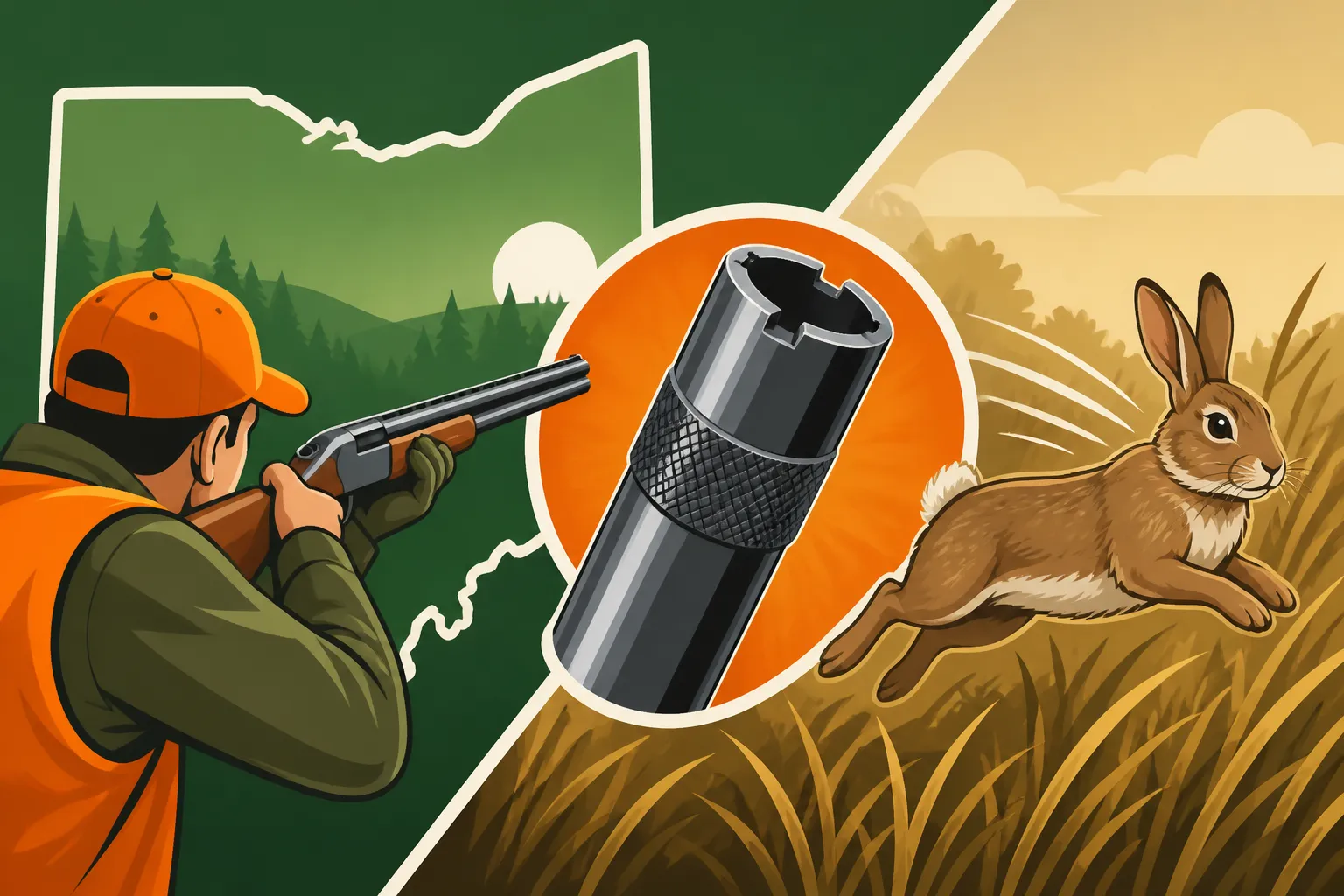
Many modern shotguns come with interchangeable choke tubes, which is a fantastic feature for hunters who pursue various game or hunt in diverse habitats. Carrying a small choke wrench and a couple of different choke tubes (say, an Improved Cylinder and a Skeet) allows you to adapt to the specific cover you're hunting that day. If you start in thick briar patches, opt for Skeet. If you then move to a more open field edge where rabbits might run further before you shoot, you can quickly swap to an Improved Cylinder.
Beyond choke choice, remember the fundamentals:
- Gun Fit: A shotgun that fits you well will point more naturally and improve your wing shooting. If your gun doesn't fit, even the perfect choke won't solve all your problems.
- Shot Size: For cottontails, 6 or 7.5 shot is usually ideal, offering a good balance of pellet count and energy. For information on this, check out Shot Size for Squirrel and Rabbit.
- Practice: The best choke in the world won't make up for lack of practice. Spend some time on the skeet range or shooting sporting clays to hone your quick-reflex shooting skills.
- Footwear: You'll be walking through some serious cover, so make sure you have appropriate footwear. Boots for Walking Ohio Farm Country are essential for a comfortable and safe hunt.
- Barrel Length: While not directly a choke issue, consider your Barrel Length for Walking Fencerows. A shorter barrel can be easier to maneuver in tight cover, which is where rabbits often flush, allowing you to get on target faster.
- Scouting: Knowing your hunting grounds and anticipating where rabbits will likely flush is always an advantage. Whether you're using a physical map or a digital tool like GoHunt, understanding the terrain will guide your choke choice, and many hunters report higher success rates when they match their choke to the expected shot distance in a given area.
Ultimately, choosing the right choke for fast rabbit flushes in Ohio is about making an informed decision that maximizes your chances of a clean kill and a successful hunt. For most, an Improved Cylinder choke will be the best all-around choice, offering that perfect balance of spread and density. But don't be afraid to experiment with more open options for those truly dense cover situations. Good luck out there, and happy hunting!
Disclaimer
This article is for general informational purposes only and does not constitute professional advice. Laws, prices and regulations vary by location and change over time. Consult a qualified professional for guidance on your specific situation.