Why Ohio Once Required Shotguns for Deer
For generations, Ohio deer hunters knew one thing above all else about firearms during the general deer season: it was a shotgun state. This wasn't just a tradition; it was the law. Many of us, myself included, grew up patterning slugs and debating smoothbore versus rifled barrels, never really questioning why things were that way. But for new hunters, or those coming from states with open rifle seasons, this can be a real head-scratcher. This guide aims to clear up the mystery, delving into the historical reasons behind Ohio's long-standing shotgun-only deer regulations and how those rules eventually evolved into the diverse options we have today.
The Historical Landscape of Ohio Deer Hunting Regulations
Ohio's journey with deer hunting regulations is a fascinating one, deeply intertwined with the state's population growth, agricultural roots, and conservation efforts. For a significant period, the idea of allowing high-powered rifles for deer hunting was simply off the table, and for very understandable reasons.
Early Days and Safety Concerns in a Populous State
Think about Ohio's landscape: it's a mix of sprawling farmlands, dense woodlots, and rapidly expanding suburban areas, all punctuated by bustling cities. It's not the wide-open, sparsely populated wilderness you might find out west. Back in the day, especially as deer populations began their slow, hard-won recovery after being almost completely wiped out in the state, the prevailing concern was safety. The thought of a high-powered rifle bullet, capable of traveling for miles with lethal force, being discharged in an area where properties often butt up against each other, or where a woodlot might be just a short distance from a school or a housing development, raised serious red flags.
Lawmakers and wildlife officials were trying to balance the reintroduction of deer hunting—a crucial tool for managing growing herds—with the very real need to protect public safety in a comparatively densely populated state. The common wisdom, at the time, was that shotguns offered a much more localized and therefore "safer" solution. A slug, while certainly powerful, was believed to have a far shorter effective range and drop much more quickly than a rifle bullet, significantly reducing the risk of a projectile traveling beyond the intended target and into an unintended area. This was a foundational principle that guided Ohio's deer hunting laws for decades, shaping how generations of hunters approached the sport.
The "Shotgun Only" Era and Its Rationale
For the better part of the 20th century, extending well into the 2000s, Ohio was staunchly a "shotgun-only" state for deer hunting during the general firearms season. While muzzleloaders and handguns were also permitted, the shotgun was king for those who chose modern firearms. This regulation wasn't arbitrary; it was based on that core belief in limited range and increased safety in a state with a relatively high population density. The thinking went like this: a typical shotgun slug, whether a traditional Foster or Brenneke, simply wouldn't travel as far as a rifle bullet. This was seen as a vital safeguard, especially when considering the mosaic of small woodlots and farm fields that characterize much of Ohio's hunting land.
This era fostered a unique hunting culture. Hunters invested in specialized slug guns, often with rifled barrels and advanced optics, trying to squeeze every bit of accuracy and range out of their setups. There was a constant chase for the "perfect" slug and barrel combination to extend that effective range just a few more yards. Despite the advancements in slug technology, the underlying reality remained: compared to centerfire rifles, shotguns still operated within a significantly more confined ballistic envelope. This meant hunters had to adapt their strategies, focusing on closer shots and understanding the limitations of their chosen firearm. It was a rule that dictated not just what you could carry, but how you hunted, from Treestand Setups in Appalachian Ohio Hardwoods to Hunting Northwest Ohio Farmland Deer.
Technical Considerations of Shotgun Slugs
When we talk about the "shotgun-only" era, it's important to understand the technical realities of shotgun slugs that shaped those regulations. These aren't just big pellets; they're solid projectiles with distinct ballistic properties.
Understanding Slug Ballistics and Range Limitations
A shotgun slug is essentially a single, heavy projectile fired from a shotgun. Unlike rifle bullets, which are typically designed to be aerodynamic and maintain velocity over long distances, traditional shotgun slugs are much less efficient in flight. They are relatively slow and lose energy rapidly, causing a significant drop in trajectory. For example, a common 12-gauge slug might leave the muzzle at around 1,500-1,800 feet per second. While powerful at close range, its velocity quickly diminishes, and gravity pulls it down quite aggressively.
This translates directly into range limitations. For most smoothbore shotguns firing traditional slugs, the effective range for ethical deer hunting is often considered to be around 75 to 100 yards. Beyond that, accuracy becomes highly questionable, and the energy delivered to the target drops considerably. Even with modern advancements like rifled barrels and sabot slugs, which we'll discuss next, pushing beyond 150-200 yards with consistent accuracy and energy retention for a clean kill was, and often still is, a challenge. Compare that to many common rifle calibers which can be accurately and effectively lethal out to 300, 400, or even further yards. This stark difference in ballistic performance was the cornerstone of the argument for keeping rifles out of the Ohio deer woods.
Smoothbore Versus Rifled Slug Guns
The world of shotgun slugs actually has two main branches that significantly impact performance: smoothbore and rifled slug guns.
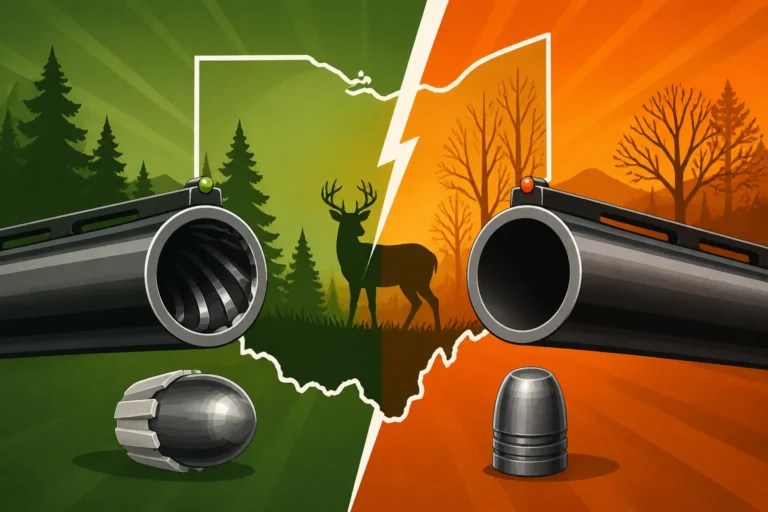
Traditional shotguns have smoothbore barrels, meaning the inside of the barrel is smooth. When firing a slug from a smoothbore, hunters typically use Foster slugs or Brenneke slugs. These slugs are designed with fins or a hollow base to provide some rotational stability as they travel through the air, much like a badminton shuttlecock. However, their accuracy is inherently limited. You might get a decent group at 50 yards, but beyond that, it can be a real gamble. For many years, this was the standard for Ohio deer hunters, and mastering these limitations was part of the annual ritual of patterning your gun.
As hunters pushed for better accuracy, the rifled slug barrel emerged. These barrels have helical grooves, just like a rifle barrel, that impart a spin on the projectile. To take advantage of this spin, specialized sabot slugs were developed. Sabots are plastic sleeves that encase a smaller, aerodynamic bullet. The sabot engages the rifling, imparting spin, and then falls away after the slug leaves the barrel, allowing the aerodynamically efficient slug to fly true. A dedicated rifled slug gun firing sabot slugs can significantly extend the effective range to 150, sometimes even 200 yards, with good accuracy. This innovation, while still technically a "shotgun," began to blur the lines of the original "limited range" rationale, as these setups performed far more like traditional rifles within their designated range envelope. They also often came with a higher price tag for both the firearm and the specialized ammunition, which was a common consideration for those looking to upgrade their gear for hunting Ohio's diverse terrain.
The Shift Towards Straight-Wall Cartridges
Despite the advancements in slug technology, the desire for more consistent and effective deer hunting tools persisted among Ohio's hunting community. This eventually led to a significant legislative change that redefined what a "legal" firearm for deer hunting could be.
The Demand for Better Performance and Accuracy
For years, Ohio hunters watched as neighboring states, many with similar population densities and landscapes, allowed various forms of rifles for deer hunting. There was a growing sentiment that modern firearm technology had advanced to a point where safe, effective, and more accurate alternatives to shotguns could be introduced without compromising public safety. Hunters expressed frustration with the inherent limitations of slugs—the rainbow-like trajectory, the significant drop at range, and sometimes inconsistent accuracy, especially beyond 100 yards.
Imagine you're hunting a sprawling cut cornfield in Northwest Ohio, or trying to reach a buck across a wide creek bottom in the Appalachian foothills. A 120-yard shot, which is fairly common in many hunting scenarios, could be a stretch for a typical slug gun. This often meant passing on ethical shots or being limited to specific stand locations that guaranteed closer engagements. The hunting community, often led by advocates and organizations like GoHunt, started making a strong case that cartridges designed for pistols or older lever-action rifles, characterized by their straight-walled cases, offered a perfect middle ground. These cartridges provided significantly better accuracy and flatter trajectories than slugs, extending the effective range, but still maintained a relatively "controlled" range compared to bottlenecked rifle cartridges, which could travel much farther.
Legislative Changes and the Introduction of Straight-Wall Rifles
The persistent advocacy from hunters and responsible firearm owners eventually paid off. Ohio lawmakers, after careful consideration of ballistic data, safety, and hunter demand, passed legislation to permit the use of straight-walled cartridge rifles for deer hunting during the firearms season. This was a monumental shift, fundamentally altering the landscape of deer hunting in Ohio. The first iteration of these rules specified particular calibers, such as the popular .450 Bushmaster, .350 Legend, .44 Magnum, and others, all sharing the characteristic of a straight-walled cartridge case, meaning the sides of the cartridge are parallel or nearly parallel, rather than tapering like a typical rifle cartridge.
This legislative change brought Ohio more in line with what other "limited rifle" states were doing, offering hunters a wider array of choices. The immediate impact was palpable: hunters could now achieve much greater accuracy at longer distances, effectively extending their ethical range in the field. This opened up new possibilities for hunting larger properties, longer shots across fields, and provided a greater sense of confidence in shot placement. Suddenly, choosing a firearm for Ohio's Two-Weekend Gun Deer Season involved considering options like the .350 Legend Enough for Ohio Whitetails? or the power of a .450 Bushmaster for Appalachian Ohio Ridges, rather than solely focusing on slug variants.
The Modern Ohio Deer Hunter's Options
Today, the Ohio deer hunter has a truly diverse arsenal at their disposal, a testament to the evolution of both firearm technology and hunting regulations. The days of strict "shotgun-only" are firmly in the rearview mirror, replaced by a suite of effective and legal choices.
Current Legal Firearm Choices for Deer Hunting
The contemporary Ohio deer hunter enjoys a broader spectrum of legal methods than ever before, allowing for personalized choices based on hunting style, terrain, and individual preference. During the general firearms season, hunters can still rely on the trusty shotgun firing slugs, a choice many continue to favor for its reliability in thick cover or for nostalgic reasons. Muzzleloaders also remain a popular and effective option, especially during the dedicated Muzzleloader Deer Hunting in Ohio season in January, offering a traditional challenge. Handguns are another viable choice, often favored by those looking for an added challenge or a compact hunting tool.
However, the most significant addition, and arguably the game-changer, has been the straight-wall cartridge rifle. These firearms, chambered in calibers like .350 Legend, .450 Bushmaster, and .44 Magnum, have quickly become a staple for many Ohio deer hunters due to their improved accuracy and extended effective range compared to traditional slugs. Beyond firearms, the long Bowhunting Ohio's Long Archery Season and crossbow seasons provide expansive opportunities, with modern vertical bows and crossbows offering silent and precise hunting experiences. Before heading out, it's always wise to review the current Ohio Legal Firearms for Deer Hunting regulations to ensure your gear complies with all the latest requirements.
Benefits and Considerations of Each Option Today
Choosing your deer hunting weapon in Ohio now involves weighing the specific advantages and disadvantages of each legal option against your personal hunting style and the conditions you expect to encounter.
- Shotguns (with slugs):
- Benefits: Often more affordable initially, versatile (can swap barrels for bird hunting), and highly effective at close to moderate ranges. Many hunters already own one. Good for dense timber or situations requiring quick, close shots.
- Considerations: Limited effective range (typically under 125-150 yards for most setups), heavier recoil, and often less inherent accuracy than a rifle. Ballistic drop can be significant.
- Straight-Wall Rifles:
- Benefits: Superior accuracy compared to shotguns, flatter trajectory, and extended ethical range (often 150-250 yards depending on caliber and shooter skill). Lighter recoil than many slug guns for similar energy transfer. Excellent for Hunting the Ohio Rut in Early November across fields or in more open woods. GoHunt resources often highlight top-performing straight-wall calibers and setups.
- Considerations: Can be more expensive than a basic shotgun, and ammunition may be less universally available than common shotgun slugs, though this has improved dramatically. Specific Ohio Straight-Wall Cartridge Rules apply to caliber and case length.
- Muzzleloaders:
- Benefits: Offers a challenging and rewarding traditional hunting experience. Often powerful and accurate, especially modern inline muzzleloaders. Extends the hunting season into January.
- Considerations: Slower to reload, sensitive to moisture, and requires more cleaning and maintenance. Can be intimidating for new hunters.
- Bows and Crossbows:
- Benefits: Longest hunting seasons, silent operation, minimal recoil. Ideal for close-quarters hunting, particularly in heavily pressured areas or near suburban fringes. Allows for greater stealth and maneuverability.
- Considerations: Requires significant practice to achieve proficiency, much shorter effective range than firearms, and typically requires very close shots for ethical kills.
Ultimately, the best choice depends on what you're comfortable with, where you hunt, and your specific goals for the season. Whether you're navigating the thick brush of Wayne National Forest with a shotgun, eyeing long field edges in Northwest Ohio with a straight-wall rifle, or patiently waiting in a treestand with your bow, Ohio offers options to suit every hunter.
| Firearm Type | Typical Ethical Range (Yards) | Accuracy Potential | Recoil | Best For |
|---|---|---|---|---|
| Smoothbore Shotgun Slug | 50-100 | Moderate | Heavy | Thick cover, close shots |
| Rifled Shotgun Slug | 100-175 | Good | Heavy | Moderate cover, slightly longer shots |
| Straight-Wall Rifle | 150-250+ | Excellent | Moderate to Heavy | Open fields, longer timber shots |
| Muzzleloader | 100-200 | Good to Excellent | Moderate to Heavy | Traditional hunting, specific late seasons |
| Bow/Crossbow | 20-60 | Excellent (close) | Minimal | Stealth, long seasons, dense cover |
This article is for general informational purposes only and does not constitute professional advice. Laws, prices and regulations vary by location and change over time. Consult a qualified professional for guidance on your specific situation.