Rifled Versus Smoothbore Slug Barrels
The world of Ohio deer hunting can feel like it’s constantly evolving, especially when it comes to firearms. For years, shotguns were king, and now with straight-wall cartridge rifles becoming popular, many hunters are left wondering if their trusty slug gun is still cutting it, and more specifically, what kind of barrel they should even be using. This guide is here to untangle the often-confusing debate between rifled and smoothbore shotgun barrels, helping you understand their differences, best uses, and ultimately, which one might be the best fit for your hunting style here in Ohio.
Understanding the Basics: Smoothbore Versus Rifled Barrels
Before we dive into the nitty-gritty of performance, let's lay down the foundational understanding of what each type of barrel actually is. It might seem obvious to some, but truly grasping the mechanics behind how each barrel interacts with a slug is key to making an informed decision. This isn't just about what looks cooler; it's about physics and ballistics tailored to your hunting environment.
The Inner Workings of a Smoothbore Barrel
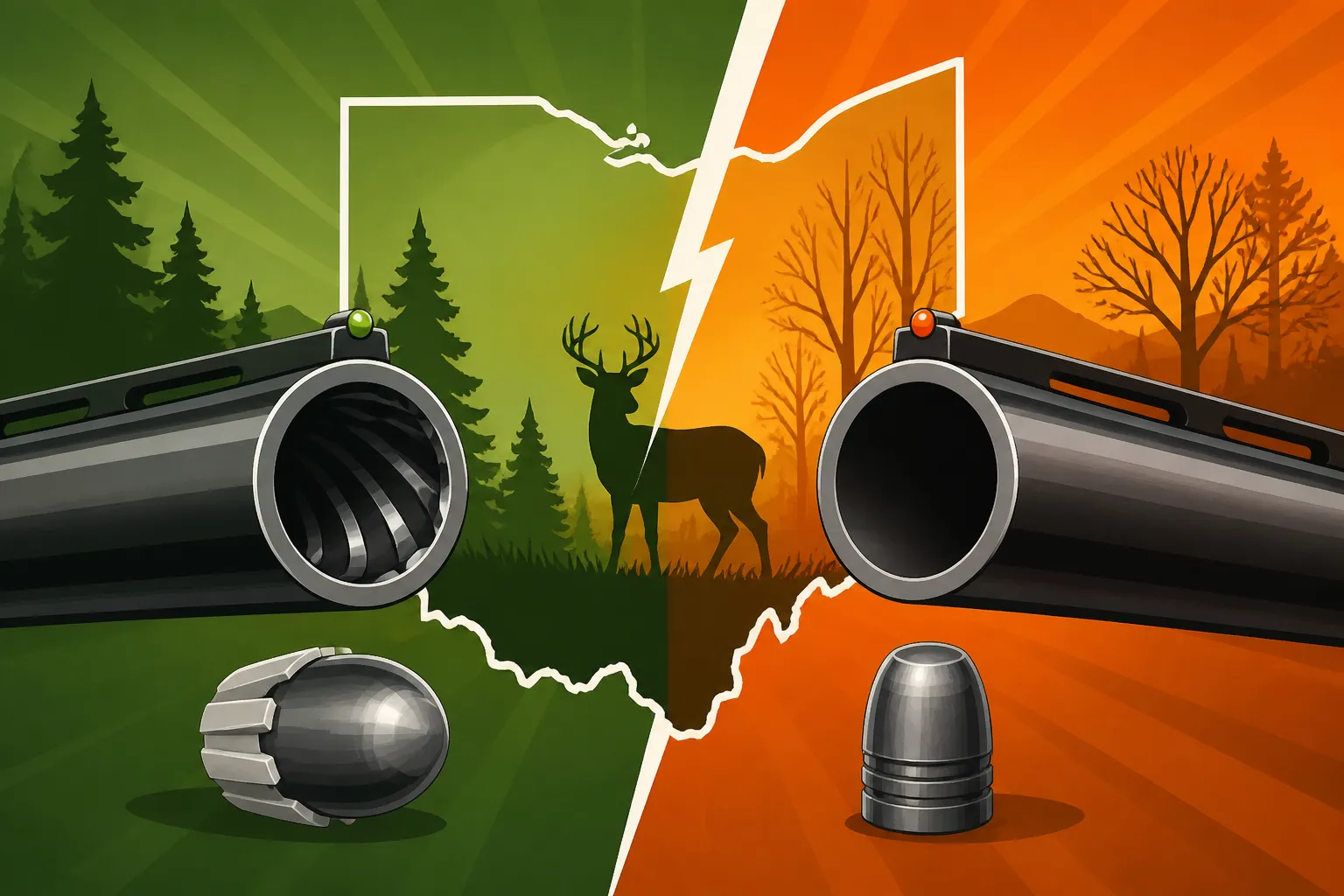
Imagine the inside of a typical shotgun barrel, the kind you might use for wingshooting doves or rabbits. It's perfectly smooth, hence the name "smoothbore." There are no spiral grooves inside. This design is fantastic for propelling a cloud of shot pellets downrange in a predictable pattern. However, when it comes to slugs, a smoothbore barrel relies on the slug itself to provide any stabilization. Traditional slugs designed for smoothbore barrels, like Foster or Brenneke slugs, are engineered with fins or a unique weight distribution to create a drag-stabilized flight, much like a badminton shuttlecock. They don't spin; they essentially tumble in a controlled manner, or have their center of gravity positioned to keep the nose forward. This design is robust and forgiving, allowing for a wide range of ammunition types.
Many Ohio hunters started their deer hunting careers with a smoothbore shotgun, often one that pulled double-duty for small game or turkeys. There's a certain nostalgia and practicality in that versatility. They're typically less expensive to produce and, for decades, they were the only option for shotgun hunters in states like Ohio that once restricted deer hunters to shotguns only. While Ohio Legal Firearms for Deer Hunting has expanded, the smoothbore slug gun still holds a dear place in many hunters' hearts and gun safes.
The Precision of a Rifled Barrel
Now, picture a rifle barrel. What you're imagining is very similar to a rifled shotgun barrel. The inside is not smooth but features helical grooves, or "rifling," that run the length of the barrel. These grooves are designed to impart a spin on the projectile as it travels through the bore. Just like a perfectly thrown football spirals through the air, that spin stabilizes the slug, making it far more accurate over longer distances. This stabilization is critical for achieving tight groups and extending ethical shooting ranges.
Rifled barrels are specifically designed to shoot what are known as "sabot slugs." A sabot (pronounced "SA-bow") is a plastic cup or sleeve that encases a smaller, typically conical or bullet-shaped projectile. The sabot engages with the rifling, imparting the spin to the slug, and then peels away shortly after the slug leaves the muzzle. The slug itself never touches the rifling. This allows for a harder, more aerodynamic projectile that retains energy and flies flatter. The introduction of rifled slug barrels was a game-changer for shotgun hunters seeking rifle-like accuracy, especially once Straight-Wall Rifles for Ohio Deer became legal.
Smoothbore Barrels: The Traditional Ohio Workhorse
For many years, if you hunted deer with a shotgun in Ohio, you were almost certainly using a smoothbore barrel. This wasn't a drawback; it was just the standard. Hunters learned to work within its capabilities, and countless Ohio whitetails have been harvested successfully with these setups.
Performance with Foster and Brenneke Slugs
Smoothbore barrels excel with traditional, full-bore slugs like the Foster and Brenneke designs. Foster slugs, identifiable by their hollow base and exterior fins, are designed to create drag that keeps the nose forward. They are typically made of soft lead, allowing them to safely compress and pass through various chokes without damaging the barrel. Brenneke slugs, on the other hand, have a lead slug with an attached wad that stays with the slug for a short distance after leaving the muzzle, aiding stability. They often feature ribs on the outside, similar to Foster slugs.
Both types are effective, but their effective range is generally limited. Most hunters would consider 75-100 yards to be the maximum ethical range for accurate shot placement with these slugs out of a smoothbore. Beyond that, accuracy drops off significantly, and maintaining consistent groups for a humane kill becomes challenging. Shotgun Slug Choices for Ohio Deer can provide more detail on these options. In thick Ohio timber, where shots are often 50 yards or less, a smoothbore with traditional slugs is more than adequate, proving its worth time and time again.
Advantages and Limitations for Ohio Hunters
One of the biggest advantages of a smoothbore shotgun for deer hunting is its versatility. You can quickly swap out for a bird shot barrel or a turkey choke, making it a truly multi-purpose firearm. This is a huge plus for hunters who might only own one or two firearms. Cost is another factor; smoothbore shotguns and their ammunition are generally less expensive than dedicated rifled slug guns and sabot slugs. For those hunting small, dense woodlots in Ohio's farm country, where shot distances are naturally limited by terrain and cover, the smoothbore is a perfectly viable and economical choice. You won't feel under-gunned when that buck steps out at 40 yards.
However, the primary limitation is range and accuracy. If you hunt more open areas, like the edge of a large bean field in northwest Ohio, or need to reach across a wider creek bottom, a smoothbore slug might leave you wishing for more precision. Groupings at 100 yards with traditional slugs can be inconsistent, making ethical shot placement difficult. It's a trade-off: great versatility and cost-effectiveness for closer range, but limited reach for those longer shots.
Rifled Barrels: Precision for the Modern Slug Hunter
As hunters pushed for greater accuracy and range from their shotguns, rifled barrels and sabot slugs emerged as the answer. These setups essentially transform a shotgun into a short-range rifle, capable of impressive precision.
The Power of Sabot Slugs
Rifled barrels are designed to be paired exclusively with sabot slugs. As mentioned earlier, the sabot is a plastic sleeve that allows a smaller, aerodynamic bullet to engage with the rifling. When fired, the sabot takes the spin from the barrel, then separates from the projectile as it leaves the muzzle. The projectile continues its flight, stabilized by its rotation, much like a rifle bullet. These projectiles are often made of harder lead alloys or copper, retaining their shape and energy much better than traditional soft lead slugs.
The result is significantly improved accuracy and extended range. Many rifled slug guns with sabot slugs can achieve accuracy comparable to centerfire rifles out to 150 yards or even beyond for skilled shooters. With proper zeroing, hitting a deer-sized target consistently at these distances is well within the realm of possibility. Hunters often find themselves Zeroing at 100 Yards for Ridge Hunting with these setups, a practice previously reserved for rifle hunters. This level of precision opens up new opportunities for stand placement and shot selection that were once unavailable to shotgun hunters.
Enhancing Range and Accuracy in Ohio Terrain
For Ohio hunters tackling diverse terrain, a rifled barrel offers a distinct advantage. If you hunt areas with larger fields, power lines, or clear-cuts, a rifled barrel can extend your ethical shooting distance considerably. Imagine sitting on a ridge overlooking a vast bottomland in the Wayne National Forest. A mature buck might step out at 120 yards. With a smoothbore, that's often a questionable shot. With a properly sighted-in rifled barrel and sabot slugs, that shot becomes much more feasible. This enhanced range can be especially beneficial when hunting properties where deer tend to shy away from closer encounters due to hunting pressure.
The superior accuracy also means tighter groupings at closer ranges, increasing your confidence in making a clean, ethical kill. However, this performance comes with a higher price tag. Rifled slug barrels are generally more expensive than smoothbore barrels, and sabot slugs are significantly pricier than traditional slugs. This is an important consideration, especially during Ammunition Availability Before Opening Day when prices might fluctuate. For hunters looking to maximize their shotgun's range and precision, the investment is often worthwhile. When researching options, a site like GoHunt can be a useful resource for comparing different brands and models of rifled barrels, often including user reviews on accuracy.
A Head-to-Head Comparison: Performance in the Field
When it comes down to choosing between a rifled and smoothbore barrel, it's not about one being inherently "better" but rather about which is better suited for your specific hunting conditions and preferences in Ohio. Let's break down how they stack up in a few key areas.
Accuracy and Effective Range
This is arguably the most significant differentiator.
- Smoothbore: Expect reliable accuracy out to about 75 yards, maybe 100 yards with practice and the right ammunition. Beyond that, groups tend to open up dramatically, making ethical shots difficult. This is perfect for dense areas where visibility is limited, such as a thick bedding area you've found near a creek bottom.
- Rifled Barrel: Capable of rifle-like accuracy out to 150 yards, sometimes more. Shooters often see groups of 3 inches or less at 100 yards with quality sabot slugs. This extended range makes them ideal for open field edges, longer timber shots, or situations where deer might be pressured and keep their distance. Think about Hunting Northwest Ohio Farmland Deer where shots across fields are common.
The difference in Practical Range for an Ohio Straight-Wall Rifle versus a smoothbore shotgun is stark. While a straight-wall rifle can push reliable ethical ranges well beyond 200 yards, a rifled slug gun narrows the gap between traditional shotguns and these newer rifle options.
Ammunition Considerations and Cost
The type of ammunition dictates barrel choice.
- Smoothbore: Uses traditional full-bore slugs (Foster, Brenneke). These are generally less expensive, widely available, and come in various configurations. You can also use birdshot or buckshot from the same barrel, making it incredibly versatile.
- Rifled Barrel: Requires sabot slugs. These are purpose-built for accuracy in a rifled bore, but they are significantly more expensive, often costing several times more per round than traditional slugs. They also cannot (or should not) be used in a smoothbore, and traditional slugs should never be used in a rifled barrel as they can lead to excessive fouling and reduced accuracy, or even safety issues in some cases.
The cost of ammunition can add up quickly, especially if you spend a lot of time patterning your gun. This is where hunters often weigh the investment in a dedicated rifled slug setup against their typical shot distances.
Versatility and Ease of Use
Consider how you use your shotgun beyond just deer season.
- Smoothbore: Highly versatile. One shotgun can serve multiple purposes just by changing barrels or choke tubes. This is a huge benefit for hunters on a budget or those who value simplicity. Swapping from a deer slug barrel to a turkey barrel or a waterfowl barrel is usually a quick process.
- Rifled Barrel: Less versatile. It's a dedicated deer hunting setup. While some shotguns allow for easy barrel swaps, the rifled barrel itself is not suitable for shot loads. If you need a gun for birds and deer, you'll either need another barrel or another gun entirely.
This table summarizes the key differences:
| Feature | Smoothbore Barrel | Rifled Barrel |
|---|---|---|
| Ammunition | Foster, Brenneke (full-bore slugs) | Sabot slugs (sub-caliber projectile in plastic) |
| Accuracy | Good out to 75-100 yards | Excellent out to 150+ yards |
| Projectile Spin | None (drag-stabilized slugs) | Yes (spin-stabilized slugs) |
| Versatility | High (can shoot shot, buckshot, slugs) | Low (dedicated slug hunting only) |
| Cost (Barrel) | Generally lower | Generally higher |
| Cost (Ammo) | Lower (traditional slugs) | Higher (sabot slugs) |
| Best For | Thick cover, short-range shots, multi-purpose use | Open terrain, long-range shots, precision |
Making Your Choice for Ohio Whitetails
Deciding which barrel is right for you boils down to a few critical factors that are unique to your hunting style and the specific areas you pursue deer in Ohio. There's no single "right" answer for everyone, and what works perfectly for one hunter might be overkill or insufficient for another.
Considering Your Hunting Environment
Your hunting grounds are perhaps the most important factor.
- Dense Woods and Thick Cover: If you predominantly hunt the deep, thick woods of southern Ohio, perhaps in areas like Shawnee State Forest or the Appalachian foothills, where shots rarely extend beyond 75 yards, a smoothbore shotgun with traditional slugs is a perfectly effective and economical choice. In these environments, deer are often encountered at close quarters, and a long-range barrel simply isn't necessary. Treestand Setups in Appalachian Ohio Hardwoods often focus on close-range opportunities.
- Open Fields and Longer Sightlines: For hunters who spend their time on the edges of corn or soybean fields, or in areas with longer clearings, a rifled barrel offers a significant advantage. It allows you to confidently take shots at deer that might be holding at 100-150 yards, dramatically expanding your effective hunting area and opportunities. This is particularly relevant in the flatter, more agricultural regions of Ohio.
Take a hard look at where you actually harvest deer. Are you frequently passing on shots because they're "too far for my slug gun"? Or are most of your deer taken inside 60 yards? The answers to these questions will guide your decision. Many Ohio hunters use mapping apps, like those found on GoHunt, to analyze their specific hunting properties for typical shot distances and sightlines before deciding on gear.
Budget and Versatility Needs
Let's be realistic: hunting is an investment.
- Budget-Friendly and Multi-Purpose: If you're looking for a single shotgun that can handle deer, turkeys, pheasants, and ducks, a smoothbore setup with an interchangeable barrel or choke system is likely your best bet. The initial cost for the shotgun and the ongoing cost of ammunition will be lower, allowing you to enjoy more hunting throughout the year without breaking the bank.
- Dedicated Performance: If deer hunting is your primary passion, and you prioritize maximum accuracy and range from a shotgun platform, then investing in a rifled barrel and quality sabot slugs makes sense. While more expensive, it provides a specialized tool for a specialized job. Remember, you might still need a separate smoothbore barrel or even a different gun for bird hunting.
It's also worth noting that the Ohio Deer Season Structure Explained allows for various methods, so having the right tool for each can be beneficial. Maybe a smoothbore for the Youth Gun Weekend Hunting the Ohio Youth Gun Weekend is fine, but you want more reach for the general gun season.
Personal Preference and Confidence
Ultimately, your confidence in your equipment matters most. If you feel more confident with a smoothbore because you've taken many deer with it and know its limitations, then stick with it! Ethical hunting is about making clean kills within your personal effective range. Conversely, if the thought of a longer shot makes you nervous with a smoothbore, and a rifled barrel provides that extra assurance, then that peace of mind is invaluable.
Practice is key, regardless of your choice. Spend time at the range with your chosen setup and ammunition. Understand its capabilities and limitations. Knowing precisely where your slug hits at various distances is far more important than any theoretical advantage one barrel might have over another.
Maintenance and Care for Your Slug Gun
Whether you choose a smoothbore or a rifled barrel, proper maintenance is crucial for ensuring accuracy, reliability, and the longevity of your firearm. A well-cared-for gun is a safe and effective gun. Ignoring the basics can lead to frustration, decreased performance, and even potential safety issues down the line.
Cleaning and Bore Care
The type of ammunition you use will influence your cleaning routine.
- Smoothbore Barrels with Traditional Slugs: Full-bore lead slugs tend to leave lead fouling in the barrel. This lead buildup can accumulate, affecting accuracy and potentially increasing pressures. Regular cleaning with a good quality bore brush, solvent designed for lead removal, and patches is essential. Make sure to get all the lead out.
- Rifled Barrels with Sabot Slugs: Sabot slugs primarily create plastic fouling from the sabot itself, along with copper fouling if the projectile is copper, or lead if it's a lead-core bullet. Plastic fouling can be particularly stubborn. You'll need a solvent specifically designed to remove plastic (wad) fouling, along with appropriate brushes. Copper solvent might also be needed. This is critical for maintaining the precision of the rifling. Cleaning a Rifle After a Wet Sit is vital, as moisture can easily lead to rust, particularly in the fine grooves of a rifled barrel.
Always follow the manufacturer's recommendations for cleaning your specific firearm. A clean barrel performs better and lasts longer. Don't forget to clean the action, chamber, and exterior of the gun too, especially after a damp hunt in the Ohio woods.
Storage and Transport Tips
Proper storage prevents rust and keeps your gun in top shape.
- Dry Storage: Always store your shotgun in a dry environment. A dehumidifier in your gun safe is a great investment, especially given Ohio's fluctuating humidity.
- Protective Cases: When transporting your slug gun, use a padded hard or soft case to protect it from bumps, scratches, and moisture. If you hunt public land, you'll likely be walking some distance to your stand, and a good case will keep your optics protected until you're ready to hunt.
- Weather Protection During Hunts: If you're out in the rain or snow, take steps to keep your barrel and action as dry as possible. Barrel plugs can prevent moisture from getting into the bore, and a simple gun sock or rain cover can protect the exterior. Keeping a Muzzleloader Dry in Wet Snow offers similar principles that apply to any firearm.
By giving your slug gun the care it deserves, you'll ensure it's ready when that Ohio whitetail steps into your shooting lane, season after season.
Disclaimer
This article is for general informational purposes only and does not constitute professional advice. Laws, prices and regulations vary by location and change over time. Consult a qualified professional for guidance on your specific situation.