Rangefinders in Thick Appalachian Cover
Hunting in the thick, rolling hills of Appalachian Ohio presents a unique set of challenges, especially when it comes to accurately judging distances. That moment when a mature buck slips through a stand of dense hemlocks or crosses a brushy ravine, and you're unsure if it's 30 or 50 yards, can make or break your hunt. This guide is all about equipping you with the knowledge to select and use a rangefinder effectively in Ohio's dense, broken timber, ensuring you're always confident in your shot.
The Unique Obstacles of Rangefinding in Ohio's Thick Appalachian Cover
Ohio's southeastern region, especially within the Appalachian foothills, isn't like the open farmlands of the northwest. Here, you're dealing with steep ravines, tight creek bottoms, and ridge tops covered in a mix of hardwoods, pines, and thick undergrowth. This varied landscape can make a simple task like ranging a deer feel like a trigonometry nightmare.
Dense Vegetation and False Readings
The biggest culprit in thick cover is, without a doubt, the sheer amount of vegetation. Picture yourself on a ridge overlooking a brushy draw. You spot a deer moving through the saplings and fallen timber. You raise your rangefinder, aim, and press the button, only to get a reading that feels way too close. What happened?
Your rangefinder's laser, designed to reflect off solid objects, often bounces off a leaf, a twig, or a small branch directly in its path before it ever reaches your target. This gives you a "false positive" – a reading that's technically accurate for the first object the laser hit, but utterly useless for your deer. It's incredibly frustrating when you're trying to make a quick, ethical shot. The laser beam, no matter how precise, still has a certain width, and in dense woods, it's almost guaranteed to hit something closer than your intended target. This is where the rangefinder's ability to "see through" obstacles becomes crucial, or at least its ability to help you differentiate between the target and the clutter.
Broken Terrain and Angle Compensation Needs
Appalachian Ohio isn't flat, and that's an understatement. Hunting here often means setting up on a steep hillside, looking down into a valley, or perhaps across to an opposing ridge. When you're shooting at an upward or downward angle, the true horizontal distance to your target is actually shorter than the straight-line distance your rangefinder initially displays. If you don't account for this, you'll invariably shoot high when aiming downhill or low when aiming uphill.
This phenomenon is due to gravity's effect on an arrow or bullet. Gravity acts perpendicular to the earth's surface, not perpendicular to your line of sight. Therefore, for an angled shot, the projectile experiences gravity for a shorter effective horizontal distance. Any rangefinder you consider for these conditions absolutely must have angle compensation built-in. Without it, you're guessing, and guessing is not a recipe for success in the field. Many seasoned hunters have missed opportunities simply by forgetting to compensate for the angle on a steep shot, a mistake easily avoided with the right technology.
Essential Features for a Rangefinder in Dense Woods
When you're trying to thread a shot through the timber, you need a rangefinder that's not just accurate but smart about its job. There are a few key features that stand out as non-negotiable for hunting Ohio's dense Appalachian cover.
Pin-Seeking and First/Last Target Priority Modes
This is arguably the most critical feature for combating false readings in thick cover. Imagine a deer standing partially obscured behind a few saplings. A basic rangefinder might give you a reading on the saplings, not the deer. A good rangefinder, however, will offer a "pin-seeking" mode (often called "first target priority" or "last target priority").
- First Target Priority: This mode identifies the closest object in the laser's path. While useful in some open situations, it's generally not what you want in dense cover because it will likely range a branch in front of your deer.
- Last Target Priority: This is your best friend in the woods. When activated, the rangefinder will ignore closer objects (like leaves, twigs, and small branches) and prioritize the furthest object the laser hits within its beam spread. This significantly increases your chances of getting an accurate reading on the deer itself, even if there's some light brush in the way. Some manufacturers, like those found on outdoor platforms similar to GoHunt, excel at implementing this technology to help hunters cut through the clutter. This mode allows you to sweep the rangefinder slowly across the target area, knowing it's actively trying to find the farthest solid object, which is hopefully your deer.
Angle Compensation Technology
As we discussed, Ohio's Appalachian terrain is anything but flat. Having a rangefinder with angle compensation is paramount. Look for models that specifically advertise "Angle Range Compensation" (ARC), "True Ballistic Range" (TBR), or similar proprietary systems.
These technologies measure the horizontal distance to your target, taking the angle of your shot into account. So, if your rangefinder reads 40 yards line-of-sight on a steep downhill shot, the angle compensation might tell you the "shoot-at" distance is actually 35 yards. This makes a profound difference in your point of aim and dramatically reduces the chance of shooting over or under your target due to elevation changes. Many rangefinders will display both the line-of-sight distance and the compensated distance simultaneously, which is incredibly helpful when you're making a quick decision. Hunting a Ridge-Top Saddle for Rutting Bucks often involves these types of angled shots.
Scan Mode and Clarity
A static rangefinder reading is great for a stationary target, but deer rarely stand perfectly still for long. A "scan mode" allows you to continuously sweep your rangefinder across an area, providing real-time distance updates as you move the unit. This is invaluable when a deer is walking, feeding, or just generally meandering through the timber. You can track its movement and get multiple readings, helping you predict where it might stop or get a clearer shot.
Beyond modes, the optical quality of the rangefinder itself is critical. In the often dim light of a dense Ohio forest, especially at dawn or dusk, you need a clear, bright display with good light transmission. Look for models with high-quality glass, anti-reflective coatings, and a clear reticle. A muddy or dim display makes it hard to quickly acquire your target, which can cost you precious seconds and a shot opportunity. Some higher-end rangefinders even offer different reticle options or adjustable brightness settings to adapt to varying light conditions.
Strategic Rangefinding Techniques for Timber Hunters
Having the right gear is only half the battle; knowing how to use it effectively in the challenging environment of Appalachian Ohio is the other. There are specific techniques that can make your rangefinder an indispensable tool, even in the thickest cover.
Pre-Ranging Key Spots from Your Stand
One of the most effective strategies, especially if you're hunting from a treestand or ground blind, is to pre-range before the action starts. As soon as you're settled in your stand, take out your rangefinder and acquire distances to various landmarks within your shooting lanes.
Range that big oak tree at the bend in the trail, the fallen log where deer often pause, the gap in the brush line, or even a specific rock near a rub line. Jot these distances down mentally or on a small card if you prefer. This way, when a deer suddenly appears, you don't have to scramble with your rangefinder, potentially spooking the animal with movement or losing precious time. You can simply look at the deer, identify its proximity to a pre-ranged landmark, and know your distance instantly. This approach minimizes movement and maximizes readiness. When setting up a Treestand Setups in Appalachian Ohio Hardwoods, always take the time to pre-range your shot windows.
Ranging Multiple Targets and the "Fence Post" Method
In dense cover, getting a clear line of sight to a deer can be tough. Don't be afraid to take multiple readings. If a deer is moving behind a curtain of brush, try to range any clear spots it might pass through, or even range objects directly in front of or behind it to bracket the distance.
The "fence post" method is a classic for a reason. If a deer is too obscured to range directly, find a tree, large rock, or another substantial object that is between you and the deer, and that you can get a clear reading on. Then, visually estimate the remaining distance from that object to the deer and add it to your rangefinder reading. This isn't perfect, but it's far better than a pure guess when a direct range is impossible. Practice this technique during your Scouting Ohio Public Land Before Season trips to get a feel for how accurately you can estimate those shorter distances.
Utilizing Natural Breaks and Openings
Deer in the big woods tend to use the easiest path, which often means trails, creek beds, logging roads, or the edges of clearings. These natural breaks in the vegetation are your best friends for rangefinding. Position yourself strategically so that you have clear views of these potential travel corridors.
When you're still-hunting or stalking, always be looking ahead for these small windows. Before you take another step, identify an opening 50 yards out and range it. If you move forward, range a new spot. This constant awareness of ranged distances in your immediate area will help you react quickly and confidently if a deer steps out. Even subtle terrain changes, like a slight dip or a drier patch where undergrowth is thinner, can create a small window to range through. Consider how Finding Sign in Big Appalachian Timber can lead you to these natural breaks.
Making Sense of Rangefinder Specifications
Beyond the core features, understanding a few technical specifications can help you choose a rangefinder that truly performs in the challenging environment of Appalachian Ohio. It's not just about the biggest numbers; it's about what those numbers mean for your hunting style.
Magnification and Objective Lens Size
Most hunting rangefinders come with a fixed magnification, typically between 4x and 8x. For dense woods, you want enough magnification to clearly identify your target and distinguish it from surrounding cover, but not so much that the field of view becomes too narrow, making it hard to find a deer quickly.
- Magnification (e.g., 6x or 8x): A 6x or 8x magnification is often a sweet spot for timber hunting. It provides a good balance of target identification and a wide enough field of view to scan. Higher magnification can make it harder to hold steady without a rest, especially when trying to pinpoint a specific deer through brush.
- Objective Lens Size (e.g., 20mm to 25mm): The objective lens (the front lens) determines how much light the rangefinder gathers. A larger objective lens generally means a brighter image, which is fantastic in low-light conditions common in thick woods, early morning, or late evening. However, a larger objective also means a physically larger and heavier unit. For a compact, easy-to-carry rangefinder, a 20-25mm objective is usually sufficient. Remember, a rangefinder isn't primarily for observing game over long periods, but for quick, precise measurements. However, pairing it with quality Binocular Power for Timber Hunting will enhance your overall visibility.
Beam Divergence and Range Limitations
Beam divergence refers to how much the laser beam spreads out over distance. A smaller beam divergence means a tighter, more concentrated laser, which is generally better for cutting through minor obstructions. A wider beam might hit more "clutter" in dense cover. Manufacturers don't always publish this spec, but it's a factor in how effectively a rangefinder uses its "last target priority" mode.
Range limitations are another important factor, but perhaps less critical in Ohio's thick woods. Most quality hunting rangefinders will advertise a maximum reflective range of 1,000+ yards, and a maximum deer range of 500-800 yards. In Appalachian Ohio, your realistic shot distances are rarely over 150-200 yards, and often much closer. So, while impressive maximum ranges are nice, don't overpay for extreme capabilities you won't use. Focus on accuracy and reliability within the typical hunting ranges you expect to encounter. What's truly important is reliable performance at 30-100 yards through some obstructions.
Battery Life and Durability
There's nothing worse than your rangefinder dying in the middle of a hunt. Always check the advertised battery life and consider carrying a spare, especially if you hunt in cold weather, which can reduce battery performance. Most rangefinders use common CR2 batteries, which are easy to find.
Durability is also key. Your rangefinder will get bumped, dropped, and exposed to the elements. Look for models that are waterproof or at least water-resistant and have a rugged, non-slip housing. A comfortable grip is important for steady ranging, particularly with cold, gloved hands. Many top brands, often featured on platforms like GoHunt, prioritize robust construction for reliable field performance. A reliable piece of gear should withstand the rigors of hunting through dense undergrowth and the occasional rain shower, ensuring it's ready when you need it most.
Integrating Your Rangefinder into Your Hunting Strategy
A rangefinder isn't just a tool to pull out when a deer appears; it's an integral part of your entire hunting strategy, from preseason scouting to shot execution. Maximizing its value means weaving it into every step of your hunt in Ohio's varied terrain.
Utilizing it During Scouting and Stand Placement
Long before opening day, your rangefinder should be a constant companion during your scouting trips. As you walk potential deer trails, evaluate bedding areas, or identify feeding zones, use your rangefinder to measure distances from prospective stand locations to key features.
If you're eyeing a specific ridge-top saddle or a funnel between two woodlots, range the distance to dominant rub trees, scrapes, or pinch points. This helps you determine the most effective placement for your treestand or ground blind, ensuring that your shot opportunities fall within your comfortable and ethical range. You might find that moving your stand just 10 yards makes all the difference in covering a critical crossing or opening up a clear shooting lane. Think about how you would range key features when identifying Where Shawnee State Forest Bucks Bed. Using a rangefinder during scouting can give you a tremendous advantage and confidence when you finally settle into your spot on opening morning.
Practicing with Your Rangefinder for Confidence
Just like practicing with your bow or rifle, you need to practice with your rangefinder. Don't wait until opening day to get familiar with its functions. Take it to the backyard or a local archery range. Set up targets at unknown distances and practice acquiring readings quickly and efficiently.
Work on using the "last target priority" mode to range through simulated cover, like a clothesline with laundry or a small shrub. Practice ranging targets at various angles to understand how the angle compensation works. The goal is to make using your rangefinder second nature so that in a high-pressure hunting situation, you can operate it without fumbling. This familiarity builds immense confidence, transforming it from a gadget into a trusted extension of your hunting skills. You'll want to be able to range a deer and then make an accurate shot, whether you're using a Crossbow Versus Vertical Bow in Ohio or a straight-wall rifle.
Knowing Your Ethical Range and Limitations
Every hunter has an ethical range beyond which they cannot consistently make a clean kill. Your rangefinder helps you stick to this. If your ethical range with a bow is 40 yards, and your rangefinder reads 55 yards to that buck, you hold your shot. It's that simple. In the dense cover of Appalachian Ohio, those long shots are rarely clean anyway, with so many opportunities for deflections.
Furthermore, understand the limitations of your specific rangefinder in truly thick cover. Some lower-end models might struggle more than others. If you consistently get inconsistent readings through dense brush, err on the side of caution. It's always better to let an animal walk than to take a low-percentage shot. The tool gives you information; your judgment makes the final decision. Remember, the goal is a quick, humane harvest, and your rangefinder is there to help you achieve that by providing precise data about shot distances. Utilizing digital mapping tools from companies like GoHunt can also help you visualize potential shot distances and clearings ahead of time.
Rangefinder Comparison for Ohio's Appalachian Terrain
Let's look at how different types of rangefinders stack up when faced with the unique challenges of hunting in thick Appalachian cover.
| Feature / Type | Basic Laser Rangefinder | Advanced Laser Rangefinder | Rangefinding Binoculars |
|---|---|---|---|
| Typical Cost | Low to Moderate | Moderate to High | High to Very High |
| Angle Compensation | Usually No | Almost always Yes | Almost always Yes |
| Pin-Seeking/Last Priority | Usually No | Essential, almost always Yes | Often Yes |
| Scan Mode | Sometimes | Almost always Yes | Almost always Yes |
| Optical Clarity | Fair to Good | Good to Excellent | Excellent |
| Size/Weight | Small & Lightweight | Small to Moderate | Larger & Heavier |
| Field Use in Cover | Struggles with false readings | Excels at cutting through brush | Excellent for combined scouting/ranging |
| Battery Life | Good | Good | Moderate (due to more tech) |
The Argument for Dedicated Advanced Laser Rangefinders
For most hunters targeting deer in Appalachian Ohio, a dedicated advanced laser rangefinder is the best bang for your buck. These units are specifically designed with features like angle compensation and last target priority modes, which are absolutely crucial for accurate readings in thick woods and broken terrain. They are typically compact, lightweight, and can be quickly pulled from a pocket or binocular harness for a rapid reading.
While they might cost more than basic models, the investment pays off in increased accuracy and confidence. You're getting optics that are clear enough for quick target acquisition in low light and processing power to filter out foreground clutter. Brands that specialize in hunting optics often optimize these units for the demands of the field, ensuring they are rugged and reliable. This dedicated approach means you're carrying a purpose-built tool that excels at its primary job: giving you the precise distance to your target, no matter how gnarly the cover.
The Appeal of Rangefinding Binoculars
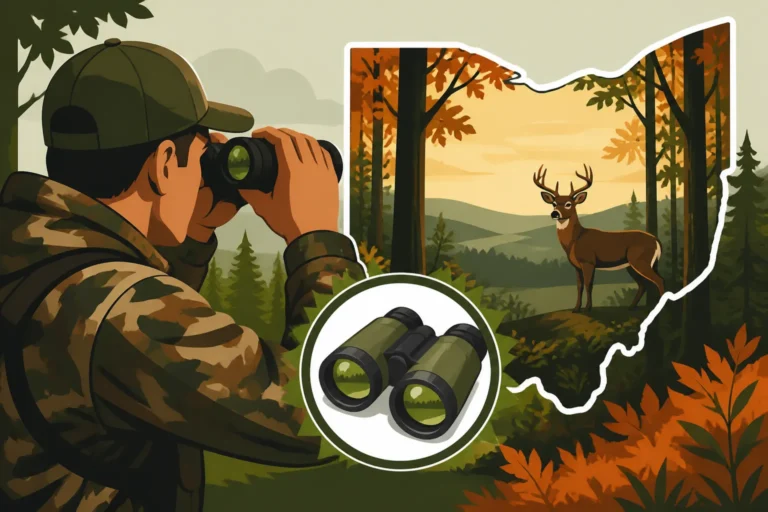
Rangefinding binoculars combine two essential tools into one, reducing the amount of gear you need to carry. This is particularly appealing for hunters who spend a lot of time glassing, especially in areas where deer might appear at longer ranges, or if you're trying to Read a Ridge for Southeast Ohio Deer from afar. The integrated design means you don't have to switch between devices, which can be faster and reduce movement.
However, rangefinding binoculars come with a significantly higher price tag and are generally heavier and bulkier than a dedicated rangefinder. Their optical quality is often superior, providing excellent clarity for observation, but the ranging function might not always be as quick or precise as a top-tier dedicated unit in extremely dense, close-range situations. For the average hunter primarily focused on the often tight, 50-100 yard shots common in Ohio's timber, the added cost and weight might outweigh the convenience.
Basic Rangefinders: When They Might (or Might Not) Suffice
Basic laser rangefinders are the entry-level option, usually without angle compensation or advanced target priority modes. They're affordable and can give accurate readings in open terrain, or to large, unobstructed objects. If you primarily hunt wide-open fields or very sparse woods and rarely deal with angled shots, a basic model might be sufficient.
However, for the thick, undulating landscape of Appalachian Ohio, these models will likely cause more frustration than they're worth. Without last target priority, you'll constantly get false readings off twigs and leaves. Without angle compensation, your uphill and downhill shots will be a guessing game. While the price point is attractive, the compromises in functionality make them largely unsuitable for the specific challenges posed by Ohio's dense timber. It's often better to save up for a model with the necessary features rather than settling for something that will leave you second-guessing your shot in critical moments.
Wrapping Up Your Rangefinder Knowledge
Navigating the dense, broken landscape of Appalachian Ohio with confidence means having the right tools and knowing how to use them. A quality rangefinder, especially one equipped with angle compensation and a last target priority mode, is more than just a convenience; it's a critical piece of gear for ethical and successful hunting in challenging timber. By choosing wisely and practicing diligently, you'll be able to quickly and accurately determine distances, even when that trophy buck is weaving through the thickest cover. Focus on features that cut through the clutter and compensate for the steep angles, and you'll be well on your way to a more confident hunt in Ohio's beautiful but demanding big woods.
Disclaimer
This article is for general informational purposes only and does not constitute professional advice. Laws, prices and regulations vary by location and change over time. Consult a qualified professional for guidance on your specific situation.