Treestand Safety Gear for Steep Ground
Hunting deer on Ohio's steep, rugged terrain, especially down in the Appalachian foothills or along the Ohio River Valley, offers incredible opportunities for mature bucks that often elude hunters on flatter ground. However, this pursuit comes with its own set of very real dangers, particularly when it involves hunting from an elevated position. Many of us have faced that heart-stopping moment on a shaky stand or while climbing in the dark, and it’s a stark reminder that gravity is an unforgiving force. This guide is all about equipping you with the knowledge and the right gear to ensure every treestand hunt in Ohio’s steep country is as safe as it is successful.
The Inescapable Reality of Steep Ground Hunting in Ohio
There's a certain allure to hunting the steep ridges and deep hollows of places like Wayne National Forest or Shawnee State Forest. The deer behave differently, often holding tight to cover, and finding a secluded spot away from the crowds can feel like discovering a hidden gem. But let's be honest, hunting these areas isn't just physically demanding; it significantly amplifies the risks associated with treestand hunting. The ground shifts, trees grow at angles, and the sheer effort involved can lead to shortcuts or lapses in judgment that become incredibly dangerous. We’ve all seen photos or videos of amazing bucks taken in these challenging landscapes, but what often goes unsaid are the very real dangers that come with setting up and hunting high above a steep drop-off.
Why Steep Terrain Magnifies Risk
When you're setting a treestand on a steep hillside, the dynamics change entirely compared to a flat woodlot. First off, finding a truly straight, sturdy tree can be a challenge. Trees often lean or grow out of the hillside, making proper stand leveling and secure attachment more difficult. This angular growth can create uneven pressure points on your stand's mounting system, potentially compromising its stability over time, especially with the constant sway of wind or your own movements. Furthermore, climbing sticks or ladders can be tricky to set securely, as the ground below is rarely level, leading to potential slippage as you ascend or descend.
Beyond the initial setup, consider the added stress on your body. Ascending a steep hill with gear, setting up a stand, and then climbing into it before dawn is physically exhausting. Fatigue can lead to mistakes – a missed step, a fumbled buckle, or simply a moment of inattention. And if you do fall, the consequences are often much more severe. Instead of falling onto relatively flat, soft ground, you might tumble down a rocky incline, hitting multiple obstacles on the way. The potential for serious injury, from broken bones to head trauma, skyrockets when you add a steep slope to the equation. That’s why preparing for a hunt in these areas requires an even greater emphasis on diligent safety practices and reliable equipment.
Common Misconceptions About Treestand Falls
One of the most dangerous mindsets we can adopt as hunters is "it won't happen to me." We might feel experienced, strong, or simply lucky. But the truth is, falls from treestands are among the leading causes of serious injury and fatalities in hunting. It's not just beginners who fall; seasoned veterans are just as susceptible, sometimes even more so, due to complacency or a rush to get into the stand when time is tight. Many believe a fall only happens if a strap breaks or a stand fails, but often, the cause is much simpler: human error.
Think about those frosty mornings or late-season hunts when you're bundled up, perhaps a little stiff from the cold, and rushing to get into position. Or after a long day of Hunting the Ohio River Valley Ridges, you're tired and eager to get down. It's in these moments that a simple misstep while transitioning from climbing sticks to your stand, or forgetting to clip in immediately, can have devastating consequences. The environment itself, especially the slippery mud or icy conditions often found on steep Ohio hillsides, can also contribute. It's crucial to understand that safety isn't just about the gear; it's about a consistent, unwavering commitment to proper procedure every single time your feet leave the ground.
Essential Treestand Safety Gear for Elevated Hunting
When you're hunting Ohio's diverse landscape, from the rolling farmlands of the northwest to the rugged Appalachian foothills, reliable safety gear isn't a suggestion – it's a requirement. This is especially true when you find yourself hanging a stand high up on an uneven ridge. While many pieces of gear might seem optional, when it comes to treestands, a few items are absolutely non-negotiable for your well-being. Investing in quality safety gear is investing in your ability to hunt another day, and it allows you to focus on the hunt itself, rather than worrying about a catastrophic accident.
The Non-Negotiable Full-Body Harness
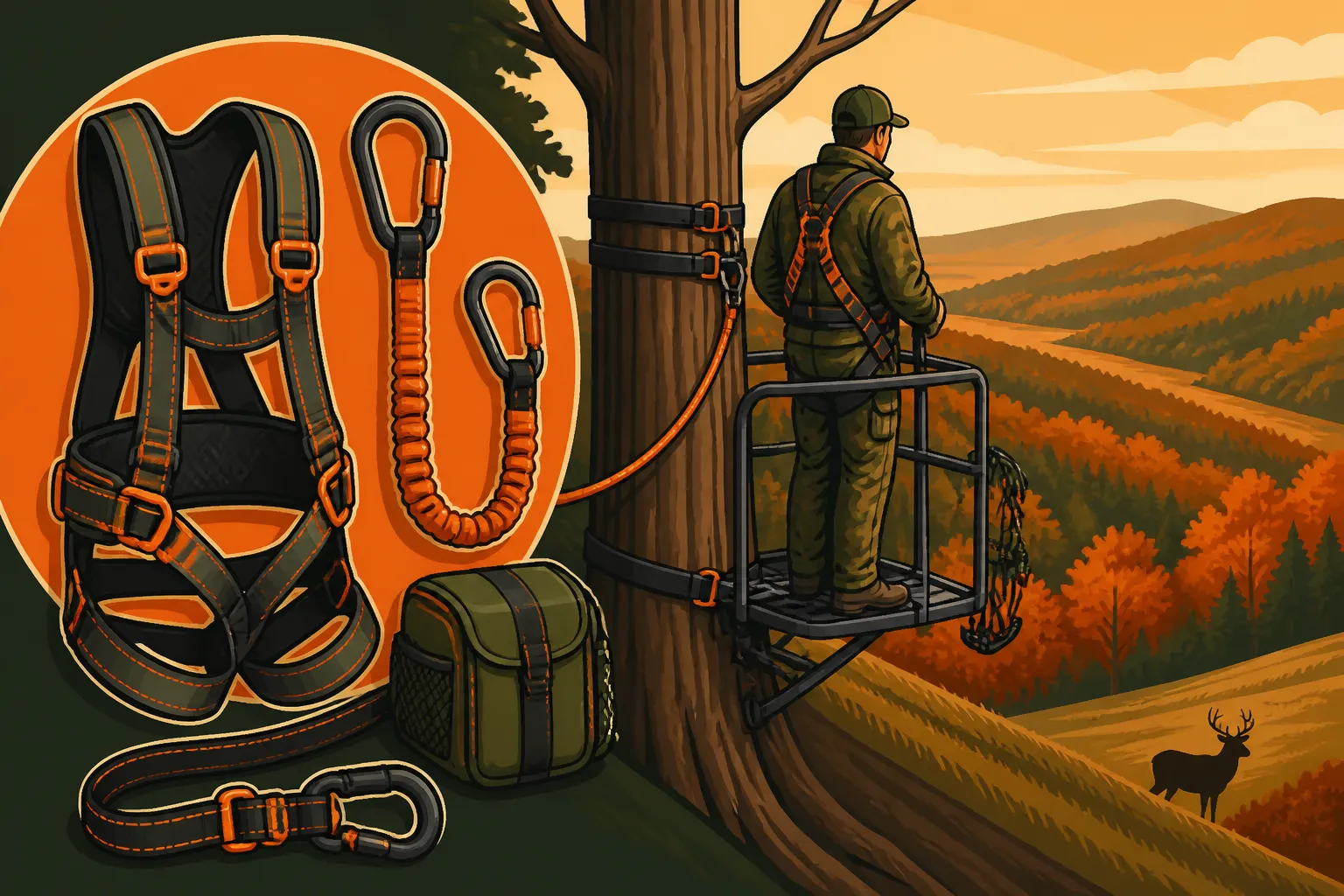
This is your absolute first line of defense, and frankly, if you're not wearing one, you shouldn't be in a treestand. A full-body harness is designed to distribute the impact of a fall across your entire body, preventing severe injury to any one area. It consists of straps that go around your shoulders, chest, and legs, all connecting to a single D-ring or attachment point at your back, between your shoulder blades. Unlike older style chest harnesses, which could cause serious injury if you hung upside down, a full-body harness keeps you upright and supported, allowing you to breathe and potentially self-rescue.
When choosing a harness, comfort is key, especially for long sits in the stand. Look for padded straps and adjustable buckles that allow for a snug, yet comfortable fit over your hunting layers. Make sure it fits properly, not too loose, and not so tight it restricts movement or circulation. Most harnesses come with a tree strap or tether that connects the D-ring on your back to the tree, allowing a short range of motion while preventing a free fall. Always inspect your harness before each season and even before each hunt for any signs of wear, fraying, or damage. Just like checking your vehicle before a long drive, a quick check of your harness could be the most important part of your pre-hunt routine. Remember, a harness is only effective if it's worn correctly and consistently.
Lifelines and Ropes: Your Vertical Lifeline
While a harness is vital, it’s only truly effective when used in conjunction with a lifeline. A lifeline, or safety line, is a rope that extends from the base of your stand all the way up to above your platform, typically with a prusik knot or similar sliding knot attached to it. This allows you to stay connected to the tree from the moment your feet leave the ground until you are safely seated in your stand, and vice versa when descending. This continuous connection is paramount, eliminating the dangerous "transition zone" where many falls occur – the moment you move from your climbing sticks to the stand, or unclip to reposition.
Installing a lifeline is straightforward. You typically secure one end around the base of the tree and the other around the trunk just above your stand platform. The prusik knot on your harness tether then slides freely along this rope as you climb, but locks immediately if you put weight on it, such as during a fall. For anyone hunting challenging terrain, where the ground can be uneven for climbing stick placement or where trees might be more difficult to navigate, a full-length lifeline is an absolute game-changer. Brands like GoHunt often advocate for this kind of continuous connection, recognizing the enhanced safety it provides, particularly when setting up on steep ground. It's an extra step in your setup, but it’s a small investment of time for priceless peace of mind.
Haul Ropes and Accessory Cords for Secure Gear Management
Many hunters make the mistake of trying to climb with their bow, backpack, or other gear strapped to their back or held in one hand. This is incredibly dangerous, as it compromises your balance, occupies a hand that should be used for climbing, and increases the risk of dropping expensive equipment. This is where a simple, sturdy haul rope comes into play. A haul rope is used to raise and lower all your hunting gear – your bow or firearm, backpack, calls, rattling antlers, and anything else you don’t need for the climb itself – once you are safely in your stand and clipped into your lifeline.
You attach your gear to one end of the haul rope before you start climbing, leaving the gear on the ground. Once you are safely seated and secured in your stand, you simply pull up your gear. The same goes for descent; lower your gear first, then unclip and climb down. This practice ensures both your hands are free for climbing, allowing you to maintain three points of contact with your climbing system at all times. Additionally, accessory cords can be used to secure items within your stand, preventing them from falling to the ground below. Losing a rangefinder or a grunt tube down a steep ravine is not just frustrating; retrieving it could put you in a dangerous situation. Using a simple cord to tether such items to your stand or harness prevents these preventable accidents.
Advanced Safety Considerations for Challenging Terrain
Hunting Ohio's steep, timbered hillsides is a different beast than hunting flat ag fields. The terrain itself, with its precarious slopes and thick cover, demands not just different hunting tactics, but also an even greater focus on safety protocols. When you're Reading a Ridge for Southeast Ohio Deer, you're thinking about wind, thermals, and deer movement, but you also need to be thinking about how the very nature of that ridge impacts your safety aloft. It's about being prepared for the unexpected and actively mitigating risks that are unique to this challenging environment.
Tree Selection and Stand Placement on Slopes
Choosing the right tree for your treestand is always critical, but on steep ground, it becomes an even more nuanced art. You're not just looking for cover or a good vantage point; you're looking for stability. Prioritize healthy, living trees that are straight and free of dead branches, rot, or significant leaning. A tree that appears solid at the base might be compromised higher up, especially in areas prone to erosion or root damage from heavy rains. Pay close attention to the bark for signs of disease or decay. When setting up a stand on a slope, try to find a tree that allows your stand platform to be as level as possible, even if it means adjusting your climbing sticks or using shims. An unlevel stand can lead to fatigue, discomfort, and an unstable shooting platform, all of which increase your risk of a fall.
Furthermore, consider the tree's position relative to the prevailing winds and thermals common in hill country. While Wind and Thermals on an Appalachian Ridge are crucial for successful hunting, they can also cause a stand to sway more, especially if it's placed on a tall, slender tree. Always check that the tree is clear of branches that could interfere with your climbing path or your sight lines. Take your time during this assessment. It's far better to spend an extra 15-20 minutes finding the perfect, safest tree than to rush into a risky setup that could lead to injury. Remember, the tree you choose is literally holding your life in its branches.
Emergency Preparedness and Self-Rescue Devices
Even with the most meticulous planning and the best safety gear, accidents can happen. If you do fall while connected to your harness and lifeline, you'll be suspended. While this is infinitely better than hitting the ground, prolonged suspension can lead to suspension trauma, a dangerous condition where blood pools in your legs, potentially leading to unconsciousness or worse. This is why having a plan and emergency tools is vital, especially when hunting Remote Wayne Forest Ground. Many hunters carry a cell phone, but signal can be spotty in deep hollows.
Modern full-body harnesses often include a suspension relief strap, which is a small strap you can deploy and stand on, relieving pressure on your legs and allowing blood to circulate. Practicing with this device before you need it is crucial. Beyond that, carrying a communication device that works without cell service, such as a satellite messenger or a two-way radio (if hunting with a partner), can be a lifesaver. A sharp knife for cutting ropes in extreme emergencies, a whistle for signaling, and a small first-aid kit are also wise additions to your pack. Knowing how to use these tools, and practicing self-rescue techniques like using your feet against the tree to reach a branch or your climbing sticks, can make all the difference in a truly dire situation. Always let someone know where you're hunting and when you expect to return.
Pre-Season Checks and In-Season Vigilance
The best safety gear in the world is useless if it's old, damaged, or used incorrectly. We all get busy, but ignoring essential maintenance and safety routines is a gamble you simply can't afford to take. Whether you're hunting the early archery season or Muzzleloader Tactics in January Cold, your gear will face the elements, and wear and tear are inevitable. Taking the time for diligent checks and consistent practice is not just about extending the life of your equipment; it's about protecting your own life every time you step into the woods.
Annual Gear Inspection and Maintenance
Before the season even begins, set aside dedicated time for a thorough inspection of all your treestand equipment. Pull out your harness, lifeline, treestand, climbing sticks, and haul ropes. Lay everything out and examine each component closely. For your harness, check all webbing, stitching, buckles, and connecting straps for any signs of fraying, cuts, tears, or sun damage. Look for rust or corrosion on metal components. Most manufacturers recommend replacing harnesses after a certain number of years, regardless of visible wear, as materials can degrade over time.
Your treestand and climbing sticks need the same scrutiny. Check all welds, cables, chains, straps, and bolts. Look for bends, cracks, or excessive rust. Ensure all pivot points move freely but aren't excessively loose. Test all locking mechanisms. If any component looks questionable, replace it or the entire unit. Don't try to "make do" with compromised gear; it's simply not worth the risk. Keep your gear clean and dry in storage to prevent rust and mildew, and lubricate moving parts as recommended by the manufacturer. Consider writing the date of purchase and annual inspection dates on your gear with a permanent marker, helping you keep track of its lifespan.
Here's a quick checklist for your annual inspection:
| Gear Item | What to Check | Frequency |
|---|---|---|
| Full-Body Harness | Webbing for cuts/frays, stitching integrity, buckle function, D-ring condition, expiry date | Pre-season & pre-hunt |
| Lifeline/Tether | Rope for cuts/frays/chafing, knot integrity (especially prusik), carabiner function | Pre-season & pre-hunt |
| Treestand | Platform welds, cables/chains (for cracks/kinks), strap/ratchet condition, all bolts | Pre-season & pre-hunt |
| Climbing Sticks | Welds, step integrity, strap/ratchet condition, connection points, secure footings | Pre-season & pre-hunt |
| Haul Rope | Rope for cuts/frays/weak spots, knots, carabiner | Pre-season & pre-hunt |
| Emergency Kit | Battery life (headlamp/radio), expiry dates (meds), functionality (whistle) | Pre-season & periodically |
Practicing Your Safety Routine
Knowledge is power, but practice makes perfect, especially when it comes to safety. It's not enough to simply know what to do; you need to do it consistently until it becomes second nature. Before opening day, take your full setup – your stand, sticks, harness, and lifeline – to a safe, low-risk tree (maybe in your backyard or a familiar woodlot) and run through the entire process. Practice putting on your harness, attaching your lifeline, climbing the sticks while maintaining continuous connection, transitioning to your stand, and then lowering your gear with the haul rope. Do this a few times, simulating different scenarios like climbing in the dark.
This practice run helps you identify any kinks in your system, any areas where you might be fumbling, or steps you tend to skip. It also builds muscle memory, so that when you're faced with a dark, cold morning and a steep climb, you perform the safety steps automatically, without thinking. Consider practicing your suspension relief strap deployment too, at a safe height where you can easily reach the ground. The goal is to build such a robust safety habit that it feels wrong not to follow every step. This vigilance will serve you well, whether you're learning Hanging a Stand on an Appalachian Ridge or just setting up a familiar spot.
Disclaimer
This article is for general informational purposes only and does not constitute professional advice. Laws, prices and regulations vary by location and change over time. Consult a qualified professional for guidance on your specific situation.