Sleds and Drags for Hill Country
There's nothing quite like the immense satisfaction of tagging a deer in Ohio's rugged hill country—especially if you've put in the sweat equity scouting those steep ravines and thick timber. But let's be honest, that moment of triumph is often quickly followed by the dawning realization of the real work ahead: getting that deer out of the woods. Hauling a heavy whitetail off a steep ridge, across a muddy creek, and through tangled briars can be an absolute back-breaker, turning a successful hunt into an exhausting ordeal. This comprehensive guide is here to help you navigate the challenging world of deer retrieval in Ohio's demanding terrain, focusing on the best sleds and drags to make your life a whole lot easier.
The Harsh Reality of Hill Country Deer Retrieval
Ohio’s Appalachian foothills, sprawling across counties like Athens, Vinton, Hocking, and Scioto, offer some of the state's most challenging yet rewarding deer hunting opportunities. These areas are characterized by steep elevation changes, dense undergrowth, deep hollows, and often, rocky, uneven ground. It's a far cry from the flat, open fields of northwestern Ohio, and it demands a completely different approach to game recovery. Many hunters, myself included, have learned this the hard way, gritting their teeth and pulling until their muscles screamed, all while wishing for a better solution than a simple rope.
The Physical Toll of Steep Terrain
Imagine this: you've just taken down a solid buck deep in Wayne National Forest. It's a great deer, maybe 180 pounds field-dressed, and it dropped right in the bottom of a steep, laurel-choked hollow. The nearest logging road is a half-mile climb, straight up a 45-degree incline. The ground is slick with wet leaves, and fallen timber makes every step a potential trip hazard. Without the right gear, this scenario quickly escalates from a challenge to a genuine safety concern. The risk of injury, from pulled muscles and strained backs to slips and falls, increases exponentially with every foot of elevation gain and every obstacle encountered.
Even if you're in peak physical condition, trying to muscle a heavy deer through such an environment is incredibly draining. It can suck the joy right out of your hard-earned success and leave you too exhausted to properly process your game or even enjoy the rest of your hunt. Many hunters in these regions opt for the "gutless method" to lighten the load, which is a fantastic strategy, but even boned-out quarters still need to be transported, and a whole deer is a monumental task. The sheer physical output required means that many hunters simply give up on trying to access deeper, less-pressured areas, limiting their hunting potential.
The Importance of Efficient Game Recovery
Beyond the physical strain, efficient game recovery is crucial for several reasons, especially in Ohio's varied conditions. First and foremost, timely recovery is about meat care. If you've been lucky enough to harvest an animal on a warm October afternoon during the early archery season, every minute counts to prevent spoilage. Bowhunting Ohio's Long Archery Season often presents these warmer temperatures, making quick retrieval vital. Dragging a deer for hours through thick cover, exposing it to air and warmth, can compromise the quality of your venison. A good retrieval system can drastically cut down this critical time.
Secondly, efficient recovery minimizes your impact on the land. While we all strive to be respectful of the areas we hunt, thrashing through thickets for hours with a heavy deer can leave a significant trail and disturb other wildlife more than a quick, clean exit. Furthermore, on public lands like Shawnee State Forest, where multiple hunters might be in the area, a prolonged, noisy extraction can disrupt someone else's hunt. Finally, a system that works well gives you the confidence to pursue deer in those tough-to-reach spots, knowing you have a reliable plan for getting your harvest out. This allows you to explore deeper into areas like Finding Ground Others Walk Past on public land, which often hold bigger, less pressured bucks.
Understanding Your Options: Sleds vs. Drags
When it comes to getting a deer out of Ohio's challenging hill country, hunters generally turn to one of two main categories of gear: deer sleds or deer drags (often combined with a harness). Each has its distinct advantages and disadvantages, making them suitable for different scenarios, types of terrain, and personal preferences. Understanding these differences is key to choosing the right tool for your specific hunting style and the kind of ground you typically cover.
Deer Sleds: When They Shine and When They Don't
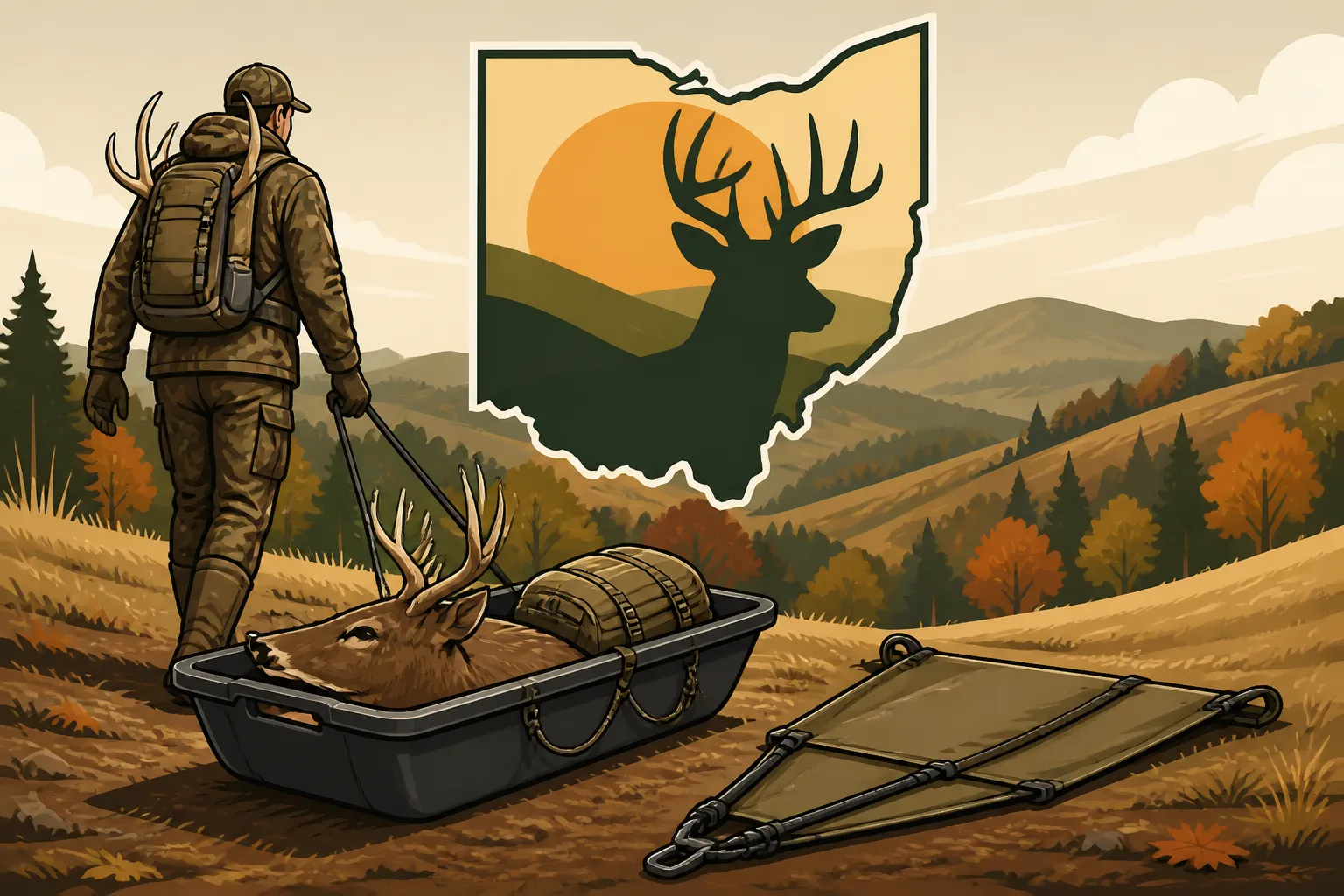
Deer sleds are essentially rigid or semi-rigid plastic sheets designed to slide over the ground, reducing friction and protecting the deer's hide. They come in various sizes and thicknesses, from lightweight, foldable options to heavy-duty models built for repeated abuse. When you're dealing with rocky terrain, mud, or even early-season snow, a good sled can feel like a godsend. The smooth bottom glides over obstacles that would snag and tear a deer's hide if dragged directly, distributing the weight and making the pull much easier. I've personally seen a single hunter manage a sizable buck down a steep, muddy incline with a quality sled that would have taken two or three men without one.
Sleds are particularly effective when you have a relatively clear path, or at least a path with manageable obstacles. Think of situations where you've got a decent logging road, an old ATV trail, or even a wide-open hardwood bottom to traverse. They protect the carcass from dirt, leaves, and abrasions, keeping your meat cleaner, which is a huge bonus when you're looking forward to Butchering a Deer at Camp. The larger models can also accommodate multiple pieces of equipment or even a second small deer, turning one trip into a more efficient effort. Brands like GoHunt often feature user reviews and comparisons for various sled models, giving you real-world insights into their performance on different terrains.
However, sleds aren't a silver bullet. Their primary drawback in dense Ohio hill country is their bulk. Carrying a full-sized deer sled into deep timber can be cumbersome, especially if you're navigating tight saplings, thick briar patches, or climbing steep ravines. They can snag on low branches and become awkward in extremely tight quarters. If your preferred hunting spots require a significant hike through dense, undeveloped woods, you might find yourself questioning the wisdom of hauling a bulky sled in before you even get a deer. They can also be quite noisy if dragged over frozen ground or dry leaves, potentially spooking other game if you're trying to retrieve one deer while still hunting. In these conditions, a more portable solution might be preferable.
Deer Drags and Harnesses: The Minimalist's Approach
Deer drags, on the other hand, are the epitome of simplicity and portability. At their most basic, they are heavy-duty ropes or straps with a handle, designed to attach to the deer's head or antlers. More advanced systems incorporate shoulder harnesses or waist belts, distributing the pulling force across your core and legs rather than just your arms and back. These are the go-to choice for hunters who prioritize lightweight gear, minimal bulk, and maximum maneuverability. They fit easily into a pack and are virtually silent to carry.
The beauty of a drag and harness system lies in its ability to navigate the absolute nastiest, thickest cover Ohio has to offer. When you're working through a tangle of multiflora rose, honey locust, or thick saplings, a sled would simply get hung up. A deer, being a natural shape, can often be squeezed through gaps that a rigid sled cannot. The harness allows you to get low and power through tough spots, using your body weight to pull, which is far more efficient than trying to pull with just your arms. I've used a simple harness system to extract deer from incredibly tight cedar thickets in southern Ohio, where a sled would have been impossible. For navigating the unique challenges of Reading a Ridge for Southeast Ohio Deer and the dense woods, this simplicity is a huge asset.
However, drags come with their own set of compromises. They offer no protection to the deer's hide, meaning your animal will pick up dirt, leaves, and potentially suffer abrasions, especially if you're dragging it over rocky ground or through briars. This can mean more work cleaning the carcass back at camp. More critically, a drag increases friction significantly compared to a sled. Even with a good harness, pulling a heavy deer directly on the ground, especially uphill or through mud, requires considerably more effort. The deer's legs can also catch on obstacles, making the drag less smooth and requiring frequent stops to clear snags. While they are great for portability and tight cover, they demand more physical exertion during the actual retrieve, and are best used when the terrain doesn't have too many sharp rocks or abrasive surfaces.
| Feature | Deer Sleds | Deer Drags & Harnesses |
|---|---|---|
| Protection | Excellent (protects hide from dirt, rocks, brush) | Minimal (hide exposed to elements) |
| Friction | Low (glides over obstacles) | High (direct contact with ground) |
| Portability | Bulky, can be cumbersome to carry in | Lightweight, compact, easy to pack in |
| Maneuverability | Can snag in very dense brush or tight spots | Excellent in dense cover and tight spaces |
| Effort | Less physical effort for a given weight/distance | More physical effort due to friction |
| Terrain Suitability | Open woods, trails, snow, rocky ground | Dense brush, extremely tight cover, less rocky |
| Noise | Can be noisy on dry leaves/frozen ground | Generally quieter |
| Cost | Typically higher initial cost | Generally lower initial cost |
Key Features to Look for in Sleds and Drags
Choosing the right deer retrieval gear isn't just about picking a sled or a drag; it's about finding the right sled or drag that stands up to the rigors of Ohio's diverse hunting landscapes. When you’re miles back in the deep woods of Zaleski State Forest, the last thing you want is for your gear to fail halfway through a grueling retrieve. Considering factors like material, design, and ease of use can make all the difference between a smooth recovery and a frustrating ordeal.
Material Durability and Construction
For deer sleds, the material is paramount. You need something tough enough to withstand repeated abuse from rocks, stumps, and sharp branches without tearing or cracking. Most quality sleds are made from a heavy-duty, impact-resistant plastic, often a form of high-density polyethylene (HDPE). Look for sleds with a thicker gauge plastic, especially on the bottom and edges, as these are the areas that take the most punishment. Some sleds feature molded ridges or channels on the underside; these can help the sled track straighter and slide more easily, especially over snow or wet leaves, by reducing surface area contact with the ground.
The attachment points for your rope or harness are also critical. Flimsy grommets or thin plastic edges will quickly rip out when subjected to the kind of force required to pull a heavy deer up a grade. Look for reinforced eyelets, often with metal rings, or sturdy pre-drilled holes where you can thread a durable rope. The rope itself should be thick, abrasion-resistant, and comfortable to grip, even when wet or cold. Some sleds come with a pre-attached rope and harness system, which can be a convenient all-in-one solution. You can often find detailed product specifications and user experiences on hunting forums or through resources like GoHunt, which can highlight how different materials hold up in real-world hunting situations.
For deer drags and harnesses, durability is focused on the webbing and stitching. A cheap rope drag will fray quickly and dig into your hands. Look for heavy-duty nylon or polypropylene webbing, typically 1-2 inches wide, with robust stitching at all stress points. The handles should be comfortable and ergonomic, ideally with a padded grip to prevent chafing and blisters, particularly if you anticipate a long haul. If you opt for a shoulder or waist harness, ensure the buckles are strong and won't slip under tension, and that the padding is substantial enough to distribute weight comfortably. Reinforced connection points where the drag rope attaches to the harness are non-negotiable for safety and longevity.
Ergonomics and Ease of Use
Beyond sheer toughness, how a sled or drag feels and functions in the field is incredibly important. An ergonomic design can significantly reduce the strain on your body. For sleds, this often means considering the shape and size. Wider sleds offer more stability and flotation over snow or soft ground but can be harder to maneuver in tight timber. Longer sleds accommodate larger deer more easily but might be more difficult to turn on winding trails. Some sleds have a slightly curved bow, which helps them ride up and over obstacles rather than digging in.
The integrated handles or ropes on a sled should be positioned to allow for a natural pulling posture. This means not too low that you're constantly bending over, and not so high that you're fighting the angle of pull. Many hunters find that a separate shoulder harness, adaptable to any sled, provides the most comfortable and efficient pulling angle, allowing them to lean into the pull and use their legs and core strength. This is especially true when navigating varied terrain, where you might be Dragging a Deer Off a Steep Ridge.
For drags and harnesses, adjustability is key. A good harness should fit a wide range of body types and allow for quick adjustments, even with cold, gloved hands. Padded shoulder straps and a padded waist belt are essential for distributing the weight evenly and preventing pressure points. The attachment point for the deer should be simple, secure, and easy to connect, even when you're tired and working in low light. Some drags incorporate a loop that goes over the deer's head and cinches tight, which is usually quite effective. Others have hooks or clips, which can be faster but need to be robust enough not to bend or break.
Portability and Packability
This is where the trade-offs often become most apparent, especially in the rugged, remote areas often found while Hunting Southeast Ohio Appalachian Foothills. If you plan on going deep into the woods, carrying your retrieval gear in with you is a necessity. A massive, rigid sled might be amazing for the drag out, but if it's too bulky or heavy to pack in, it becomes a liability.
Many sled manufacturers address this by offering foldable or rollable sleds made from thinner, more flexible plastic. These can be a fantastic compromise, providing much of the friction-reducing benefit of a rigid sled while being compact enough to strap to a backpack or even roll up and carry over your shoulder. However, with flexibility often comes a slight reduction in ultimate durability and protection compared to the thickest rigid sleds. You'll have to weigh how much initial portability you need against the protection and stiffness required for your typical hunting conditions.
Deer drags and harnesses inherently win on portability. A simple drag rope can be coiled and stuffed into almost any pack pocket. A full shoulder or waist harness might take up a bit more space, but it's still far less voluminous than even a foldable sled. This makes them ideal for run-and-gun tactics, scouting trips where you might unexpectedly tag a deer, or any situation where minimal gear is a priority. If your hunt involves significant hiking, especially through dense woods or over complex topography, the ability to carry your retrieval gear easily and quietly is a major advantage. This is particularly true if you're trying to reach those less-pressured areas on public land that require a longer walk.
Field Testing Your Gear: Real-World Scenarios
No matter how many reviews you read or how well a piece of gear performs in the store, the true test comes in the field. Ohio’s hunting conditions can throw everything at you, from slick mud and thick briars to freezing temperatures and rocky slopes. Understanding how your sled or drag performs in these real-world scenarios, both alone and with a partner, is crucial for successful and safe game recovery. Every hunter has a story about a tough retrieve, and often, the difference between a nightmare and a manageable task comes down to preparation and the right tools.
Solo Recovery Strategies in Challenging Terrain
Hunting alone is a common practice, especially with the extended seasons, like How Ohio's Archery Season Runs Into February. But a solo hunt means a solo recovery, which can be daunting in hill country. If you're pulling a deer by yourself, a well-chosen sled or harness becomes even more critical. For solo retrieves, a lightweight, flexible sled can be a game-changer. It significantly reduces the friction, allowing one person to move an animal that would otherwise require two or three. When working solo, focus on momentum. Get the deer moving, then use short, powerful bursts to keep it going, resting often.
One of the biggest challenges solo hunters face is maintaining control on steep descents. A heavy deer on a slick sled can quickly gain speed and become unmanageable, leading to a dangerous situation. If you're facing a steep downhill section, consider looping a rope around a tree or solid stump and "rappelling" the sled down, controlling its descent gradually. Alternatively, if the ground is soft or there's snow, digging the edges of the sled into the earth can provide some braking. When using a harness, angle your body to use your weight for stability, almost leaning back into the pull. For solo hunters venturing deep into areas like Wayne National Forest Hunting, planning your extraction route beforehand—identifying the path of least resistance, even if it's longer—can save immense effort. Scouting with mapping apps like the Ohio HuntFish App or those found on GoHunt to identify old logging roads or less steep contours is invaluable.
The specific terrain will dictate your solo strategy. On muddy, relatively flat ground, a sled is ideal. The mud provides lubrication, and the sled glides. However, in dense, thorny thickets, a simpler drag and harness might allow you to worm the deer through tight spots that a sled would hang up on. If you're quartering your deer to lighten the load, having a good game bag system and a sturdy frame pack becomes part of your "drag" strategy, essentially turning the animal into manageable loads. Remember, patience is your best friend when retrieving solo. Rushing leads to exhaustion and mistakes.
Teamwork Makes the Dream Work: Group Retrieval Tactics
While solo hunts are rewarding, there's no denying that many hands make light work, especially when pulling a sizable Ohio buck out of a deep ravine. When hunting with a partner or a group, your retrieval options expand, and you can tackle even tougher terrain with greater ease and safety. This is where a larger, more robust deer sled truly shines, as multiple people can pull from different angles, distributing the load and providing more control.
With two or more hunters, you can rig a sled with ropes on both ends, allowing one person to pull from the front and another to push or guide from the rear. This is particularly effective on steep uphills, where the "pusher" can lift and guide the deer over obstacles while the "puller" maintains forward momentum. On tricky side-slopes, having people on either side of the sled can prevent it from sliding downhill or flipping. This coordinated effort is far more efficient than two people simply trying to pull with individual drags, as the sled still offers superior friction reduction and protection. Deer Drives With Three or Four Hunters are also perfect scenarios for group retrieval, as everyone is already present.
Even with a group, communication is paramount. Call out obstacles, signal for stops and starts, and work together to maneuver the deer efficiently. If you're using a drag and harness system with multiple people, consider using multiple harnesses attached to different points on the deer (e.g., one on the head, one on the hind legs) to distribute the load evenly. For exceptionally large deer or extremely difficult terrain, such as a long, arduous climb out of a steep river bottom when Hunting the Ohio River Backwaters, a heavy-duty sled combined with a solid team can be the only way to get the animal out without spending half the night in the woods. Always make sure everyone understands their role and position, especially when navigating dense woods or around fallen trees.
Maintenance and Longevity of Your Recovery Gear
You've invested in good hunting gear, and your sled or drag is no exception. These tools endure significant abuse—mud, rocks, sharp sticks, fluctuating temperatures, and heavy loads. Neglecting them after a successful retrieve can lead to premature wear and tear, and nobody wants to find their gear compromised when they need it most. Proper care ensures your retrieval system is always ready for the next adventure, no matter when or where in Ohio you might tag your next deer.
Cleaning and Storage for Extended Life
The first step in maintaining your deer sled or drag is immediate and thorough cleaning after each use. Dried mud, blood, and plant matter not only look unsightly but can also degrade materials over time. For sleds, a simple spray with a hose, followed by a scrub brush and a mild detergent, is usually sufficient. Pay close attention to any nooks and crannies, and ensure all debris is removed. If blood has dried on the plastic, a little extra scrubbing or a soak might be necessary. Avoid harsh chemical cleaners, as these can sometimes weaken the plastic over time.
For drags and harnesses, a similar approach applies. If they've gotten bloody or muddy, a good rinse with a hose and a gentle scrub with soap will do wonders. Be sure to let them thoroughly air dry before storing them. Storing damp webbing or rope can lead to mildew, rot, and a weakened material, which is absolutely something you want to avoid when safety and strength are critical. Hang them in a well-ventilated area, away from direct sunlight, until completely dry. Inspect all stitching and buckles for any signs of wear while cleaning.
Once clean and dry, proper storage is key. Sleds, especially rigid ones, should be stored flat or hanging to prevent warping. Avoid leaving them propped up against a wall in a hot garage, as the plastic can soften and lose its shape. Keep them out of direct sunlight, as UV rays can degrade plastics and webbing over time, making them brittle. Drags and harnesses should be coiled neatly and stored in a dry, cool place, ideally in a gear tote or on a hook, away from any sharp objects that could snag or cut the material. This attention to detail will ensure your gear is ready for whatever comes your way, whether you're hunting during Ohio's Two-Weekend Gun Deer Season or trying to fill an antlerless permit late in the season.
Repairs and Modifications for Peak Performance
Even the most durable gear can suffer damage in the field. Being able to perform minor repairs or make smart modifications can extend the life of your sled or drag significantly and prevent a small issue from becoming a big problem. For plastic sleds, minor cracks can sometimes be repaired using specialized plastic welding kits or even strong epoxy-based adhesives. Larger tears, unfortunately, might mean it's time for a replacement. However, if an eyelet rips out, you might be able to drill new holes and reinforce them with fender washers and bolts, or even fabricate a new attachment point from a piece of sturdy nylon webbing.
For drags and harnesses, vigilance is important. If you notice fraying on the webbing, especially near attachment points, it's a red flag. Small areas of fraying might be addressed with a strong, heat-sealable tape or even by carefully melting the edges with a lighter (use extreme caution and do this outdoors in a well-ventilated area, only if you know what you’re doing with synthetic materials). However, significant fraying or compromised stitching often means the integrity of the material is weakened, and it might be time to replace that component or the entire drag. Don’t risk a broken drag with a heavy deer halfway up a hill.
Modifications can also improve functionality. Many hunters add their own custom ropes or handles to sleds that come with flimsy ones. Using a longer rope allows you to stand further away from the deer, providing a better angle of pull and keeping your boots clear of the carcass. Adding a small bungee net to a sled can help secure gear or quartered meat if you're not dragging a whole animal. For harnesses, some hunters add extra padding or modify the attachment system to better suit their body mechanics. Always ensure any modifications enhance safety and durability rather than compromising them. Regularly inspecting your gear before and after each hunt, just as you would your firearm or bow, is a habit that will serve you well in Ohio's demanding hunting environment.
Disclaimer
This article is for general informational purposes only and does not constitute professional advice. Laws, prices and regulations vary by location and change over time. Consult a qualified professional for guidance on your specific situation.