Ohio Fox Squirrel and Gray Squirrel Range
If you've spent any time in Ohio's woods, you know the frustration of trying to identify which bushy-tailed bandit is chattering at you from the treetops. Pinpointing the exact range and preferred habitat of Ohio's two main squirrel species – the fox squirrel and the gray squirrel – can feel like a real puzzle. This guide will meticulously break down where these fascinating critters thrive, what makes them unique, and how understanding their distinct territories can make you a more informed hunter.
Understanding Ohio's Squirrel Diversity
Ohio is home to a robust population of squirrels, primarily the eastern gray squirrel and the eastern fox squirrel. While both are common sights, their distribution across the state and their habitat preferences are distinctly different, a crucial detail for anyone looking to hunt them or simply appreciate their ecological roles. Knowing these differences isn't just academic; it directly impacts your scouting and hunting success. Many a hunter has walked into a dense woodlot expecting fox squirrels only to find grays, or vice-versa, leading to unproductive days afield.
The Ecological Niche of Squirrels
Squirrels aren't just cute backyard critters; they play a vital role in Ohio's ecosystems. As prolific seed dispersers, especially of acorns and hickory nuts, they contribute significantly to forest regeneration. Their endless burying and forgetting of nuts helps spread tree species across vast areas, shaping the future landscape. They're also an important food source for various predators, from hawks and owls to foxes and bobcats, fitting neatly into the intricate web of life here in Ohio. Their presence, or lack thereof, can tell you a lot about the health of a particular woodlot or forest.
Ohio's Historic Squirrel Populations
Historically, Ohio's landscape was a mix of dense, old-growth forests and open savannas, which likely supported different distributions of squirrel species. As European settlers cleared vast tracts of forest for agriculture and timber, the landscape dramatically changed. This alteration profoundly impacted wildlife, including squirrels. Gray squirrels, being more reliant on continuous, mature forest cover, likely saw their numbers fluctuate and their range contract in some areas, while fox squirrels, adaptable to more open, fragmented woodlands, may have expanded their territory in response to increasing farmland edges and smaller woodlots. Understanding this historical context helps us appreciate the current distribution patterns we see today.
The Fox Squirrel: Ohio's Resilient Bushy-Tail
The eastern fox squirrel ( Sciurus niger ) is the largest tree squirrel species native to North America, and certainly the largest in Ohio. These are the chunky, often reddish-brown squirrels you're most likely to spot scampering across a field edge or along a fencerow. Their resilience and adaptability have allowed them to thrive in human-modified landscapes, making them a common target for small game hunters across the state.
Geographic Range Across Ohio
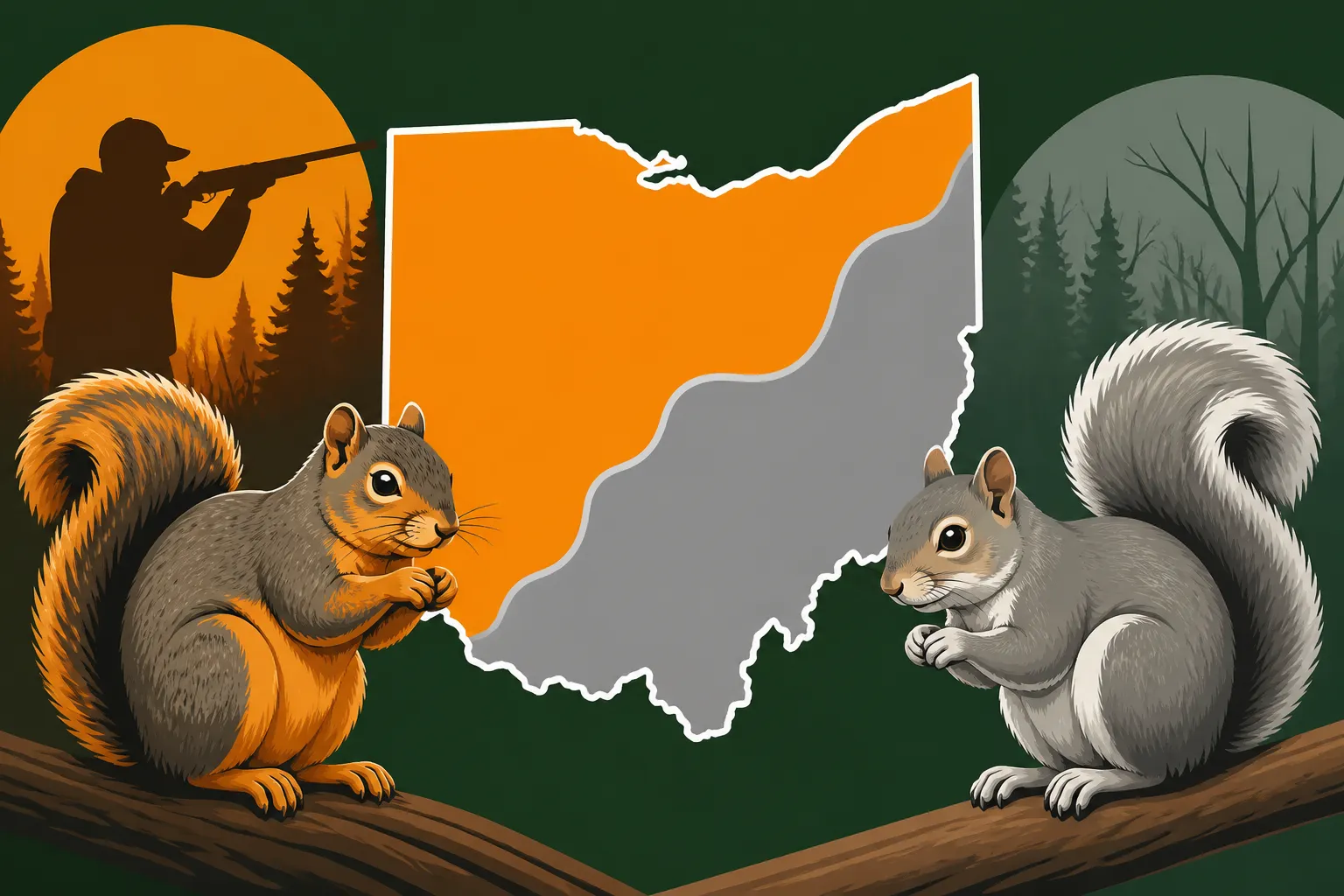
Fox squirrels are incredibly widespread across Ohio, found in nearly all 88 counties. However, their highest concentrations tend to be in the central, western, and northwestern parts of the state. Think of the vast agricultural landscapes, interspersed with smaller woodlots, fencerows, and riparian corridors—that's prime fox squirrel territory. They are less common in the deep, unfragmented forests of southeastern Ohio, where gray squirrels typically dominate, though you can still find them on the edges of these larger forest blocks, especially where they meet farmland. If you're hunting in counties like Wyandot, Hardin, or Darke, you're almost certainly going to encounter more fox squirrels than grays.
When you're looking at a hunting map, perhaps using a tool like GoHunt to scout for promising locations, focus on areas where woodlands meet open fields. These "edge habitats" are exactly what fox squirrels prefer. They aren't as dependent on a continuous canopy as gray squirrels, allowing them to utilize smaller patches of timber and travel across more open ground between food sources. This makes them a more visible and often easier target for hunters who prefer to sit and wait or still-hunt along field edges.
Preferred Habitats and Food Sources
Fox squirrels are generalists when it comes to habitat, but they certainly have their favorites. They thrive in open, mature deciduous woodlands, especially those with an abundance of oak, hickory, and walnut trees. Crucially, they prefer areas with a relatively open understory, allowing them to see potential threats and travel more freely on the ground. You'll often find them along the edges of agricultural fields, in farm woodlots, riparian zones (areas along rivers and streams), and even in suburban parks and golf courses. Their ability to adapt to fragmented habitats is a key to their success.
Their diet is equally varied, but mast crops are paramount. Acorns, hickory nuts, and walnuts are high on their list, providing essential fats and proteins. You'll also find them munching on corn, soybeans, and other agricultural crops when available, which is why they're so prevalent in Ohio's farm belt. They'll also eat buds, seeds, fungi, insects, and even bird eggs, demonstrating their opportunistic nature. When scouting for these creatures, look for the tell-tale signs of their feeding, like shell fragments under nut trees or evidence of their digging in soft soil. A good strategy for these areas is learning Squirrel Hunting Ohio Hickory Groves and watching for activity.
Identifying the Fox Squirrel
Distinguishing a fox squirrel from a gray squirrel is usually straightforward, mainly due to their size and coloration. Fox squirrels are noticeably larger and heavier, often weighing between 1.5 to 2.5 pounds. Their fur typically has an overall reddish or yellowish-orange cast, especially on their undersides, with grizzled gray and brown on their backs. They lack the distinct white-fringed tail that gray squirrels possess. Their tails are long and bushy, often with a tawny or reddish tint.
Their behavior also gives them away. Fox squirrels tend to be a bit bolder and more terrestrial than gray squirrels, spending more time on the ground foraging. When spooked, they might run across open ground to a distant tree rather than immediately scampering up the nearest trunk. They are also known for being a bit less agile in the canopy compared to their gray counterparts. Observing these traits can help you quickly identify the species you're pursuing when you're out Squirrel Hunting Ohio Oak Ridges.
The Gray Squirrel: Forest Dweller Extraordinaire
The eastern gray squirrel ( Sciurus carolinensis ) is often considered the quintessential forest squirrel. Smaller and more agile than the fox squirrel, these animals are masters of the canopy, preferring dense, mature woodlands where they can navigate from tree to tree without touching the ground. If you're deep in an old-growth forest in Ohio, chances are you're surrounded by these energetic, chattering creatures.
Geographic Range Across Ohio
While gray squirrels can be found throughout much of Ohio, their strongest populations and densest concentrations are found in the eastern and southeastern portions of the state. This includes the Appalachian foothills and the rugged, heavily forested counties like Athens, Hocking, Vinton, and Scioto. These areas are characterized by extensive, contiguous hardwood forests, which provide the ideal habitat for gray squirrels. They are less common in the heavily fragmented agricultural regions of western and northern Ohio, though they can still be found in urban parks and well-wooded suburban areas that offer sufficient cover and food.
If you consult a mapping application or a public land atlas, like those available through GoHunt, and see large blocks of uninterrupted forest, especially on state and national forests, you're looking at prime gray squirrel territory. Places like Wayne National Forest and Shawnee State Forest are classic gray squirrel strongholds. When hunting here, you'll want to focus on areas that offer maximum canopy cover and a rich diversity of nut-bearing trees, as detailed in guides like Squirrel Hunting a Shawnee Forest Ridge.
Preferred Habitats and Food Sources
Gray squirrels are true forest animals. They prefer extensive, mature deciduous and mixed deciduous-coniferous forests with a dense canopy and a rich understory. Old-growth forests, where trees are tall and numerous, allowing them to travel extensively through the branches, are ideal. They are particularly fond of oak-hickory forests, but will also utilize beech, maple, and other hard mast-producing trees. They often rely on tree cavities for nesting and shelter, as well as building leaf nests high in the branches. Their preference for continuous canopy is critical, as it provides both protection from predators and efficient travel routes.
Their diet, like that of the fox squirrel, heavily relies on mast crops. Acorns, hickory nuts, and walnuts are foundational, with beech nuts and maple seeds also being important. They'll supplement this with tree buds, bark, fungi, fruits, and occasionally insects. They are expert at caching food, burying nuts individually across their territory to retrieve later, a behavior crucial for survival through the lean winter months. Finding these cached nuts or Reading Cuttings Under an Oak can be a great way to locate active feeding zones.
Identifying the Gray Squirrel
Gray squirrels are smaller and more slender than fox squirrels, typically weighing between 1 to 1.5 pounds. Their fur is predominantly gray on their back and sides, with a clean white or light gray belly. Their most distinctive feature is their long, bushy tail, which is also gray but often edged with white, giving it a characteristic "frosted" appearance. This white fringe on the tail is a reliable distinguishing mark.
In terms of behavior, gray squirrels are incredibly agile and arboreal. They spend a significant amount of time in the trees, leaping between branches with remarkable dexterity. When startled, their instinct is usually to quickly ascend the nearest tree and often try to put the trunk between themselves and the perceived threat. They are also more communal, often seen in higher densities than fox squirrels, especially in prime habitat. Their chattering and barking vocalizations are also a common sound in their preferred woodlands.
Habitat Overlap and Interspecies Dynamics
While fox squirrels and gray squirrels have distinct preferences, their ranges do overlap significantly across Ohio. This overlap creates fascinating dynamics and sometimes competition, influencing where you might find one species more than the other, even within the same general area. Understanding these nuances can give you an edge, especially if you're targeting a specific species.
Where They Coexist
In many parts of central and eastern Ohio, particularly in mixed landscapes where larger forest blocks transition into more open, agricultural areas, both fox and gray squirrels can be found. For instance, a state park or wildlife area might have a large, mature woodlot at its core that holds gray squirrels, while the fringes of that woodlot, especially those bordering fields or more open timber stands, will host fox squirrels. This creates a sort of "buffer zone" where both species exist, often utilizing different microhabitats within the broader area.
These areas of coexistence require a hunter to be particularly observant. You might find fox squirrels foraging on the ground near a cornfield edge, while simultaneously hearing the distinct chatter of a gray squirrel high in the canopy of a nearby dense oak stand. For successful hunting, knowing Ohio Squirrel and Rabbit Season Rules is key, and then adapting your tactics based on the specific habitat you're in becomes paramount. If you're seeing mostly smaller, more agile squirrels, you're probably in gray territory; if they're larger, more reddish, and spending more time on the ground, you're likely in fox squirrel country.
Factors Influencing Dominance
Several factors influence which squirrel species dominates in a given overlapping habitat:
- Forest Maturity and Continuity: Gray squirrels thrive in large, continuous blocks of mature forest with a closed canopy. The more fragmented the forest, the less suitable it becomes for grays, and the more favorable it becomes for fox squirrels.
- Understory Density: Fox squirrels prefer a more open understory that allows for easier ground travel and visibility. Dense brush and thick undergrowth, while offering cover, can hinder their movement. Gray squirrels, being more arboreal, are less affected by a dense understory.
- Mast Crop Diversity: Both species rely heavily on mast, but the specific mix of oak, hickory, and other nut-bearing trees can favor one over the other. For example, a heavy concentration of large oak trees often benefits both, but if the overall habitat leans towards open timber, fox squirrels might still have the edge.
- Predator Pressure: While both are prey species, their different escape strategies (arboreal vs. terrestrial dash) might make one more vulnerable in certain settings.
- Hunting Pressure: Areas with high hunting pressure might see changes in squirrel behavior and population densities, potentially affecting the perceived dominance of one species over another.
Recognizing these subtle ecological cues is part of the art of hunting. It's about more than just finding a tree; it's about understanding the entire environment.
Hunting Squirrels in Ohio: Species-Specific Strategies
Understanding the distinct ranges and habits of Ohio's fox and gray squirrels isn't just for academic interest; it's fundamental to becoming a more effective small game hunter. Your scouting, gear choices, and hunting tactics should ideally adapt to which species you're primarily targeting and the habitat they call home. When Ohio Squirrel Season Opening Day arrives, you want to be prepared.
Tactics for Fox Squirrels
Hunting fox squirrels often involves working the edges of fields, farm woodlots, and more open timber. Their tendency to spend more time on the ground and their larger size makes them a bit easier to spot and target than grays, especially when they're foraging for mast or agricultural crops.
- Still-Hunting Edges: Walk slowly and deliberately along fencerows, field edges, and riparian corridors. Stop frequently, scan the ground and trees, and listen for the rustle of leaves or the cutting of nuts. You'll often catch them moving on the ground between trees or from a woodlot to a field.
- Ambush Hunting: If you've scouted a particular area with heavy mast production along a field, sitting quietly near a cluster of oaks or hickories can be very effective. Fox squirrels will often come out to feed, especially in the early morning or late afternoon. Using
GoHuntto identify property boundaries and ideal tree stands can greatly improve your success here. - Firearm Choice: .22 Rifles for Early Season Squirrels are an excellent choice for fox squirrels, especially if you're taking longer shots across open areas or aiming for headshots to preserve meat. Shotguns, such as Shotguns for Ohio Squirrel and Rabbit, are also effective, especially if you expect closer, faster shots in denser cover. The key is to match your firearm to the expected engagement distance and habitat.
Many hunters find that How Early Season Squirrels Give Themselves Away is by their noisy ground foraging. Listen for the distinct rustle of leaves or the subtle cutting of nut shells. This can help you pinpoint their exact location before they even know you're there.
Strategies for Gray Squirrels
Hunting gray squirrels requires a slightly different approach, focusing more on their arboreal nature and preference for dense, mature forests. They are quicker, more agile, and often harder to pinpoint in the thick canopy.
- Sneak and Peek: This involves moving very slowly through the forest, pausing for long periods to scan the treetops. Focus on detecting slight movements in the branches, or the tell-tale shake of a tree as a squirrel leaps from one limb to another. Binoculars can be incredibly useful for spotting them high up.
- Roosting Trees: In areas with heavy gray squirrel populations, identifying their den trees or preferred roosting areas can be highly productive. Setting up quietly nearby before daylight and waiting for them to emerge can yield consistent opportunities.
- Call and Wait: While not as common as for deer or turkeys, some hunters use squirrel calls, such as a bark or distress call, to make a gray squirrel reveal itself or come closer. This can be effective, especially if you've heard one chattering but can't quite get a visual.
- Firearm Choice: Shotguns are often favored for gray squirrels due to their rapid movement and the often obstructed view in dense timber. The wider pattern of a shotgun offers a better chance at hitting a fast-moving target. However, for those who enjoy the challenge, a
.22 Rifle for Early Season Squirrelscan be extremely rewarding, demanding precision and patience.
When hunting grays, keep in mind their incredible ability to use tree trunks for cover. They will often circle the tree, keeping the trunk between themselves and you. Patience is key; wait for them to expose themselves or try to circle the tree yourself to get a clear shot. Understanding Ohio's Squirrel and Rabbit Populations can also help you determine if an area is worth the effort for gray squirrels.
Conservation and Future Outlook
Ohio's squirrel populations are generally robust, a testament to their adaptability and effective wildlife management strategies by the Ohio Department of Natural Resources (ODNR). Both fox and gray squirrels contribute significantly to Ohio's small game hunting tradition, providing countless hours of enjoyment and a delicious wild game meal.
Population Trends and Management
Currently, both eastern gray and eastern fox squirrels maintain healthy populations across their respective ranges in Ohio. The ODNR monitors squirrel populations through various methods, including hunter harvest surveys, squirrel nest counts, and mast crop assessments. These efforts provide crucial data for understanding population health and informing season structures and bag limits. For example, Ohio Squirrel Nest Counts and Mast Crops play a significant role in predicting the upcoming hunting season's success.
Overall, habitat availability remains the primary factor influencing squirrel numbers. Where mature forests are maintained, gray squirrel populations generally thrive. Where fragmented woodlands and agricultural edges are prevalent, fox squirrels continue to do well. The balanced approach to hunting regulations, combined with responsible land management, ensures that these species will continue to be a valuable resource for Ohio hunters and wildlife enthusiasts.
Challenges and Considerations
While stable, Ohio's squirrel populations do face challenges. Habitat fragmentation due to development, disease outbreaks, and fluctuations in mast crops can all impact local squirrel numbers. For instance, severe droughts or late frosts can reduce acorn and nut production, leading to tougher times for squirrels in the following winter. Climate change could also subtly shift forest composition over decades, potentially altering preferred habitats.
For hunters, being aware of these factors can help inform their efforts. Consulting Best Ohio Counties for Squirrel Hunting reports can sometimes give insight into areas that have had good mast production in recent years. Additionally, being mindful of hunter ethics and responsible harvesting ensures that this cherished tradition continues for future generations. Supporting conservation efforts and habitat improvement projects is vital for maintaining healthy populations of all game species in Ohio, including our beloved bushy-tailed squirrels.
Disclaimer
Please remember that hunting regulations and seasons can change. Always consult the latest Ohio Department of Natural Resources (ODNR) hunting regulations before heading afield. This article is for informational purposes only and should not replace official state guidance.