Ohio Squirrel Nest Counts and Mast Crops
Ever wonder why some years the squirrel woods feel absolutely teeming with bushy-tailed critters, practically begging for you to fill your limit, while other seasons feel like you're walking through a ghost town? It's a common frustration for Ohio squirrel hunters, and it often boils down to factors largely out of our control but entirely predictable if you know what to look for: the abundance of natural food sources, known as mast crops, and the subsequent health of the local squirrel population, often indicated by their nest counts. This guide will help you decode these critical environmental cues, giving you a serious edge in predicting squirrel activity and finding success in the timber.
The Annual Dance: Understanding Mast Crops in Ohio
For squirrels, and indeed for a huge array of other wildlife across Ohio, the forest is their grocery store, and mast crops are the seasonal produce that sustains them. Understanding this rhythm is fundamental to predicting where squirrels will be and how they'll behave.
What Exactly Are Mast Crops?
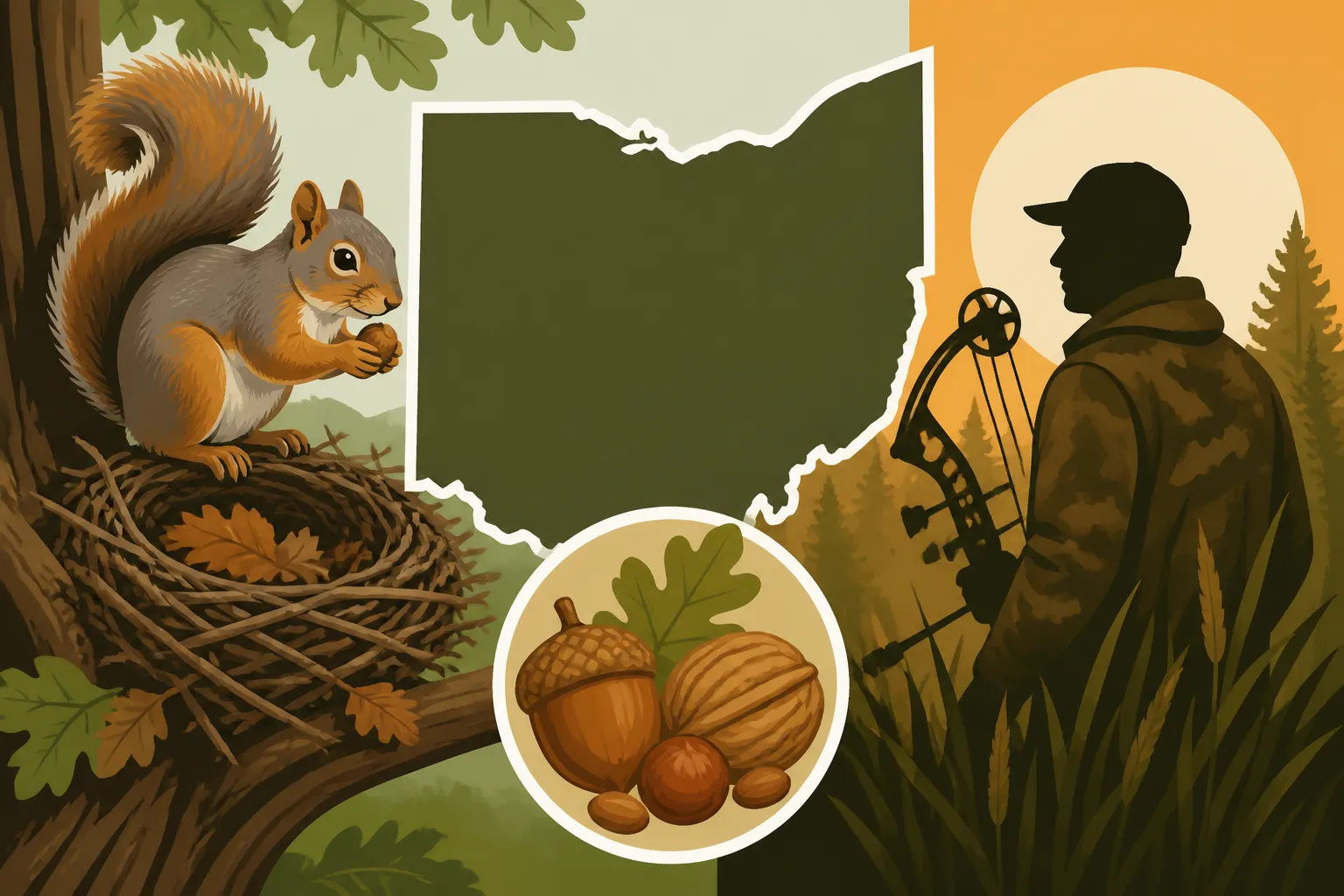
When we talk about mast crops, we're primarily referring to the nuts and fruits produced by trees and shrubs. There are two main categories: hard mast and soft mast. Hard mast is what most hunters think of first: acorns from oak trees, hickory nuts, walnuts, and beechnuts. These are dense, energy-rich food sources that are absolutely vital for squirrels, deer, turkeys, and many other species to put on weight and survive the lean winter months. A robust hard mast crop can literally make or break a local wildlife population's winter survival rates.
Soft mast includes things like berries, wild grapes, dogwood berries, and black cherries. While often available earlier in the season and perhaps not as calorically dense as hard mast, soft mast provides crucial hydration and nutrients, especially in late summer and early fall. Squirrels will readily feast on soft mast, but their long-term survival and population health are more closely tied to the hard mast bonanza. In Ohio, you'll find a wide variety of oaks—white oaks, red oaks, pin oaks—and several species of hickories, like shagbark and pignut, all contributing to this critical food supply.
The Cyclical Nature of Mast Production
If only every year were a banner year for acorns, right? Unfortunately, mast production isn't a consistent, year-to-year affair. Trees, especially oaks, often operate on "boom and bust" cycles. One year, a particular stand of white oaks might be absolutely loaded, dropping nuts like rain, and the next year, those same trees might produce very little. This natural fluctuation is influenced by a myriad of environmental factors.
Late spring frosts, for instance, can wipe out developing flowers on oak trees, leading to a drastically reduced acorn crop. Heavy rains during pollination, which often occurs in early spring for many mast-producing trees, can also interfere with the process. Insect outbreaks can damage developing nuts, and even the overall health and age of the tree play a role. A stand of mature oaks in peak health is more likely to produce a decent crop more consistently than younger, struggling trees. This variability means that a squirrel hunter can't just assume last year's hot spot will be the same this year; scouting for mast is an annual pilgrimage.
How to "Read" the Mast Crop Before Season
The most effective way to gauge the upcoming squirrel season is to get out into the woods in late summer and early fall, well before opening day. This pre-season scouting is crucial. You're looking for evidence of mast production. Under oak trees, scan the ground for early-dropping acorns, both good ones and "duds" (small, undeveloped, or insect-damaged nuts). The quantity of duds can sometimes tell you if the crop is going to be sparse. Look up into the branches: can you see clusters of developing acorns or nuts? Are the trees heavy with them?
For hickories, look for the tell-tale green husks starting to fall, or even whole nuts. Walnut trees are pretty obvious with their large, round green fruits. Pay attention to the understory too – sometimes you'll find wild grapes, dogwood, or even black cherry trees offering soft mast. Identifying key mast-producing areas early gives you a significant advantage. If you find a ridge loaded with white oak acorns, you can bet squirrels will be spending a lot of time there. Conversely, if you scout several of your favorite spots and find little to no mast, it's time to expand your search or adjust your expectations. This early intel is just as important as scouting for deer sign; it dictates where the food is, and where the animals will be.
Squirrel Nest Counts: A Window into Population Health
Beyond just finding food, understanding the overall health and density of the local squirrel population can greatly inform your hunting strategy. Squirrel nests, or dreys, offer a surprisingly accurate, albeit general, insight into how many squirrels are calling a particular woodlot home.
Why Squirrel Nests Matter
Squirrel nests, often referred to as dreys, are much more than just messy clumps of leaves. They are direct indicators of squirrel presence and, by extension, population density in a given area. When you see a high concentration of well-maintained leaf nests, especially during the colder months when leaves are off the trees, it suggests a healthy, thriving squirrel population. These nests are often used for rearing young and for shelter from harsh weather and predators. A high number of nests indicates that conditions have been favorable for squirrels to reproduce and survive.
While squirrels also use den trees – natural cavities in trees – leaf nests are easier to spot and count, especially from a distance. A proliferation of dreys means that squirrels are not only present but have been successfully raising litters and establishing territories. On the other hand, if you walk through a seemingly perfect woodlot and find very few, if any, nests, it might suggest a low squirrel population, perhaps due to past hunting pressure, disease, or simply a lack of consistent food sources over time.
Conducting Your Own Nest Count
The best time to conduct a squirrel nest count is typically in late fall or early winter, after most of the leaves have dropped from the trees, or in early spring before the new foliage emerges. This allows for maximum visibility of the nests, which are often built high in the canopy. Grab a pair of binoculars and slowly walk through your potential hunting areas. Systematically scan the treetops, looking for those tell-tale spherical clumps of leaves and twigs. It's easy to dismiss them as random debris, but with a keen eye, you'll start to recognize the distinct structure of a drey.
Don't just count the nests; try to get a feel for their condition. Are they robust and tightly packed, suggesting recent use? Or are they falling apart, indicating they might be old and abandoned? It's important to remember that a single squirrel might have multiple nests, and nests can persist for several years. The goal isn't to get an exact squirrel-to-nest ratio, but rather a general impression of high, medium, or low density. You can even use mapping tools like GoHunt to mark areas where you observe high nest concentrations, helping you build a historical picture of squirrel activity in different woodlots. Think of it as a Scouting Ohio Public Land Before Season strategy specifically tailored for squirrels.
Connecting Nest Counts to Hunter Success
There's a strong correlation between robust squirrel nest counts and the likelihood of successful hunting. Simply put, more nests generally mean more squirrels. If you've scouted a particular ridge or woodlot and noted an abundance of dreys, it stands to reason that you'll have more opportunities to encounter squirrels there. This knowledge can help you prioritize your hunting efforts. Why spend your time in a sparse woodlot when another, healthier-looking area is just a short walk away?
Conversely, if your nest count is low, it might be an indication that the area has a low squirrel population, perhaps due to heavy predator pressure, a previous harsh winter, or simply isn't prime squirrel habitat. This doesn't mean you won't find any squirrels, but your success rate might be significantly lower, and you might need to adjust your expectations or expand your search to other locations. It's one more piece of the puzzle, informing your strategy and helping you make the most of your time in the woods.
The Interplay: Mast, Nests, and Ohio Squirrel Hunting
Connecting the dots between mast availability and squirrel population indicators like nest counts is where real hunting strategy comes into play. It’s about understanding the entire ecosystem your target species relies upon.
How Mast Crops Influence Squirrel Behavior
The presence or absence of a good mast crop fundamentally alters how squirrels behave. In years with an abundant hard mast crop – think white oaks dropping acorns everywhere you look – squirrels tend to be more localized. They don't have to travel far to find food, so they'll concentrate their activity within those mast-rich areas. This makes them more predictable. You can often sit near a cluster of productive oak or hickory trees and wait for the squirrels to come to you, or slowly still-hunt through these food-rich zones. This is especially true when you're Squirrel Hunting Ohio Oak Ridges or focusing on Squirrel Hunting Ohio Hickory Groves. The squirrels will be there, busy cutting nuts and burying them for later.
However, a poor mast crop changes everything. When acorns and hickory nuts are scarce, squirrels become much more nomadic. They'll travel further, often seeking out alternative food sources like hidden caches from previous years, persistent soft mast, or even agricultural fields if available. This makes them harder to pattern. Your strategy might need to shift from sitting and waiting to more active still-hunting, covering more ground, and searching for any available food source. Understanding this dynamic is crucial for adapting your approach each season.
Interpreting the Data for Your Hunt
Bringing together your mast crop observations and nest counts allows you to create a personal "squirrel map" for your hunting spots. If you find an area with both a strong mast crop and numerous active nests, that should be your primary focus. These are your high-probability zones. Conversely, areas with poor mast and few nests should be considered secondary, or perhaps even avoided until you've exhausted the prime locations.
Modern hunting tools, such as the GoHunt app or similar mapping software, can be incredibly helpful here. You can mark specific oak stands, hickory groves, and areas of high nest density directly on your map. This allows you to track these areas year after year, building a valuable historical record. Over time, you'll start to see patterns – certain ridges might consistently produce good mast, or particular woodlots always seem to hold a strong squirrel population. This informed approach helps you make strategic decisions about where to invest your time, whether you're trying to Read Cuttings Under an Oak or locate a productive hickory grove.
Beyond Nests and Nuts: Other Factors
While mast crops and nest counts are powerful indicators, they are not the only factors influencing squirrel populations and hunting success. Predator pressure can significantly impact squirrel numbers. Coyotes, bobcats, foxes, and various raptors are constantly preying on squirrels. A localized spike in predator activity, perhaps due to a lack of other prey animals, can depress squirrel numbers even in a mast-rich area. Ohio's Coyotes and Predators in Ohio are always a factor in the food chain.
Weather also plays a vital role. A particularly harsh winter, especially following a poor mast year, can lead to increased mortality rates among squirrels. Prolonged drought can impact tree health and mast production, creating a domino effect. Lastly, don't forget hunting pressure itself. Heavily hunted public land might see squirrels become warier and more nocturnal, regardless of food availability. Learning How Early Season Squirrels Give Themselves Away can help, but sometimes, moving to less pressured ground is the best bet.
Here's a quick overview of how mast crops can influence your hunting strategy:
| Mast Crop Quality | Squirrel Behavior | Recommended Hunting Strategy |
|---|---|---|
| Excellent | Localized, active, less wary | Still-hunt or sit near active feeding trees |
| Good | Fairly localized, consistent activity | Mix of still-hunting and sitting in prime areas |
| Poor | More nomadic, travel for alternative foods | More active still-hunting, cover wider areas |
| Very Poor | Widely dispersed, low activity, harder to locate | Target secondary food sources, increased scouting |
Ultimately, becoming a more successful squirrel hunter in Ohio means becoming a keen observer of the forest itself. Pay attention to the details, connect the ecological dots, and let the trees and the nests guide your path.
Disclaimer
This article is for general informational purposes only and does not constitute professional advice. Laws, prices and regulations vary by location and change over time. Consult a qualified professional for guidance on your specific situation.