Gray Versus Fox Squirrels in Ohio
For many of us, chasing squirrels in the early fall woods is where our hunting journey truly began. There's nothing quite like the crack of a .22 or the rustle of leaves as you try to pinpoint that chattering bushytail. But if you’ve spent any time at all in Ohio’s forests, you've likely noticed that not all squirrels are created equal. This guide will walk you through the often-misunderstood differences between the gray squirrel and its larger, bolder cousin, the fox squirrel, helping you identify them, understand their habits, and ultimately, become a more effective squirrel hunter in the Buckeye State.
The Tale of Two Tail-Waggers: Spotting the Key Differences
It's easy to lump all squirrels into one category, especially when they're darting through the canopy or burying acorns. However, the eastern gray squirrel and the fox squirrel are distinct species with different preferences and behaviors. Knowing these nuances can make a world of difference when you're trying to fill your game bag or just observe nature.
Physical Characteristics: More Than Just Color
While their names suggest a clear color difference, it’s not always that simple. Both species can have variations, and a "gray" squirrel might have reddish tints, while a "fox" squirrel can appear quite dark. However, there are some reliable markers.
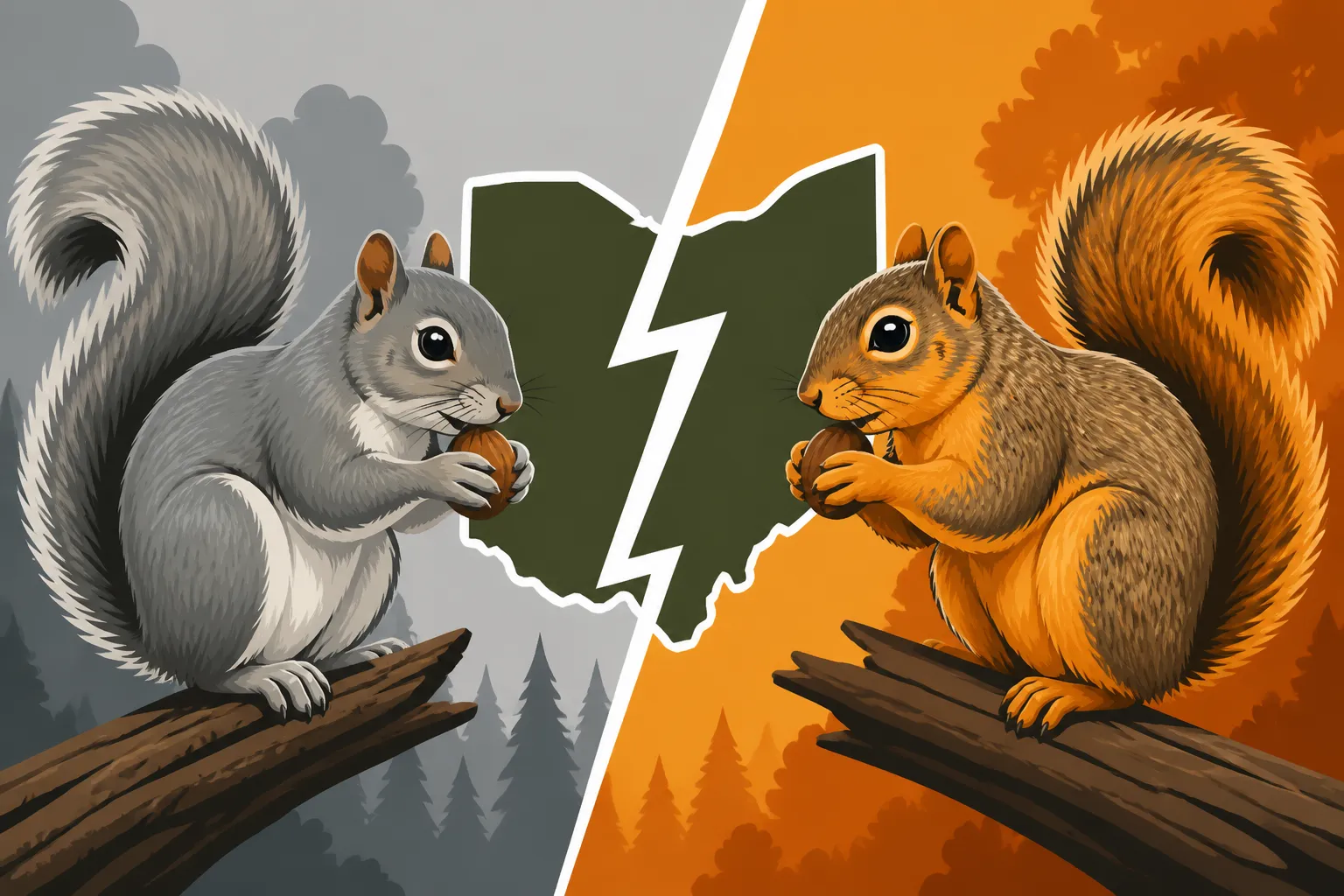
The fox squirrel (Sciurus niger) is generally the larger of the two, often boasting a body length of 10-15 inches with a tail adding another 10-14 inches. They typically weigh between 1.5 to 2.5 pounds, making them quite a substantial meal. Their fur is usually a grizzled reddish-brown or yellowish-brown on their back, with a paler, often orange or rusty, underside. You might also notice patches of orange or red around their ears, nose, and feet. Their tail is full and bushy, often with a reddish-brown fringe. When you see one on a branch, they just look big.
The eastern gray squirrel (Sciurus carolinensis), on the other hand, is smaller and more slender. They usually measure 8-10 inches in body length, with a tail of 7-10 inches, and typically weigh between 1 to 1.5 pounds. Their fur is primarily grayish on the back, often with a white or pale gray belly. Sometimes, they can have a brownish or even black phase, which can certainly throw you for a loop if you're only going by color! Their tail is also bushy but often appears more uniformly gray, sometimes tipped with white. When these little acrobats are scampering through the trees, they move with a different kind of speed and agility.
Habitat Preferences: Where Each Calls Home
Understanding where each squirrel prefers to live is perhaps the most crucial distinction for a hunter. It directly influences where you’ll spend your time scouting and hunting.
Gray squirrels are true denizens of the deep woods. They thrive in mature, dense hardwood forests with a diverse canopy, especially those rich in oak and hickory. These trees provide not only their preferred food sources (acorns, hickory nuts, beechnuts) but also the intricate network of branches they use for travel and escape. You'll find them at home in large timber tracts, places like Ohio's extensive state forests or areas within the Wayne National Forest. They rely heavily on tree cavities for dens, but will also build leaf nests high in the branches. If you're hunting in a big, unbroken stand of timber with plenty of mast trees, chances are you're primarily in gray squirrel country. Checking out a place like Squirrel Hunting Ohio Oak Ridges might give you a better idea of these specific habitats.
Fox squirrels are a bit more adaptable and prefer a more open, fragmented habitat. They're often found in smaller woodlots, along fencerows, at the edges of agricultural fields, and in mixed hardwood-pine stands. They're more common in Ohio's farm country, where patches of woods border corn and soybean fields. While they will use tree cavities, they are more prone to building leaf nests than grays, especially in trees with fewer natural holes. They spend a good deal more time on the ground foraging than their gray counterparts, making them a common sight in cut cornfields or along woodland edges. If you're hunting on private land bordering fields in counties like those in Northwest Ohio, you’re very likely to encounter fox squirrels. A hunter using mapping tools like GoHunt might notice how their preferred habitats often show up as distinct patterns on satellite imagery – dense, continuous canopy for grays versus more interspersed woodlots for fox squirrels.
Behavioral Quirks: How They Act
Beyond their looks and living arrangements, these two squirrels have different personalities, so to speak. These behavioral patterns can give you clues to their identity and help you predict their movements.
Gray squirrels are incredibly agile and arboreal. They are master tree climbers and spend most of their time in the canopy, often using the branches to escape danger. When threatened, a gray squirrel will typically run up a tree and then flatten itself on the opposite side of the trunk, peeking around to see if the coast is clear. They are famously chattery, often barking and scolding hunters from a safe distance. Their nervous energy means they're constantly on the move, especially during peak foraging hours. You'll often see multiple gray squirrels in one area, as they can live in higher densities than fox squirrels. Their tendency to stick to the trees means if you hear a lot of activity high up, it’s likely a gray.
Fox squirrels, while capable climbers, are noticeably more terrestrial. They spend a significant amount of time on the ground foraging for nuts, seeds, and even fungi. When spooked, a fox squirrel might run up a tree, but they're just as likely to run along the ground to a different patch of cover, often pausing to look back before making their next move. They are generally less vocal than grays, and when they do bark, it's often a deeper, more guttural sound. Their larger size means they're a bit slower and less acrobatic in the trees. When you spot a squirrel making long dashes across an open forest floor or even a field, it's a good bet you're looking at a fox squirrel. This difference in movement is a crucial aspect to consider when you're hunting; knowing How Early Season Squirrels Give Themselves Away can be a game-changer.
Here's a quick comparison table to keep their key differences straight:
| Feature | Eastern Gray Squirrel | Fox Squirrel |
|---|---|---|
| Size | Smaller, more slender (1-1.5 lbs) | Larger, stockier (1.5-2.5 lbs) |
| Primary Color | Gray back, white/pale gray belly | Reddish-brown/yellowish-brown back, rusty/orange belly |
| Tail | Bushy, typically gray, sometimes white-tipped | Bushy, reddish-brown fringe |
| Preferred Habitat | Mature, dense hardwood forests | Open woodlots, field edges, fragmented forests |
| Arboreal/Terrestrial | Highly arboreal, spends most time in trees | More terrestrial, spends significant time on ground |
| Escape Behavior | Runs up tree, flattens on far side | Runs up tree or along ground to new cover |
| Vocalization | Chattery, high-pitched barks | Less vocal, deeper, guttural barks |
| Density | Higher density, often seen in groups | Lower density, often solitary |
Hunting Strategies: Tailoring Your Approach
Once you can tell these two species apart, you can start to adjust your hunting tactics to be more effective. What works for a gray squirrel in deep timber might not be the best approach for a fox squirrel along a fencerow.
Early Season: Mast Crops and Quiet Movement
The early part of Ohio's squirrel season, which typically opens in late summer or early fall (you can always check the specific dates for Ohio Squirrel Season Opening Day on the ODNR website or with a tool like GoHunt), is often defined by the availability of mast crops.
For gray squirrels, this means focusing your efforts on large stands of mature oak, hickory, and beech trees. These areas are prime feeding grounds. You'll want to move slowly and quietly, stopping frequently to listen for their chatter or the tell-tale sound of nuts falling to the forest floor. When they're feeding on acorns, you might even hear the distinct crunching sound. Often, early mornings and late afternoons are the most productive times. When you find an active area, sit still for 15-20 minutes, scanning the trees and ground for movement. Grays are experts at hiding, so patience is key. Areas described in Squirrel Hunting Ohio Hardwoods are ideal for these early season hunts. Look for fresh cuttings under nut trees – these are definitive signs of recent squirrel activity.
Fox squirrels, while they also enjoy mast, will often be found along the edges of these woods, venturing into adjacent fields to forage on corn, soybeans, or other agricultural crops. When targeting fox squirrels, consider walking fencerows, drainage ditches, and small woodlots that connect larger timber patches to open fields. Their ground-dwelling tendencies mean you'll be doing more walking and less sitting. Use the cover of the fencerows or creek beds to sneak up on them. Since they are often found near fields, they can be a bit warier of human presence, so long-range shots might be necessary. This is where a good scouting app can come in handy; using GoHunt to identify specific field edges and connecting woodlots can streamline your early season efforts.
Late Season: Adapting to Colder Weather
As the leaves fall and winter approaches, squirrel hunting takes on a different feel. The colder temperatures and reduced natural food sources change their behavior.
Gray squirrels in the late season will still frequent mast-producing trees, but their activity might be more concentrated around den trees, especially on colder days. Look for old, mature trees with visible cavities or leaf nests. On sunny, warmer winter days, they will often emerge to bask and forage, but on truly frigid days, they might stick close to their dens. Hunting after a fresh snow can be incredibly productive, as you can easily spot their tracks and follow them to their feeding or denning areas. Their high arboreal nature means you'll still be looking up, but perhaps with more focus on specific trees rather than broad canopy movements. This is often when you'll truly get a chance to confirm you're Reading Cuttings Under an Oak to find where they've been feasting.
Fox squirrels, in the colder months, will often increase their ground foraging, especially in agricultural fields where residual crops like corn or soybeans might still be available. They're more likely to be seen out in the open, making them potentially easier to spot but also more challenging to approach undetected. Look for them in cut cornfields, around abandoned farm buildings, or along thick brushy fencerows that offer both cover and food. They might even burrow into hay bales or brush piles for warmth. Late-season hunts for fox squirrels often involve more walking and flushing, similar to rabbit hunting, but always keeping an eye on the trees for those brief moments they might climb for safety.
Gear Considerations for Both Species
Whether you're after grays or fox squirrels, your gear choices can greatly impact your success.
A .22 caliber rifle is a classic choice for squirrel hunting, especially if you’re aiming for headshots to preserve meat. The quiet report and accuracy are ideal for multiple shots in an active area. For gray squirrels, whose nervous energy makes them dart around, a quick, accurate shot is essential. For fox squirrels, especially when they're feeding on the ground at a distance, the precision of a rifle is invaluable. You can learn more about specific choices in .22 Rifles for Early Season Squirrels.
A shotgun (typically a .410, 20-gauge, or 12-gauge with light shot like #6 or #7.5) is another excellent option, particularly if you're less confident in your rifle skills or if squirrels are moving quickly through dense cover. For fast-moving gray squirrels in the canopy, a shotgun can offer a larger pattern for better chances of a hit. For fox squirrels, especially if you're walking them up from fencerows, a shotgun allows for quick, reactionary shots. When considering your firearm, think about the kind of cover you'll be hunting. You can find more detail on Shotguns for Ohio Squirrel and Rabbit.
Beyond firearms, consider a good pair of binoculars to help spot camouflaged squirrels, especially grays high in the trees. A comfortable pair of walking boots is essential, particularly when chasing fox squirrels across larger areas. Dress in quiet, layered clothing appropriate for the weather, as early season hunts can be warm, while late season can be quite chilly. Finally, a small game vest with plenty of pockets for shells, game, and water can make your hunt much more enjoyable.
Distribution and Population in the Buckeye State
Ohio is blessed with healthy populations of both gray and fox squirrels, making squirrel hunting a accessible and rewarding pursuit across much of the state. However, their distribution isn't uniform, directly reflecting their habitat preferences.
Where to Find Each Species in Ohio
The distribution of gray versus fox squirrels largely mirrors the availability of their preferred habitats across Ohio.
Gray squirrels are most prevalent in the heavily forested eastern and southeastern portions of the state. Think of counties within the Appalachian foothills, where vast tracts of mature hardwoods dominate the landscape. Areas like Vinton County, Athens County, and across the Wayne National Forest are prime gray squirrel territory. These regions offer the dense, unbroken forest canopy that grays favor, providing both food and ample escape routes. If you're looking for the best places to chase grays, focus on these larger wooded areas. Hunters can use the Ohio HuntFish app or GoHunt's public land layers to zero in on these extensive forest ecosystems. For specific locations, you might want to look into Best Ohio Counties for Squirrel Hunting to identify areas known for consistent populations.
Fox squirrels dominate the more open, agricultural landscapes of western and northern Ohio. Counties in the rich farm belt, with their patchwork of fields, fencerows, and smaller woodlots, provide the ideal fragmented habitat for fox squirrels. Northwestern Ohio, with its expansive farmlands, is particularly known for its robust fox squirrel populations. While you might still find fox squirrels in smaller woodlots in eastern Ohio, their density won't be as high as in the western half of the state. They adapt well to suburban fringes too, as long as there are some trees and available food sources. If you're hunting smaller, private tracts near farms, you're almost guaranteed to encounter fox squirrels.
It's important to remember that there are transitional zones where both species can be found, particularly in central Ohio where agricultural lands begin to blend into more extensive woodlands. In these areas, you might encounter both species during the same hunt, adding an interesting challenge to your day!
Population Trends and What They Mean for Hunters
Overall, Ohio's squirrel populations are considered stable and healthy. Both gray and fox squirrels are resilient species, and their numbers tend to fluctuate more with mast crop availability than with long-term habitat loss, although habitat certainly plays a role.
Historically, gray squirrels have seen some localized declines with extensive clear-cutting of mature forests, but conservation efforts and forest regrowth have generally helped stabilize their numbers. Their high reproductive rate and adaptability to various mast crops (oaks, hickories, walnuts, etc.) ensure a robust population. Hunters in forested areas can generally expect consistent opportunities. Checking the Ohio Squirrel Harvest Numbers from previous years can give you an idea of overall population health and success rates in different regions.
Fox squirrels have adapted incredibly well to human-modified landscapes. While they might not be as numerous in sheer numbers in a single contiguous forest, their widespread distribution across farmlands ensures their continued success. Their ability to utilize various food sources, including agricultural crops, helps buffer them against poor mast years in natural woodlands. For hunters, this means fox squirrels offer consistent opportunities in agricultural regions and smaller woodlots.
When planning your hunts, keep an eye on the annual mast crop reports from the Ohio Department of Natural Resources. A good mast year often translates to higher squirrel populations and better hunting opportunities the following season. Conversely, a poor mast year can lead to more concentrated squirrel activity as they search for food, or potentially lower numbers. Using a resource like GoHunt can help you stay informed about localized conditions and find areas with good mast production.
Ultimately, whether you're chasing the acrobatic gray squirrel through dense hardwoods or the more terrestrial fox squirrel along a field edge, Ohio offers fantastic opportunities for small game hunting. Understanding the subtle yet significant differences between these two common species will not only make you a more knowledgeable hunter but also add a richer layer of appreciation to your time spent in Ohio's diverse natural landscapes. Don't forget to check the specific regulations and seasons for Ohio Small Game and Upland Bird Seasons before heading out!
Disclaimer
This article is for general informational purposes only and does not constitute professional advice. Laws, prices and regulations vary by location and change over time. Consult a qualified professional for guidance on your specific situation.