8×42 Versus 10×42 in the Woods
Choosing the right set of binoculars for your Ohio hunting adventures can feel like a surprisingly big decision. It’s not just about seeing further; it’s about how clearly you can discern a deer’s antler points in the fading light, or how steadily you can track a gobbler through dense spring woods. Many hunters agonize over the common dilemma: should I go with 8×42 or 10×42 binoculars? This guide will dive deep into the nuances of each option, helping you understand which might be your perfect companion for the varied terrain and hunting styles found across our great state.
Understanding Binocular Magnification and Objective Lens Diameter
Before we can compare specific models, let's break down what those numbers—like 8×42 and 10×42—actually mean. It’s more than just a model number; it's a window into how that particular optic will perform in the field. Grasping these fundamentals will give you a solid foundation for making an informed choice.
Decoding the Numbers: 8×42 and 10×42
The first number, "8x" or "10x," refers to the binocular's magnification. An 8x magnification means that an object viewed through the binoculars will appear eight times closer than it would to your naked eye. Similarly, 10x magnification makes things appear ten times closer. So, if a deer is 400 yards away, an 8x binocular makes it look like it's 50 yards away, while a 10x binocular makes it seem like it's only 40 yards off. That extra "2x" might not sound like much on paper, but in the field, it can be the difference between confidently identifying an antlered buck or simply seeing a blur.
The second number, "42," represents the diameter of the objective lens in millimeters. This is the large lens at the front of the binocular that gathers light. A larger objective lens generally means more light can enter the binocular, which is crucial for bright, clear images, especially in challenging lighting conditions like dawn and dusk. For most hunting applications, a 42mm objective lens is considered a sweet spot, offering a good balance between light-gathering capability and manageable size and weight. While some binoculars boast 50mm or even larger objective lenses, they tend to be heavier and bulkier, which isn't always ideal for long treks on public land.
The Exit Pupil: Why it Matters for Low Light
Beyond magnification and objective lens size, there's another crucial factor that often gets overlooked: the exit pupil. This is the diameter of the light beam that exits the binocular and enters your eye. You can calculate it by dividing the objective lens diameter by the magnification. For an 8×42 binocular, the exit pupil is 42mm / 8 = 5.25mm. For a 10×42 binocular, it's 42mm / 10 = 4.2mm.
Why is this important? Your eye's pupil dilates (gets larger) in low light to let in more light, typically reaching a maximum of 5-7mm in adults. If the binocular's exit pupil is smaller than your eye's dilated pupil, you're essentially "wasting" some of the light the objective lens gathered, and your eye won't receive the full brightness potential. Conversely, if the exit pupil is larger, your eye can't use all the light, but you're not losing anything. Therefore, an 8×42 with its larger 5.25mm exit pupil will generally provide a brighter image in low light compared to a 10×42, assuming equal glass quality. This distinction is paramount for hunters who are often glassing at first light or last light, trying to catch a deer moving on a Late-Season Food Sources for Ohio Whitetails.
8×42 Binoculars: The Ohio Hunter's Steady Companion
When you're slipping through the woods, climbing into a stand before dawn, or trying to discern movement in dense cover, the 8×42 binocular often shines. It's a workhorse for many Ohio hunters, offering a blend of attributes that make it incredibly versatile, especially in our state's diverse, often timber-heavy landscapes.
Advantages in the Thick Stuff and Timber
One of the most significant advantages of an 8×42 binocular is its wider field of view (FOV). This means you see a broader area through the lenses, which is incredibly helpful when you're scanning dense woods or trying to pick up a moving deer in thick brush. Imagine you're still-hunting through a vast tract of Wayne National Forest Hunting land, slowly picking apart the timber. A wider FOV allows you to cover more ground with less head movement, making it easier to spot a twitching ear or a flicking tail. This also reduces the "tunnel vision" effect that can happen with higher magnification, allowing you to react quicker to sudden movements.
Another huge benefit is image stability. Holding binoculars perfectly still, especially after a long walk or during an all-day sit in a treestand, can be surprisingly difficult. The lower 8x magnification means that any natural hand shake is less pronounced than it would be with 10x binoculars. This translates to a steadier, more comfortable viewing experience, which is crucial when you're trying to count points on a buck through a small opening in the canopy. For those long hours on stand, patiently waiting, the reduced fatigue from a stable 8x image is a real blessing. This stability can be invaluable when trying to pick out a detail on a deer moving through the trees during Hunting the Ohio Rut in Early November. For many hunters, myself included, spending extended periods with 8x binos feels less strenuous, which is a major plus on those colder, longer sits.
Practical Scenarios for 8×42 in Ohio
Consider deep woods deer hunting, like in the rolling hills of Shawnee State Forest. Here, shot distances are often shorter, and the cover is thick. You’re less likely to be glassing across sprawling cornfields and more likely to be searching for a deer moving subtly through dense oak stands. An 8×42 provides ample magnification to identify deer at typical timber ranges, usually under 200 yards, while offering that crucial wide field of view to scan for movement. The superior low-light performance, thanks to that larger exit pupil, is also a game-changer when legal shooting hours begin or end, helping you spot that buck slipping through shadows.
Spring turkey hunting is another perfect application for 8x42s. When you're trying to pinpoint a gobbler's location in heavily foliated woods or confirm if that distant dark blob is indeed a strutting tom or just a stump, the stable, bright image of an 8×42 is invaluable. The wider FOV also helps you quickly locate the source of a distant gobble without sweeping too much. Even for small game hunters pursuing Squirrel Hunting Ohio Hardwoods or Rabbit Hunting Thick Ohio Fencerows, the ability to quickly acquire and follow fast-moving targets in dense cover makes the 8×42 an excellent choice. Many hunters consult platforms like GoHunt for reviews of various 8×42 models, seeking out those known for their robust build and exceptional optical clarity for these demanding conditions.
10×42 Binoculars: Reaching Out Across Open Spaces
While the 8×42 excels in the timber, the 10×42 earns its keep when you need to stretch your vision further, providing that extra reach and detail crucial for specific hunting situations across Ohio. It’s the choice for those moments when every bit of magnification counts.
Advantages for Distance and Detail
The primary advantage of 10×42 binoculars is, quite simply, more magnification. That extra 2x might not seem like a massive jump, but when you're trying to resolve fine details at longer distances, it truly makes a difference. If you're hunting in areas with vast agricultural fields, like much of Hunting Northwest Ohio Farmland Deer, or scanning a large clear-cut in southeastern Ohio, that added magnification helps you pick apart distant cover and identify game more precisely. You can often make out antler configuration on a buck much more confidently at 300+ yards with a 10x system than with an 8x. This allows you to evaluate trophy potential or even confirm if a deer is antlered or antlerless before making a move, saving precious time and effort.
However, this increased magnification comes with a trade-off: a narrower field of view and a more pronounced effect of hand shake. While it lets you see further, you're seeing a smaller slice of the landscape, which can make it harder to quickly locate an animal or follow one on the move. The slightly diminished low-light performance due to the smaller exit pupil is also something to consider, though with modern, high-quality glass, this difference can often be minimal or even imperceptible to the average hunter in most practical low-light conditions.
Practical Scenarios for 10×42 in Ohio
Picture yourself hunting western Ohio farmland, set up on the edge of a vast soybean field or winter wheat. Deer often cross these fields at considerable distances, or bed down in standing cover at the far end. Here, the 10×42 really shines. It allows you to meticulously glass that distant tree line, the fencerow, or the edge of a woodlot, hoping to spot a deer stepping out or bedded down. When you’re trying to determine if that distant flicker is a rack or a branch, the 10x power gives you the edge. Similarly, for hunters who enjoy Hunting a Standing Soybean Field or are positioned to overlook a large cut cornfield, the ability to zoom in on potential game is critical.
Beyond deer hunting, 10×42 binoculars are excellent for waterfowl hunting, particularly when you're set up in a layout blind in a cut cornfield or on the edge of a large marsh. Being able to spot distant flocks of ducks or geese, identify species, and judge their approach path before they're within calling range gives you a significant tactical advantage. Even in the Appalachian foothills, if you're Reading Aerial Photos for Southeast Ohio Deer and planning to glass a distant ridge or valley from a high vantage point, the 10x provides the necessary power to scrutinize those far-off shadows and shapes. When comparing various brands and their optical performance at this magnification, many hunters turn to resources like GoHunt to see which models excel in clarity and ruggedness for these long-range tasks.
Making Your Choice: Factors Beyond Magnification
While the 8×42 vs. 10×42 debate often focuses purely on magnification, there are other critical factors that should weigh heavily on your decision. A binocular's overall design, build quality, and how it feels in your hands can be just as important as its optical specifications.
Weight, Ergonomics, and Durability
Consider the weight of the binoculars. A few extra ounces might not seem like much at home, but after a full day of hiking up and down hills in Zaleski State Forest Hunting or navigating miles of public land, every ounce adds up. Lighter binoculars mean less fatigue around your neck or in your pack. The ergonomics—how the binoculars fit your hands, the smoothness of the focus wheel, the eye relief—are also paramount. Can you comfortably hold them steady for extended periods? Can you operate them easily with gloves on? Many high-quality binoculars are designed with ergonomic considerations in mind, making them a pleasure to use in adverse conditions.
Durability is another non-negotiable trait for hunting optics in Ohio. Our weather can be notoriously unpredictable, swinging from mild autumn days to bitter cold, wet snow, or sudden downpours. Your binoculars need to be waterproof, fog proof, and robust enough to handle accidental bumps and drops. Features like rubber armor provide protection and a secure grip, even when wet. Investing in a quality pair, perhaps after comparing reviews on platforms like GoHunt, means you won't be replacing them after just a few seasons. Opting for a reputable brand with a good warranty can also provide peace of mind, knowing your investment is protected against the rigors of the field.
Considering Your Primary Hunting Style and Terrain
Ultimately, the "best" binocular for you comes down to your individual hunting style and the specific terrain you frequent most often in Ohio. If you spend the majority of your time still-hunting through thick timber, like Still-Hunting Shawnee State Forest Ridges, or navigating the dense undergrowth for squirrels and rabbits, the wider field of view and enhanced stability of an 8×42 will likely serve you better. It’s easier to quickly acquire targets in close quarters, and the reduced hand shake is a real advantage when you’re on the move or bracing against a tree.
On the other hand, if your hunting grounds are characterized by open agricultural fields, expansive clear-cuts, or if you regularly find yourself glassing across long distances on properties like Hunting small private tracts in Ohio or larger wildlife areas, the increased magnification and detail resolution of a 10×42 will be more beneficial. It allows you to pick apart those distant edges and identify game with greater confidence. Many experienced hunters even own both, choosing the appropriate pair based on the specific hunt of the day. Think about your most common hunting scenarios: Are you watching a food plot from a distance, or are you deep in the woods trying to catch a subtle flick of an ear? Your answer will guide you to the right magnification.
Here's a quick comparison to help you visualize the differences:
| Feature | 8×42 Binoculars | 10×42 Binoculars |
|---|---|---|
| Magnification | 8x (Objects appear 8x closer) | 10x (Objects appear 10x closer) |
| Field of View | Wider, easier to scan large areas quickly | Narrower, more focused on specific details |
| Image Stability | More stable, less noticeable hand shake | Less stable, hand shake more pronounced |
| Low Light Performance | Generally brighter due to larger exit pupil (5.25mm) | Slightly dimmer due to smaller exit pupil (4.2mm) |
| Best For | Thick timber, dense cover, still-hunting, closer ranges, tracking moving game | Open fields, long-distance glassing, identifying fine details, stationary viewing |
| Fatigue | Less eye strain over long periods of glassing | Can be more fatiguing over long periods |
| Weight/Bulk | Often slightly lighter/more compact | Can be slightly heavier/bulkier |
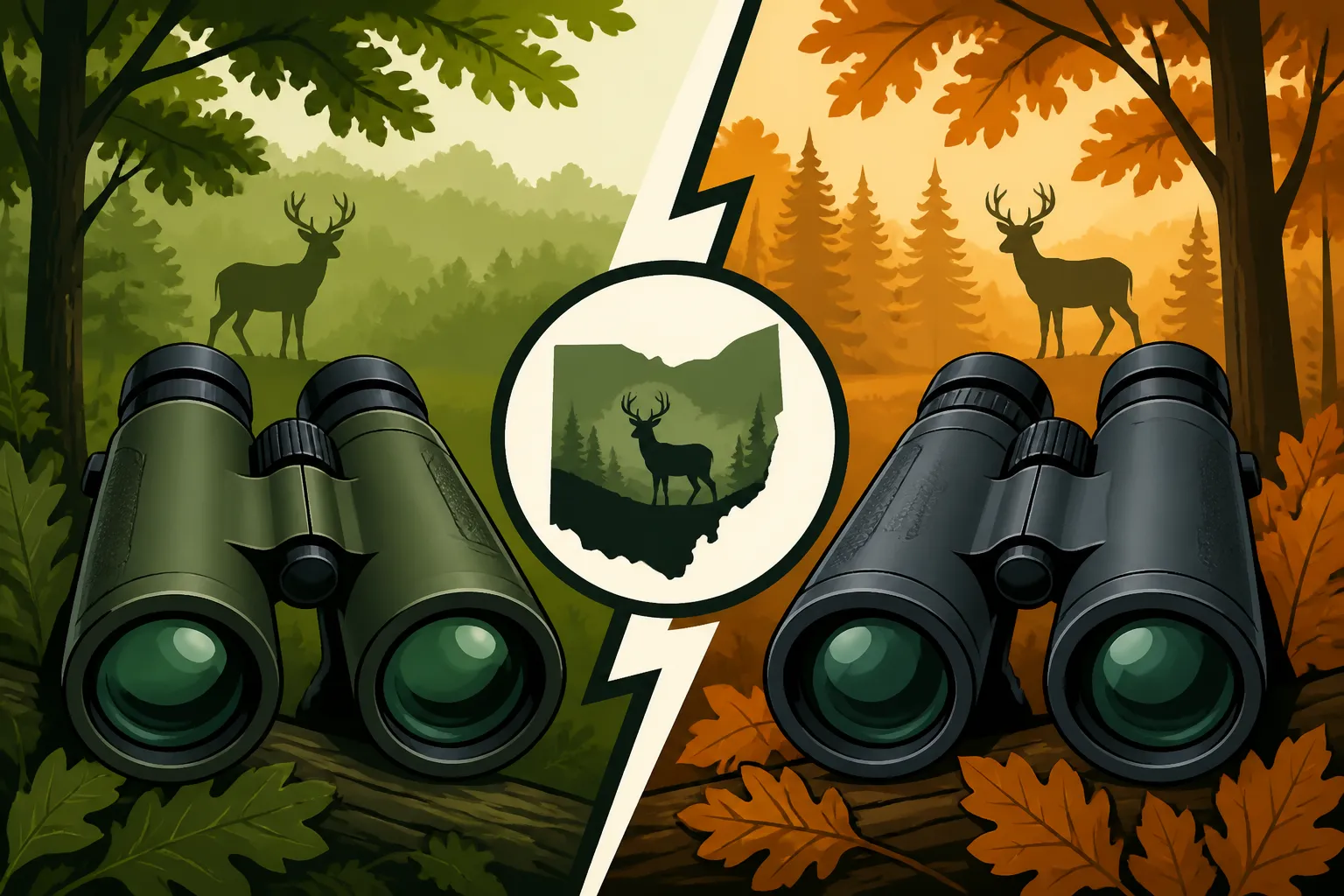
Choosing between an 8×42 and a 10×42 is less about one being inherently "better" and more about which one aligns best with your hunting environment and preferences. If you frequently find yourself hunting dense woodlands and prefer a stable, wide view for quickly spotting game, the 8×42 is likely your champion. However, if you're often glassing across vast Ohio farm fields or distant ridges, needing to resolve fine details at range, the 10×42 will give you that extra edge. My advice? If you can, try both in the field. Spend some time looking through them at different times of day, simulating your typical hunting conditions. You might be surprised at what feels right to your eyes and hands.
Disclaimer
This article is for general informational purposes only and does not constitute professional advice. Laws, prices and regulations vary by location and change over time. Consult a qualified professional for guidance on your specific situation.