Treeing a Raccoon With a GPS Collar
It’s a familiar scenario for any dedicated coon hunter in Ohio: the dogs strike a hot track, disappear into the inky blackness of a woodlot, and then… silence. Or maybe a distant bay, but you're left wondering if they've truly treed a raccoon, or if they're just cold-trailing a possum a mile away. The frustration of not knowing exactly where your hounds are, especially in dense cover or across unfamiliar terrain, can turn a promising night hunt into a stressful search party. This guide is all about embracing modern technology to eliminate that guesswork, showing you how a GPS collar system can revolutionize your night hunts and help you consistently find your treed raccoons in Ohio.
Why GPS Collars Are a Game Changer for Raccoon Hunters
For generations, coon hunting relied on the sound of the hounds, a good ear, and perhaps a trusty lantern. And while those core elements remain, the advent of GPS collar technology has brought a level of precision and safety that old-timers could only dream of. The primary pain point GPS collars address is the uncertainty of your dog's location and activity, particularly when they're out of earshot or deep in challenging Ohio terrain.
Eliminating the Guesswork of Location
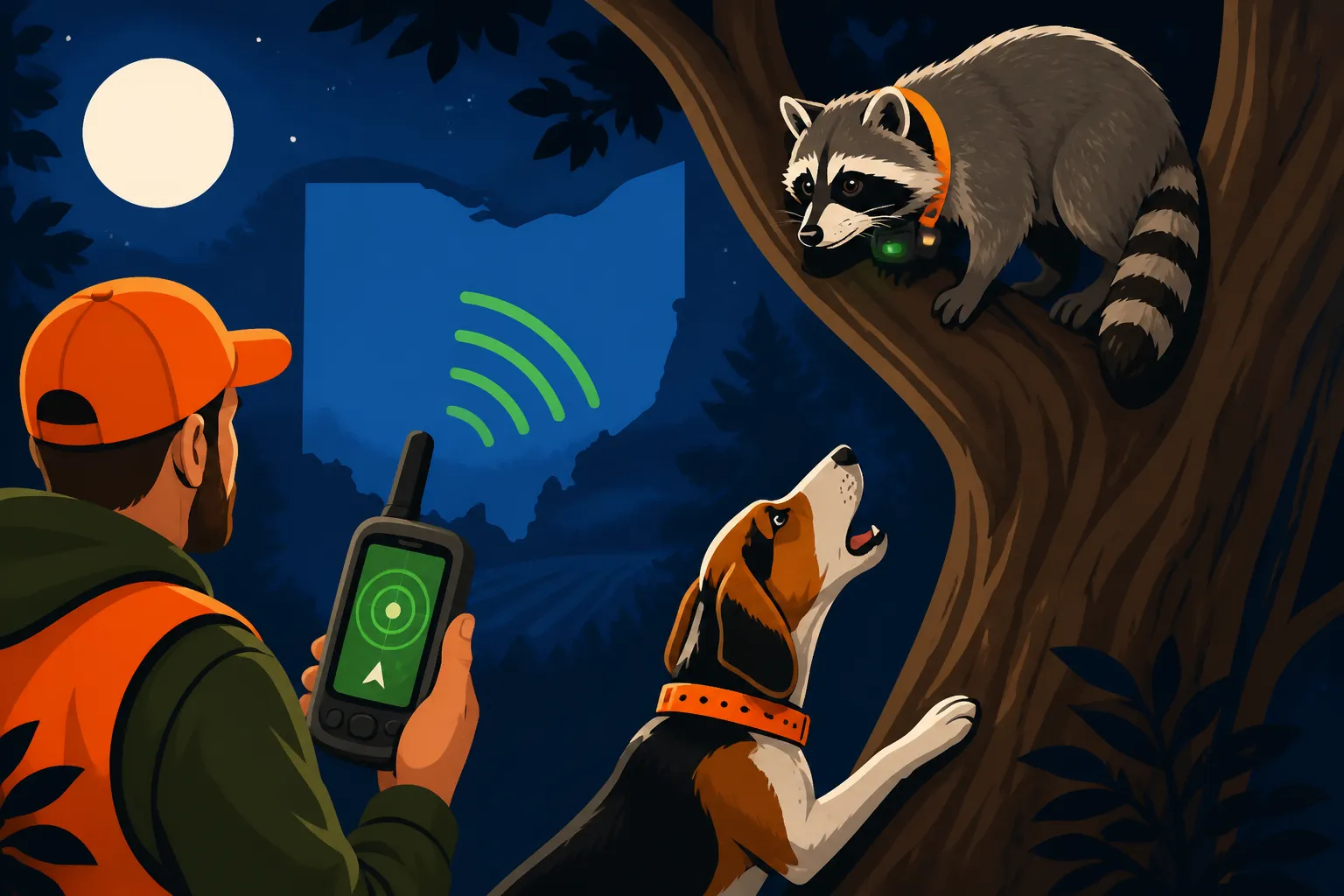
Imagine your best hound, a Bluetick named "Ol' Blue," takes off like a rocket into a thick stand of pines bordering an Ohio cornfield. You hear his chop mouth fade, then maybe a distant bay, then nothing. In the old days, you'd be following faint sounds, hoping for the best, maybe casting around for tracks in the dim light. With a GPS collar, that anxiety is immediately quelled. A glance at your handheld device instantly shows Ol' Blue's exact coordinates, how fast he's moving, and crucially, if he's "treed" – meaning stationary with a distinctive baying pattern that the collar can often detect and report. This capability isn't just a convenience; it's a profound change to the entire hunting experience, letting you focus on the hunt itself rather than constantly worrying about lost dogs. It helps you quickly identify if your hounds are on a fresh track or just wandering, saving valuable time and energy.
Enhancing Dog Safety and Recovery
Ohio's diverse landscapes, from the rolling Appalachian foothills in the southeast to the flat farmlands of the northwest, present various hazards for hounds. Roads, busy highways, deep ravines, private property lines, and even other nocturnal predators like coyotes can pose risks. A GPS collar significantly increases your ability to keep your dogs safe. If a dog crosses onto private land where you don't have permission, or gets too close to a road, you know instantly. More importantly, if a hound gets injured or stuck, perhaps in a thorny thicket or a creek bottom, you can pinpoint its location and reach it quickly. This peace of mind is invaluable, protecting your significant investment in your hunting partners and ensuring they return home safely after a night spent Running Hounds for Ohio Raccoon. In an emergency, knowing their exact location can be the difference between a swift recovery and a heartbreaking loss.
Optimizing Hunt Efficiency and Strategy
Beyond safety and location, GPS collars transform how you strategize your raccoon hunts. When you know where your dogs are and what they're doing in real-time, you can make smarter decisions about how to approach, when to push them further, or even when to call them back. For instance, if you're hunting near a river and one dog skirts the edge, you can anticipate its movement. If two dogs are treed a half-mile apart, you can prioritize which one to go to first based on terrain or other factors. Furthermore, many systems allow you to see other hunters' dogs (with their permission), which can prevent conflicts on public lands or coordinate efforts within a hunting party. This level of oversight allows you to adapt to the unpredictable nature of raccoon hunting with greater confidence and effectiveness, making every minute of your Raccoon Hunting at Night in Ohio more productive.
Choosing the Right GPS Collar System for Ohio Hunters
The market for GPS tracking systems for hunting dogs has grown considerably, offering a range of features and price points. Selecting the right system involves considering factors like range, mapping capabilities, battery life, and durability. The goal is to find a system that stands up to the rigors of Ohio's woods and fields while providing reliable tracking.
Understanding Key Features and System Types
When you're looking at GPS collar systems, you'll primarily encounter integrated units that combine a GPS receiver, a radio transmitter, and often an e-collar function, all linked to a handheld receiver. Leading brands like Garmin offer robust systems like the Alpha and Astro series, which have become industry standards.
- Range: This is critical. How far can your handheld receive a signal from the collar? Top systems boast ranges of several miles, crucial for when dogs range widely or in hilly terrain common in southeast Ohio. Walls, dense foliage, and terrain can impact real-world range, so always err on the side of more.
- Mapping: The best systems come with preloaded topographic maps or allow you to download detailed satellite imagery. This is incredibly helpful for navigation in unfamiliar areas, identifying property lines, and understanding the terrain your dogs are covering. Some systems, like the Garmin Alpha, integrate with apps like Garmin Explore, allowing you to plan routes and review hunts.
- Battery Life: Night hunting means long hours in the dark. Collars and handhelds need excellent battery life, ideally lasting 20-40 hours on a single charge. Look for systems with rechargeable batteries and consider carrying spare battery packs for your handheld.
- Durability and Waterproofing: Coon hunting is tough on gear. Collars must be rugged, impact-resistant, and fully waterproof to withstand creek crossings, mud, and harsh weather. Handhelds also need to be built to take a beating and survive an accidental drop in the muck.
- E-Collar Functionality: Many GPS systems include remote training features, offering tone, vibration, and static stimulation options. This allows for immediate communication with your dogs, whether for corrections, recall, or encouraging them to move in a certain direction. While not strictly for locating treed coons, it's an invaluable tool for overall dog management in the field.
- Multiple Dog Tracking: If you run a pack, ensure the system can track multiple collars simultaneously. Most modern systems can track up to 20 dogs, displaying each on the map with a unique icon.
For hunters looking to purchase new gear or understand the latest technology, a reputable source like a local hunting supply store or even outdoor lifestyle sites where hunters share gear reviews can be beneficial. Many hunters research on platforms like GoHunt before making a significant investment, seeking real-world feedback on what performs best in conditions similar to Ohio's Raccoon Season Opening Night.
Comparing Popular GPS Collar Systems
Let's look at some popular options and what they offer. This table provides a general overview, but specific models within each series will have varying features.
| Feature | Garmin Alpha Series (e.g., Alpha 200i) | Garmin Astro Series (e.g., Astro 430) | Budget/Basic GPS (e.g., SportDOG TEK 2.0) |
|---|---|---|---|
| Primary Function | Tracking + Training (E-collar) | Tracking Only (E-collar on some) | Tracking + Training (E-collar) |
| Mapping | Detailed Topo/Satellite (via inReach/app) | Basic Topo/Satellite | Basic Topo/Satellite |
| Live Tracking Update | 2.5 seconds | 2.5 seconds | 2.5 seconds |
| Max Dogs | Up to 20 | Up to 20 | Up to 21 |
| Range | Up to 9 miles | Up to 9 miles | Up to 10 miles |
| Battery Life (Collar) | ~20-40 hours | ~20-40 hours | ~24 hours |
| Connectivity | GPS, GLONASS, Galileo, inReach | GPS, GLONASS | GPS, GLONASS |
| "Treed" Alerts | Yes | Yes | Yes |
| Price Point | High | Mid-High | Mid-Range |
Note: Features and specific models change frequently. Always check the latest specifications before purchasing.
When evaluating these, consider where and how you typically hunt. If you're often in areas with poor cell service (which is common in remote parts of Wayne National Forest Hunting areas), an integrated system with robust offline mapping and satellite communication (like Garmin's inReach-enabled Alpha models) might be invaluable. For those hunting smaller, more open woodlots in Ohio's farmlands, a slightly less expensive unit might suffice. Regardless of your choice, ensuring the system can handle the wet, muddy, and often freezing conditions of an Ohio night hunt is paramount.
Training Your Hounds with GPS Collars
Introducing GPS collars to your hounds isn't just about snapping them on and hitting the woods. For optimal performance and your dog's comfort, a thoughtful introduction and integration into your training regimen are crucial. Just like any new piece of gear, acclimating your dogs to the collar and understanding its features is key to success in the field.
Acclimation and Initial Introduction
Start by simply having your dogs wear the collar without activating the GPS or e-collar functions. Let them wear it around the house for short periods, gradually increasing the time. The goal is for the collar to become a normal, non-threatening part of their gear. Once they're comfortable, take them on short walks with the collar on, praising them for ignoring it. If your system has e-collar functions, avoid using them during this initial phase. The last thing you want is for the dog to associate the new collar with an unpleasant sensation. Many hunters recommend doing this during the off-season, long before Ohio Raccoon and Fox Season Dates arrive, so the dogs are fully accustomed. This also builds their confidence in the equipment, a crucial step for any hunter who values their dog's well-being.
Integrating GPS into Your Training Routine
Once your dogs are comfortable wearing the collars, begin using the tracking functions during daylight training sessions. Take them to familiar areas where you can observe their reactions and monitor the handheld's display. Practice calling them back and using the e-collar (if applicable) for standard obedience commands while they are wearing the GPS unit. This helps them associate the collar with your commands and positive reinforcement.
For "treed" specific training, you can set up simulated scenarios. Place a caged raccoon or a treed hide in a controlled environment and let your dogs find it. Observe how the GPS system registers the "treed" status and how the collar's alert features work. When they perform correctly, praise them lavishly and reward them. This reinforces the desired behavior and helps them understand that "treeing" while wearing the collar leads to good outcomes. Over time, this consistent positive reinforcement will strengthen the dog's association with the collar and its function in hunting, preparing them for the real deal. Many find resources on GoHunt helpful for advanced training tips and connecting with experienced houndmen who can offer practical advice.
Common Training Challenges and Solutions
Even with careful introduction, challenges can arise. Some dogs might initially try to chew or scratch at the collar. Ensure the collar fits snugly but not too tightly, preventing it from dangling or rubbing uncomfortably. Distraction techniques, like playing fetch or offering treats when they're wearing it, can help divert their attention.
Another common challenge is ensuring the dogs respond to e-collar commands consistently while wearing the GPS unit. This is why integrating it into existing obedience training is key. Start with low stimulation levels and gradually increase only if necessary, always pairing it with a verbal command or tone. The goal isn't punishment, but communication. If a dog is struggling with distractions or ignoring commands, consider working in a less stimulating environment initially. Remember, the GPS collar is a tool to enhance your existing training, not replace it. Consistency, patience, and positive reinforcement are your greatest allies in preparing your hounds to effectively use this technology on your next Raccoon Hunting at Night in Ohio adventure.
Real-World Application: Hunting with GPS Collars in Ohio
With your hounds acclimated and your GPS system dialed in, it's time to put it to the test in the diverse hunting grounds of Ohio. From the dense woods of Shawnee State Forest to the sprawling agricultural lands of Northwest Ohio, applying GPS collar technology effectively requires understanding local conditions and regulations.
Navigating Diverse Ohio Terrain with Confidence
Ohio offers a wide array of hunting environments, each presenting unique challenges for coon hunters.
- Appalachian Foothills (Southeast Ohio): Areas like Hunting Southeast Ohio Appalachian Foothills are characterized by steep ravines, thick timber, and winding creek bottoms. Here, a strong GPS signal is paramount. Hounds can quickly get out of earshot, and the rugged terrain makes physical tracking difficult and often dangerous in the dark. GPS collars allow you to monitor your dog's progress through these challenging landscapes, identify when they’ve reached a tree on a steep hillside, and plan the safest, most efficient route to reach them. Without GPS, searching for a treed coon here could involve hours of strenuous hiking, potentially in the wrong direction.
- Farmland Woodlots (Northwest Ohio): In areas like Hunting Northwest Ohio Farm Country, dogs might range across vast open fields before finding a treed coon in a small woodlot or fencerow. While visibility might be better in open areas, the risk of dogs encountering roads or private property is higher. GPS allows you to quickly see if a dog is approaching a boundary or a busy road, giving you time to intervene using e-collar commands if your system has them. The "treed" alert function becomes invaluable here, as the baying might not carry far across open fields.
- Marsh and River Bottoms: Hunting near water bodies like those found in Hunting the Ohio River Backwaters or along Ohio’s many rivers presents its own set of challenges, including wet ground, dense undergrowth, and the risk of dogs crossing waterways. Waterproof and durable collars are non-negotiable here. GPS helps you track your dogs across flooded timber or through dense cattails, ensuring you know they are safe and haven't gotten into trouble.
Essential Tips for GPS Collar Use in the Field
Beyond just tracking, there are several practical considerations to make your GPS collar experience smooth and successful:
- Battery Management: Always start with fully charged collars and handhelds. Carry portable power banks to recharge your handheld device on longer hunts. Some hunters keep an extra set of charged batteries for collars, especially during colder weather when battery life can be diminished. Nothing ruins a hunt faster than a dead battery when your dog is treed deep in the woods.
- Regular Software Updates: GPS systems, like smartphones, receive software updates. Ensure your handheld and collars are always updated to the latest firmware for optimal performance and bug fixes.
- Practice with Your Handheld: Before a hunt, practice navigating the menus and functions of your handheld. You don't want to be fumbling with controls in the dark when a dog is treed. Familiarize yourself with how to mark waypoints, zoom in/out, and interpret the various dog status icons.
- Communication with Hunting Partners: If you hunt with a group, ensure everyone understands the GPS system. Many systems allow you to share dog data with other compatible handhelds, enhancing coordination during a hunt. Knowing how to use these features allows for more effective Deer Drives With Three or Four Hunters or coon hunts where dogs might split up.
- Local Regulations: Always double-check Night Hunting Rules for Ohio Coyotes, as general night hunting regulations might apply to raccoons. While GPS collars are generally legal and widely accepted, it's good practice to be aware of any specific rules that might pertain to electronic devices or dog training.
Overcoming Challenges: Signal Loss and Troubleshooting
Even the best GPS systems can encounter issues. Signal loss can occur in deep ravines, under heavy canopy, or near strong electrical interference. If you lose a dog's signal:
- Move to Higher Ground: Sometimes, simply moving to a ridge or a clearing can re-establish the signal.
- Check Battery Status: A low collar battery is a common culprit for signal loss.
- Use the Directional Antenna: Many handhelds have a directional antenna you can extend or rotate to help pinpoint a faint signal.
- Backtrack: Go back to the last known location of the dog, which the GPS unit often records. This helps narrow down the search area.
- Listen Actively: Even if the GPS is down, your ears are still your best tool. Listen for distant bays or chops.
Adopting GPS collar technology for raccoon hunting in Ohio isn't about abandoning tradition; it's about embracing tools that make the hunt more effective, safer, and ultimately, more enjoyable for both you and your loyal hounds. With proper setup, training, and a good understanding of your hunting grounds, you'll be able to confidently tree raccoons all season long.
Disclaimer
Hunting is an inherently dangerous activity. Always prioritize safety, adhere to all local, state, and federal hunting regulations, and ensure you have the necessary licenses and permits. The information provided here is for educational and informational purposes only and should not replace professional guidance or personal judgment. Be aware of your surroundings, know your equipment, and consider taking a hunter education course.