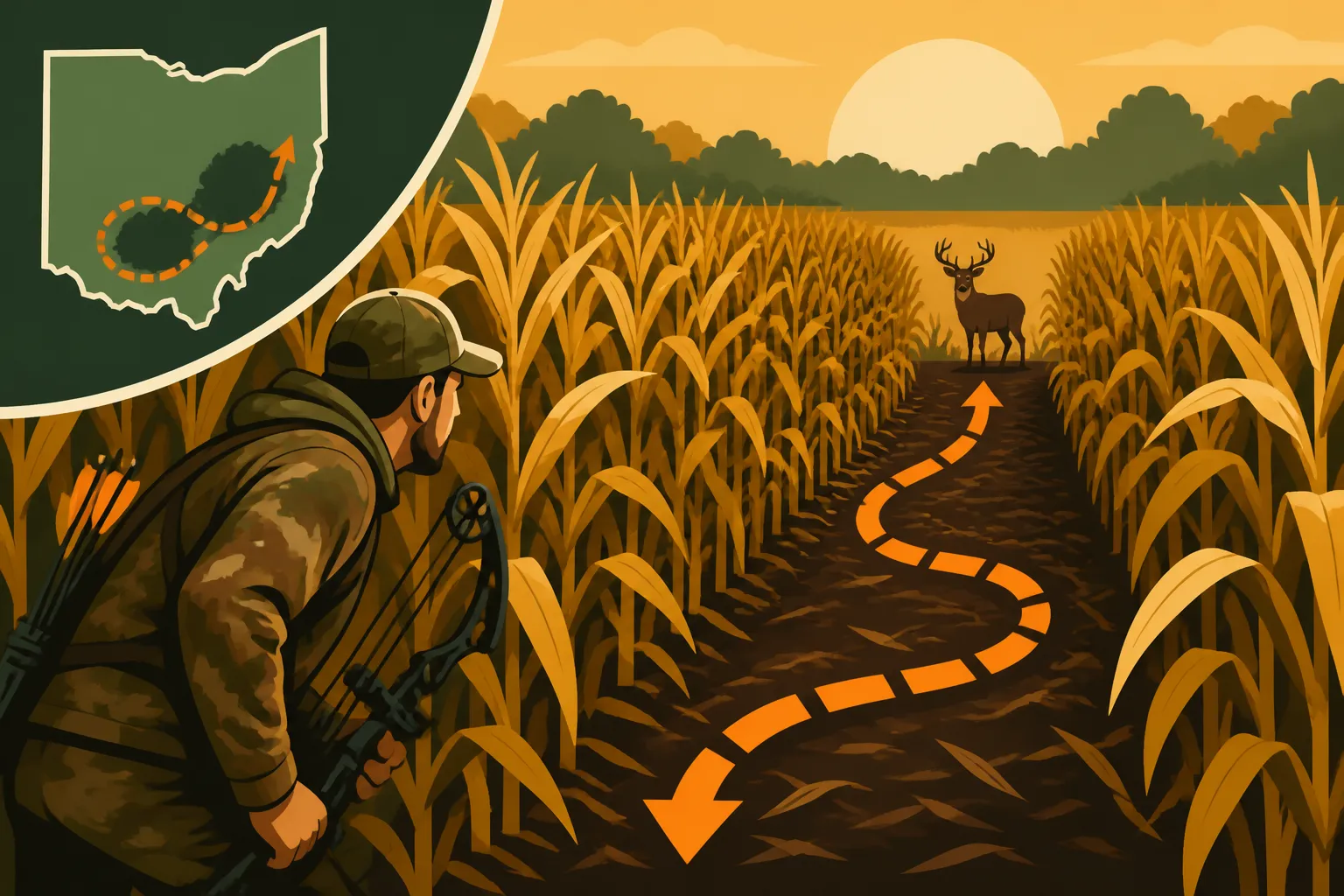
Entry Routes Through Standing Corn
There’s nothing quite like the sight of a mature Ohio cornfield in late summer or early fall – rows upon rows of towering green stalks, rustling gently in the breeze. As a deer hunter, your heart leaps, because you know those deer are in there, living it up, practically invisible. But that joy quickly turns to frustration, right? Because getting into that impenetrable fortress, finding the deer, and setting up without blowing them out of the county feels like trying to walk through a minefield blindfolded. This guide is all about tackling that exact challenge, breaking down how to scout, plan, and execute successful entry routes through standing corn, turning a potential deer haven into your hunting advantage.
The Irresistible Allure and Frustrating Fortress of Standing Corn
Ohio's agricultural landscape is a hunter's dream, offering an abundance of food and cover that whitetails simply can't resist. And when it comes to combining those two critical elements, nothing beats a standing cornfield. For hunters, though, this blessing can quickly become a significant tactical hurdle.
Why Ohio Whitetails Love Standing Corn
Imagine being a deer: endless calories right at nose level, combined with a dense, visually impenetrable canopy that offers safety from predators and hunters alike. That's a standing cornfield. It's not just a food source; it's a sanctuary, a bedroom, and a highway all rolled into one. Bucks will often bed down deep inside the corn, especially mature ones who’ve learned to avoid pressure, using the thick cover to disappear during daylight hours. Does and fawns find security and nourishment, making it a primary draw for much of the hunting season. This is particularly true in areas where hardwood timber might be scarce, pushing deer to rely heavily on agricultural crops for sustenance and concealment. If you've ever wondered about the overall health of the deer population, understanding how they utilize these resources is key. We've got a whole guide on the Ohio Deer Herd Size that really puts it into perspective.
In regions like Northwest Ohio, where vast expanses of farmland dominate the landscape, standing corn becomes the lifeblood for whitetails. These deer adapt to agricultural cycles, treating cornfields as their primary refuge. They know the rhythm of the farm, and they know how to melt away into the stalks at the first hint of danger. It’s no wonder so many hunters focus on Hunting Northwest Ohio Farmland Deer, as the strategies for these areas are unique.
The Hunter's Cornfield Conundrum
So, we know they're in there. That's the easy part. The hard part is figuring out how to get to them. Standing corn presents a multitude of challenges that can make a hunter feel utterly defeated:
- Noise: Every step feels like a drumbeat. Stalks snap, dry leaves rustle loudly, and even the slightest brush against your clothing can send sound echoing through the rows. This is perhaps the biggest frustration, as stealth is paramount in deer hunting.
- Visibility: You can see maybe 5-10 yards, if you're lucky. This limited sightline means you might walk right past a deer without ever knowing it, or worse, spook one at close range you never saw coming.
- Wind Swirls: While a consistent wind direction is your best friend in open timber, within the labyrinth of a cornfield, wind can swirl unpredictably. This means scent can be carried in multiple directions, easily betraying your presence to a bedded deer.
- Navigation: What seems like a straight line can quickly become a disorienting maze. Unless you're using a GPS or a mapping app, it's incredibly easy to get turned around, waste precious hunting time, and even get lost, especially in the dark.
- Exit Strategy: Just as important as getting in, how do you get out after a hunt, especially if you've harvested a deer, without alerting every other deer in the field to your presence?
These challenges lead to countless blown hunts and leave many hunters scratching their heads, wondering if entering a standing cornfield is ever truly worth the risk. But with careful planning and execution, it absolutely can be.
Mastering the Art of Scouting and Planning Your Cornfield Entry
Successfully hunting deer near or within standing corn isn't about luck; it's about meticulous scouting and strategic planning. You can't just dive in headfirst and hope for the best. You need a game plan that accounts for deer movement, wind, and your own stealth.
Unlocking Secrets with Aerial Recon and Topography
Before you even step foot on the ground, modern mapping tools are your absolute best friend. Forget the old paper maps; we're talking about sophisticated apps that bring satellite imagery right to your fingertips. Platforms like GoHunt offer incredible detail that can reveal hidden features you'd never see from the ground.
- Finding Natural Corridors: Zoom in on that cornfield. What do you see? Often, farmers will leave unplanted strips, drainage ditches, old fencerows, or even small, neglected woodlots within or bordering the corn. These are your golden tickets. Deer will almost always prefer to travel along these natural breaks rather than push through dense stalks. They provide slightly easier movement, sometimes better visibility, and a consistent path. Look for ditches, especially if they have some cover like weeds or brush growing in them.
- Identifying "Islands" and Peninsulas: Sometimes, small patches of timber or brush are completely surrounded by corn. These "islands" are often prime bedding areas, and the narrow strips of corn leading to them (peninsulas) can act as natural funnels. Similarly, a finger of woods that juts into a cornfield is a high-traffic area.
- Analyzing Field Edges and Transitions: Pay close attention to where the cornfield meets other types of cover—a woodlot, a CRP field, a creek bottom. These transition zones are where deer often enter and exit the corn, offering concentrated points of activity.
- Using Topographical Features: Even in relatively flat farm country, subtle elevation changes can create pinch points or travel corridors. A slight rise or dip might be enough to encourage deer to move along a specific line. While often discussed in the context of big woods, learning to Read Aerial Photos for Southeast Ohio Deer offers valuable insights into identifying such features, applicable even to flatter agricultural areas.
Remember to cross-reference your ground scouting with satellite imagery on platforms like GoHunt to get a complete picture. Many hunters utilize the detailed satellite views offered by GoHunt to uncover these critical, subtle terrain features that can make or break a hunt. Another great tool for understanding property boundaries and access is using onX Layers for Ohio Land Status, which can highlight if those promising ditches are still on huntable land.
Ground Truthing: What the Dirt Tells You
Once you've identified potential entry points and travel corridors from above, it's time to put boots on the ground. This part is crucial, but timing is everything to avoid educating deer.
- Pre-Season Recon: Ideally, you want to do as much ground scouting as possible before the season opens, when deer pressure is minimal. Walk the edges of the cornfield, looking for well-used trails leading into the stalks. Look for tracks, scat, and rubs, especially where a natural corridor merges into the corn.
- Mid-Day Lull Scouting: During the season, if you need to ground scout, do it during the middle of the day (10 AM to 2 PM), when deer are typically bedded and less likely to be disturbed. Stick to the very edges of the field or walk just inside a known natural travel lane.
- Focus on the "Highways": Deer are creatures of habit. They will take the path of least resistance. Your goal is to find their established "highways" or create a path of least resistance for yourself that mirrors theirs. Look for areas where the corn stalks are pushed over or bent, indicating heavy traffic. Fresh tracks in soft dirt within a ditch are a dead giveaway.
- Scout for Pressure: Pay attention to human sign as well. Are there other boot prints? Blinds set up? If a specific entry point is heavily pressured, you might need to find a less obvious alternative. Sometimes, finding ground that others walk past is the secret to success. This is a critical aspect of Scouting Ohio Public Land Before Season.
The Unpredictable Wind and Thermals in a Cornfield
Wind direction and thermals are always important, but they become even more complex and critical when navigating standing corn.
- Understanding Wind Behavior: Tall corn stalks act like a dense forest, disrupting consistent wind patterns. The wind can swirl, eddy, and change direction within the field, even if it's blowing steadily in one direction above the stalks. This is where your careful planning comes in.
- Predicting Swirls: While exact prediction is tough, certain features can cause predictable swirls. Ditches or depressions can funnel wind or create pockets of still air. The interface where the corn meets a solid wood line can also create swirling effects.
- Utilizing Wind Mapping Tools: This is another area where a good mapping app with wind overlays truly shines. Platforms like GoHunt allow you to input various wind directions and see how they might affect scent dispersal based on terrain. Pay close attention to historical patterns and real-time forecasts. The advice for predicting Wind and Thermals on an Appalachian Ridge might seem specific, but the principles of understanding how terrain impacts air movement are universally applicable.
- The Scent Cone: Your goal is always to approach from downwind or crosswind, ensuring your scent cone is carried away from where you expect deer to be. In a cornfield, this often means walking into the field along a distinct lane, with the wind carrying your scent across, not down, the rows. If the wind is inconsistent or swirling, reconsider your entry or wait for better conditions.
Executing a Stealthy Approach Through the Stalks
Okay, you've done your homework. You've identified a promising entry point, checked the wind, and got a general idea of where you want to go. Now comes the execution – the walk-in. This is where many hunts are won or lost.
Timing and Conditions: Your Allies in Stealth
Choosing the right moment to make your move into the corn is just as important as choosing the right path.
- Pre-Dawn Darkness: For morning hunts, arriving well before first light is ideal. The cool, damp air of pre-dawn can help muffle sounds, and deer are less likely to be actively feeding or moving in the deepest parts of the corn. You want to be settled in your stand or blind at least 30 minutes before shooting light.
- Mid-Day Lull: If you're planning an afternoon or evening hunt, entering the corn during the mid-day lull (10 AM to 2 PM) can be effective. Deer are typically bedded down then, making them less prone to spooking, though they'll still be alert. This is a good time to adjust a stand or still-hunt deeper into the field.
- Leverage Adverse Weather: This is perhaps the best time to enter standing corn.
- Rain: A steady, light rain is a hunter's dream for stealth. It dampens sound, washes away scent, and often keeps deer bedded and less vigilant.
- High Winds: A strong, consistent wind (say, 15-20 mph) can provide incredible cover for your movement and sound. The rustling of the corn stalks can completely mask your footsteps. Just be mindful of wind direction and swirling, as discussed earlier.
- Snow: Fresh, light snow also dampens sound and can make tracks easy to follow, aiding in navigation and confirming deer presence. However, heavy snow can make moving through corn extremely difficult.
- Avoid Frosty Mornings: As beautiful as a frosty morning is, walking through frosted corn stalks is like walking through a bag of potato chips. Every movement will be amplified, sending deer scattering. Wait until the frost melts before attempting a deep entry.
Gear and Movement: Becoming a Ghost
Your gear and how you move are paramount to success in a noisy environment like a cornfield.
- Quiet Clothing: This cannot be stressed enough. Ditch anything that crinkles, rustles, or makes noise when you move. Wool, fleece, or quiet soft-shell materials are your best options. Layer up for warmth, but prioritize quietness. Think about how important quiet gear is when on a long hike in the woods; the same applies here. A good day pack, like those used for Packs for a Day on Wayne National Forest, should also be quiet and streamlined.
- Footwear: Choose soft-soled boots that allow you to feel the ground and place your feet precisely. Avoid heavy, clunky boots. Rubber boots are often a good choice as they reduce scent transfer and are quiet on damp ground.
- Slow and Deliberate Steps: This is the golden rule. Take each step slowly, deliberately, and with purpose. Don't lift your feet high; shuffle them slightly to avoid snapping stalks. Place your foot down softly, testing the ground for hidden obstacles or dry, crunchy leaves before committing your weight. Imagine stalking a wary buck in open timber; that's the pace you need.
- The "Cornfield Shuffle": When moving through the stalks, try to glide rather than stomp. If you encounter dense sections, gently push stalks aside with your hands, rather than bursting through them. Sometimes, creating a small, quiet path as you go can be more effective than forcing your way through.
- Minimize Gear Clanking: Secure everything in your pack. Make sure your bow, rifle, or any accessories aren't clanking against each other. Use tape or felt pads if necessary. Your rangefinder, grunt tube, and rattling antlers should be silenced.
Utilizing Natural Features: Sticking to the Path
Your pre-scouted natural corridors are your best bet for a silent entry.
- Ditches and Waterways: These are often the quietest paths. The ground is usually softer, and the banks can provide some visual concealment. Walk in the ditch, staying low if possible.
- Old Fencerows/Unplanted Strips: These offer open lanes. While they might still have weeds or stubble, they are infinitely quieter than pushing through dense corn.
- Field Edges within the Corn: If you're targeting a deer that's using an "island" of timber within the corn, or a peninsula of woods, approach along the edge of that timber, using its cover as you move.
- Using Existing Deer Trails: If you've found a heavily used deer trail into the corn, consider using it. Deer have already created a path, and it will likely be quieter than breaking new ground. Just be extra vigilant, as these are also high-traffic areas for deer.
By combining meticulous planning with a deliberate, stealthy approach, you dramatically increase your chances of reaching your hunting spot within or adjacent to standing corn without alerting the deer you're pursuing.
Adapting to Different Hunting Scenarios in Standing Corn
The tactics for entering a cornfield will naturally shift depending on whether you're carrying a bow or a firearm, and whether you're hunting solo or with a group. Each method has its own set of advantages and challenges that need to be considered when planning your entry.
Bowhunting Strategies: Close-Range Stealth and Precision
Bowhunting in or around standing corn is a high-stakes game. You need to get close, remain undetected, and have a clear shot lane.
- Shorter Penetration, Higher Stealth: Generally, bowhunters shouldn't try to penetrate too deeply into a massive cornfield unless there's a very specific, pre-scouted internal feature like a woodlot or a wide ditch. Your effective range is shorter, so your setup needs to be closer to where you expect deer to be. Focus on the first 50-100 yards of the cornfield from a known bedding or feeding area, or where it meets another cover type.
- Internal Edges and "Islands": The most effective bowhunting spots are often where an "island" of timber or a finger of woods juts into the corn. Setting up a treestand or ground blind on the inside edge of this timber, overlooking the corn, is a prime tactic. Deer often filter out of the deep corn and follow these edges. Detailed guides on Treestand Setups in Appalachian Ohio Hardwoods offer foundational knowledge that can be adapted, focusing more on field edge trees than deep timber.
- Ground Blinds for Corn: A well-brushed-in ground blind can be incredibly effective right on the edge of the corn, or even slightly inside if you can find a suitable natural opening or create a small, quiet lane. The blind provides excellent concealment and helps contain your scent. Learning about Using a Ground Blind on Ohio Public Land can give you an edge, focusing on how to make it blend seamlessly with the cornfield environment.
- Shot Lanes: Crucially, with a bow, you must have clear shot lanes. This means you might need to carefully trim a few stalks in front of your stand or blind, well in advance of your hunt, if permitted. Don't wait until the day of the hunt to do this, as the noise will blow your cover.
- The Exit: With a bow, a silent exit is critical. If you spook deer coming out, they'll be much warier the next day. Plan your exit route just as meticulously as your entry, often along the same stealthy path.
Gun Hunting Strategies: Depth and Drives
Gun hunters have a bit more flexibility in terms of range, but stealth and planning remain paramount, especially for still-hunting or stand hunting.
- Deeper Penetration (Still-Hunting/Stand Hunting): With a straight-wall rifle or shotgun slug gun, you can comfortably take shots out to 150-200 yards, sometimes more. This allows you to set up further inside a cornfield, perhaps overlooking a wider internal clearing or intersection of deer trails. However, the same rules of quiet entry apply. You still need to minimize noise and scent.
- Deer Drives in Corn: For a large standing cornfield, a well-coordinated deer drive can be highly effective, but it requires careful planning and a good number of hunters.
- The Setup: "Standers" need to be positioned strategically at the downwind end of the field, or along known escape routes (like where the corn meets a woodlot or fencerow). These positions need to be scouted well in advance, and standers need to get in quietly and early.
- The Push: "Drivers" enter the cornfield from the upwind side, walking slowly and systematically through the rows, pushing deer towards the standers. The key is a slow, methodical push, allowing deer to move naturally rather than bursting out in a panic. Loud noises should be controlled – too much noise too early can send deer running in random directions, too little and they might just bed down.
- Safety: Communication is critical. Everyone needs to know where everyone else is, and safe shooting lanes must be established. This is an advanced tactic and something covered in more detail in guides like Deer Drives With Three or Four Hunters. It's not for the faint of heart or the unorganized.
- Post-Harvest Hunting: Don't forget the cornfield even after it's cut! The stubble field still offers residual food, and the adjacent cover (woodlots, fencerows) becomes even more important for deer movement. Scouting for Late-Season Food Sources for Ohio Whitetails is crucial once the combine has gone through.
The All-Important Exit Strategy
Regardless of your weapon choice or hunting method, your exit strategy is just as vital as your entry. A sloppy exit can ruin future hunts by educating deer to your presence.
- Reverse Your Entry: Whenever possible, use the same stealthy path you used to enter. Deer have a short memory for minor disturbances, but a repeated, noisy exit will quickly make them nocturnal in that area.
- Wait for Darkness (If Necessary): If you've had a particularly active sit and deer are still moving around you, sometimes the best strategy is to wait until full dark before quietly slipping out. The cover of night can provide the best concealment for both sound and sight.
- Deer Recovery: If you've harvested a deer, the recovery process can be challenging in deep corn. Mark your spot meticulously, and use a GPS to aid in tracking. A bright, steady light (or even a thermal imager, where legal) can be invaluable. Recovering a deer from a cornfield requires patience and methodical grid searching if the blood trail is sparse.
By understanding these nuances and adapting your approach, you can transform the daunting challenge of standing corn into one of your most productive hunting opportunities in Ohio.
| Entry Route Type | Pros | Cons | Ideal Conditions |
|---|---|---|---|
| Ditch/Waterway | Excellent noise reduction, natural concealment, scent funneling | Can be muddy, might require getting wet, limited setup options | Wet weather, light rain, consistent crosswind |
| Old Fencerow/Unplanted Strip | Clear path, often less noisy, provides some visual break | Can be choked with weeds, may have less consistent cover | Dry conditions, light snow, consistent wind |
| Woodlot Edge (Internal) | Great cover for setup, natural travel corridor, ambush point | Can still be noisy to get to the edge through corn, limited locations | Any consistent wind, bowhunting, evening sit |
| Directly Through Rows | Most direct path to deep cover (if necessary) | Extremely noisy, poor visibility, high risk of spooking deer | High winds (15+ mph), heavy rain, emergency only |
Remember, no single strategy works every time. The most successful Ohio hunters are those who are adaptable, patient, and willing to learn from every experience in the field.
Disclaimer
Hunting is an inherently dangerous activity. Always prioritize safety, understand and follow all Ohio hunting regulations, and ensure you are familiar with your equipment. This guide provides general information and should not replace professional training or expert advice. Always hunt responsibly and ethically.