First Focal Plane Versus Second
One of the most common dilemmas many Ohio hunters face when eyeing up a new rifle scope, especially for those challenging shots across varying distances, is trying to figure out the difference between a first focal plane (FFP) and a second focal plane (SFP) reticle. It's not just a fancy technical term; it directly impacts how you acquire targets, make holdovers, and ultimately, whether you connect with that buck across a bean field or that coyote darting through the hardwoods. This guide is here to untangle the complexities, explaining exactly what each type of reticle means for your hunting experience right here in the Buckeye State.
Understanding the Basics: What are Focal Planes Anyway?
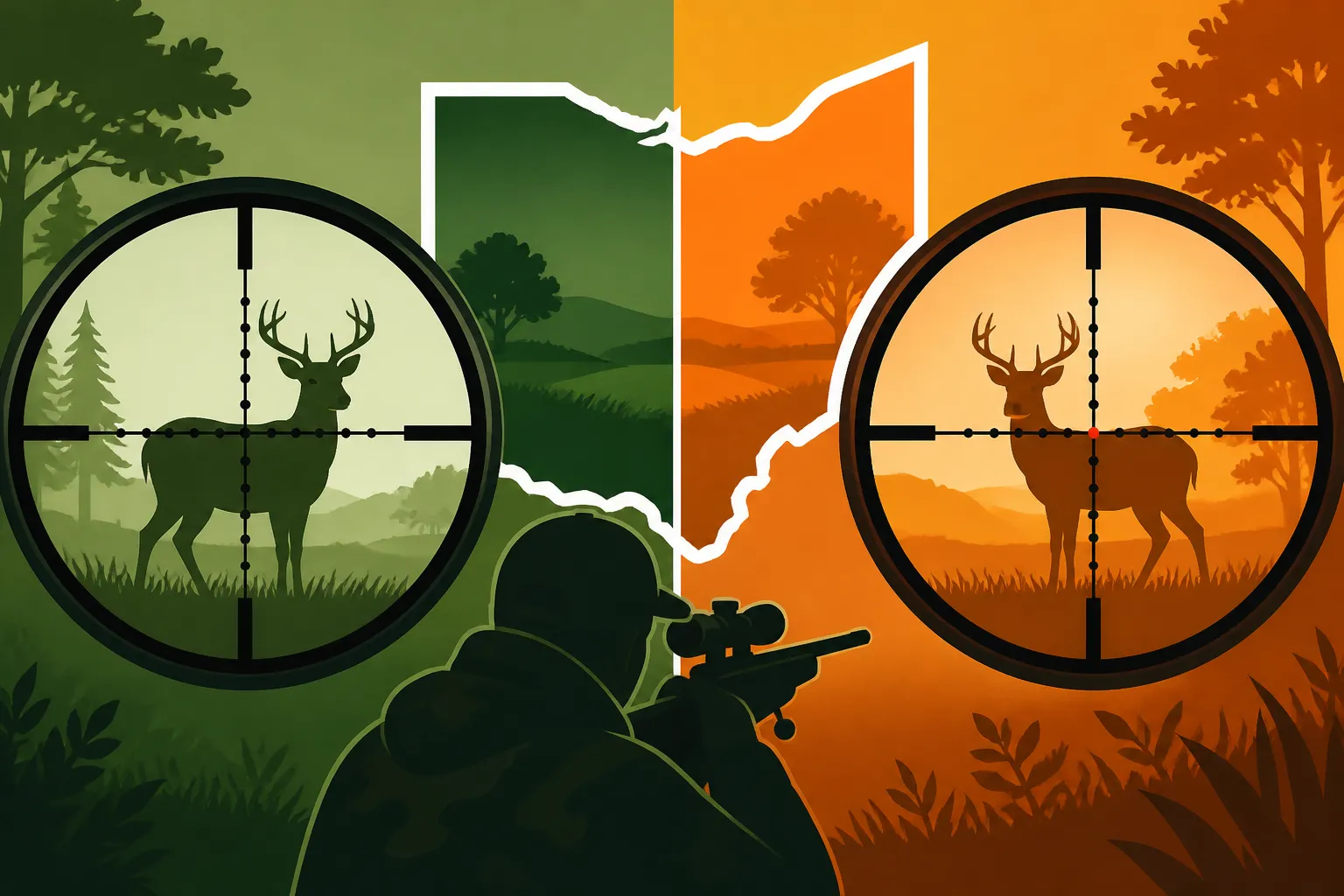
Before we dive into the nitty-gritty of FFP versus SFP, it’s helpful to understand the basic mechanics of how a rifle scope works. Think of your scope as a series of lenses that magnify an image and place a reticle (that crosshair or aiming point) over it. The critical distinction between FFP and SFP lies in where that reticle is positioned within the optical system. This placement dictates how the reticle appears and behaves as you adjust the scope's magnification.
The Reticle's Purpose
At its core, a reticle serves as your aiming point. But modern reticles are often much more than just simple crosshairs. Many include hash marks, dots, or elaborate Christmas tree patterns designed to help you compensate for bullet drop at longer distances (holdovers) and wind drift without having to physically adjust your turrets. This is especially useful in situations where a quick follow-up shot might be needed, or when game doesn't give you time to dial. For Ohio hunters pursuing deer, coyotes, or even groundhogs, these ballistic reticles can be incredibly valuable tools. Understanding their full potential, however, depends heavily on whether your scope is FFP or SFP.
Where the Reticle Sits
In a rifle scope, there are two main focal planes where a reticle can be placed: the first focal plane, which is positioned in front of the magnification assembly, and the second focal plane, which is located behind it. This might sound like a minor technical detail, but it profoundly changes how you interact with your reticle, particularly when you're zooming in or out. The optical system of a variable power scope essentially moves lenses around to change magnification, and depending on which side of this moving assembly your reticle lives, it will either grow and shrink with the image (FFP) or remain a constant size (SFP). This fundamental difference is what leads to the unique advantages and disadvantages of each type for various hunting scenarios.
First Focal Plane FFP: The Reticle That Grows
Imagine looking through your scope and as you dial up the magnification, not only does your target get bigger, but the reticle itself appears to grow proportionally. That's the essence of a first focal plane scope. The reticle is placed in front of the erector system (the part that moves to change magnification), meaning it magnifies along with the image. This feature has become increasingly popular, particularly among long-range shooters and tactical users, but its benefits are undeniable for certain hunting applications here in Ohio as well.
How FFP Reticles Work
With an FFP reticle, the subtensions (the spacing of the hash marks or dots on your reticle) remain true at all magnification settings. This is a huge deal for hunters who rely on their reticle for ranging or for making precise holdover and windage corrections. If you're using a ballistic reticle with specific increments, those increments will represent the exact same angular measurement (e.g., 1 MOA or 0.25 MIL) regardless of whether your scope is set at 3x or 15x. This consistency means less mental math and fewer chances for error when you're trying to make a critical shot. A hunting partner once forgot his rangefinder on a public land hunt and had to estimate distance based on an FFP reticle; the consistent subtensions helped him make an ethical shot at a distance he wouldn't have attempted with an SFP scope where the reticle values would have been off. For serious hunters wanting to maximize their understanding, some platforms like GoHunt offer resources that delve into ballistic calculations, which integrate well with FFP reticles.
Advantages for Ohio Hunters
For Ohio hunters who find themselves in diverse terrain, from the sprawling crop fields of Northwest Ohio to the steep ridges of Appalachia, FFP scopes offer clear advantages.
One primary benefit is the confidence in your ballistic reticle. If you've zeroed your rifle and know your bullet's trajectory, you can use the holdover points on your FFP reticle at any magnification, knowing they are accurate. This is invaluable when a deer pops out at 300 yards in a harvested soybean field, and you only have a few seconds to react without fumbling with turrets.
Another advantage is for ranging. If your reticle has features that allow for range estimation (often based on known object sizes), those capabilities also remain true at all magnifications. This can be a lifesaver if your rangefinder battery dies or if you're in a situation where pulling it out isn't feasible. For situations like Zeroing at 100 Yards for Ridge Hunting or needing to make a precise shot after a long stalk, an FFP provides consistency. The ability to use your reticle for wind holds, regardless of zoom, means you can hold for a crosswind on a Coyote Calling in Ohio Winter setup, whether it's a tight shot or a longer one, without changing your magnification or dialing.
Disadvantages to Consider
While FFP scopes offer impressive functionality, they aren't without their drawbacks, especially for some Ohio hunters. The most common complaint is that at very low magnifications, the reticle can appear extremely small and fine, sometimes almost disappearing against dark backgrounds like dense timber. Conversely, at high magnifications, the reticle can become very thick and potentially obscure a small target, especially at longer distances. This can be particularly frustrating when Low-Light Performance in a Scope is critical, or when trying to pick out a small squirrel in a hickory tree.
Another factor is cost; FFP scopes generally tend to be more expensive to manufacture, and therefore, more costly to purchase than comparable SFP models. For a hunter on a tight budget, this might be a significant consideration. Lastly, some hunters simply prefer a constant reticle size, finding the changing FFP reticle distracting or less intuitive, especially those used to traditional SFP designs.
Second Focal Plane SFP: The Static Reticle
In stark contrast to FFP, a second focal plane (SFP) reticle remains a constant size regardless of the magnification setting. This is the more traditional design found in most hunting scopes, and for many, it's the familiar comfort of what they've always used. The reticle is placed behind the magnification erector system, so it doesn't magnify along with the image.
How SFP Reticles Work
With an SFP reticle, as you increase the magnification, the target image gets larger, but the reticle itself appears to stay the same size. This means the subtensions (the actual angular values of your hash marks or dots) are only accurate at one specific magnification setting, usually the highest power or a marked power like 10x. If you're at any other magnification, those holdover points will no longer be true for their stated values. For example, a hash mark that means 100 yards of drop at 10x might only mean 50 yards of drop at 5x. This requires hunters using ballistic reticles to either always shoot at the designated magnification or to perform quick, mental calculations to adjust for the discrepancy. Many hunters primarily use SFP scopes at maximum power for distant shots where precision holdovers are needed.
Advantages for Ohio Hunters
The most significant advantage of an SFP reticle for many Ohio hunters is its clarity and usability across all magnification ranges. At low magnifications, the reticle remains bold and easy to see, which is fantastic for quick, close-range shots in thick cover or when a deer bolts from a bedding area. You won't struggle to find your reticle against a dark timber background. Conversely, at high magnifications, the reticle doesn't become overly thick and doesn't obscure your target, which can be a real plus when trying to pick out a small vital zone on a deer across a long field. For deer hunting in general, if you primarily use your scope for a simple aiming point at varying ranges, or if you plan to dial your turrets for precise long shots rather than using holdovers, an SFP scope is often simpler and more intuitive. They also tend to be more affordable, making them a great option for hunters who want quality optics without breaking the bank. Some hunters find the straightforwardness ideal for Hunting Northwest Ohio Farmland Deer where shots might be across open fields one minute and in a small woodlot the next.
Disadvantages to Consider
The main drawback of an SFP reticle is the variability of its ballistic holdover points. If you rely on those hash marks for bullet drop or windage, you must remember that they are only accurate at one specific magnification setting. If you're on 6x power and your scope's ballistic reticle is calibrated for 12x, your holdovers will be incorrect, potentially leading to a missed shot or, worse, a wounded animal. This necessitates careful practice and a deep understanding of your specific scope and ammunition. This is particularly challenging for dynamic hunting situations, or if you are using an application like GoHunt to help with ballistic data and then need to quickly translate that to a non-calibrated SFP reticle at a different magnification. Another potential disadvantage is for long-range precision where a consistent subtension across all magnifications is preferred for ranging and advanced holdovers, which is where FFP excels.
Making the Choice: FFP or SFP for Your Ohio Hunt?
The decision between FFP and SFP isn't about one being inherently "better" than the other; it's about matching the scope to your specific hunting style, the terrain you hunt in Ohio, and your budget. Both have distinct strengths, and understanding these can help you select the optic that will truly enhance your time in the field. Think about how you typically hunt and what types of shots you anticipate taking.
Scenario 1: Deer Hunting Wide-Open Fields
If your primary hunting grounds involve long sightlines across open fields, cut corn, or expansive clear-cuts, where shots can easily stretch beyond 150-200 yards, an FFP scope might be an excellent choice. Imagine sitting in a ground blind Brushing In a Blind on a Field Edge overlooking a winter wheat field. A nice buck steps out at 300 yards. With an FFP scope, you can dial up to 10x or 12x, use your ballistic reticle's holdover points, and know they're accurate without having to worry about your magnification setting. This consistency under pressure can be a significant advantage when that trophy buck only offers a fleeting opportunity. The ability to use consistent holdovers for precise long shots, whether for deer or for Coyote and Predator Hunting in Ohio, can reduce dialing time and increase confidence.
Scenario 2: Deep Timber and Quick Shots
For hunters who spend most of their time still-hunting the dense forests of Shawnee State Forest or navigating the thick woodlots of central Ohio, where shots are typically 100 yards or less and often need to be taken quickly, an SFP scope often shines. When a deer busts out of a thicket at 40 yards, you don't want to be fumbling to find a tiny, fine FFP reticle at low magnification. The consistently bold SFP reticle will be immediately visible, allowing for rapid target acquisition. If your hunting involves much Still-Hunting Shawnee State Forest Ridges or sitting in a treestand with shots under 100 yards, the simpler, consistently visible reticle of an SFP scope often proves more practical and forgiving. You might pair this with a good set of Binocular Power for Timber Hunting to scan distant areas before the shot.
Budget and Personal Preference
Beyond the technical considerations, budget plays a significant role. SFP scopes generally offer more bang for your buck, allowing you to get higher quality glass or more features for the same price as a more basic FFP model. If you're new to hunting or on a limited budget, a well-chosen SFP scope will serve you exceptionally well.
Ultimately, personal preference also matters. Some hunters simply prefer the uncluttered look of an SFP reticle that doesn't change size, especially if they are accustomed to traditional crosshairs. Others love the advanced capabilities and versatility of FFP reticles for more technical shooting. Consider what you’re most comfortable with. Many brands now offer both options, so you can explore what feels right in your hands. Platforms like GoHunt often feature reviews and comparisons that might help you see real-world applications of each.
Here's a quick comparison to help you weigh the options:
| Feature | First Focal Plane (FFP) | Second Focal Plane (SFP) |
|---|---|---|
| Reticle Size | Changes with magnification (grows/shrinks) | Remains constant regardless of magnification |
| Ballistic Reticle Accuracy | Subtensions are accurate at ALL magnifications | Subtensions are accurate at ONE specific magnification (usually highest) |
| Low Magnification Use | Reticle can appear very fine, sometimes hard to see | Reticle remains bold and easy to see |
| High Magnification Use | Reticle can appear thick, potentially obscuring target | Reticle remains fine, less likely to obscure target |
| Best For | Long-range shooting, precise holdovers, ranging at any zoom | Close-to-mid range hunting, quick target acquisition, dialing for long shots |
| Cost | Generally higher | Generally lower |
| Learning Curve | Slightly steeper for new users | More traditional and intuitive for most hunters |
No matter which you choose, practicing with your specific setup is paramount. Knowing your rifle, ammunition, and chosen optic inside and out is the most critical factor for success in the Ohio woods and fields.
Disclaimer
This article is for general informational purposes only and does not constitute professional advice. Laws, prices and regulations vary by location and change over time. Consult a qualified professional for guidance on your specific situation.