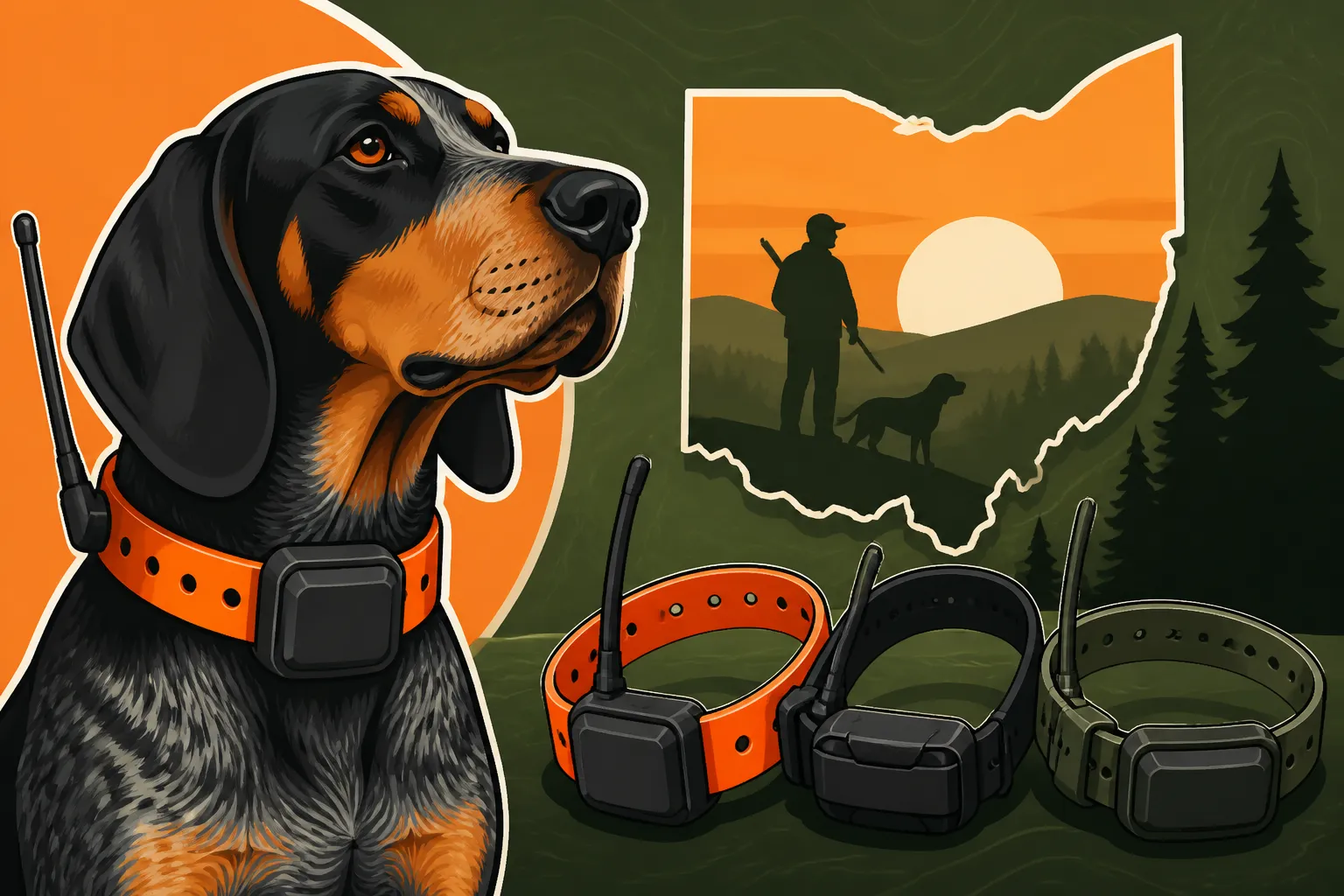
Choosing a Coonhound Tracking Collar
For those of us who run coonhounds in Ohio, there's nothing quite like the sound of a good dog on a hot trail, baying treed deep in the timber. But the thrill can quickly turn to dread when that tell-tale bark fades or moves unexpectedly fast through thick cover or across a property line. Losing a valuable, beloved hound in the dense woods of Wayne National Forest or a vast tract of private farmland is a real fear, and it's why choosing the right tracking collar isn't just a luxury; it's an absolute necessity for peace of mind and the safety of your hunting partner. This guide will walk you through the essential considerations for selecting a reliable tracking collar, ensuring you can always find your coonhound, no matter where the chase leads in Ohio.
Why a Reliable Tracking Collar is Crucial for Ohio Coonhounds
Ohio's diverse terrain and rich furbearer populations offer fantastic opportunities for coonhound enthusiasts, but they also present unique challenges. From the steep, tangled ravines of the Appalachian foothills to the sprawling agricultural fields bordered by woodlots in the northwest, a coonhound can cover a lot of ground quickly, often out of sight and earshot. A reliable tracking collar is your lifeline, providing vital information on your dog's location, movement, and even its status, preventing heartbreaking losses and ensuring you stay within legal boundaries.
Navigating Dense Cover and Farmland
Picture this: your prized Black and Tan, "Blue," just struck a track on a chilly November night in southeast Ohio. The scent is hot, and Blue is off like a shot, plunging into a dense patch of multiflora rose and honeysuckle along a creek bottom. Within minutes, the familiar chop has moved deep into a stand of mature timber. Without a tracking collar, you'd be left straining your ears, hoping for a distinct tree bark to guide you through the impenetrable darkness and tangled undergrowth. That's a frustrating, and potentially futile, endeavor.
Ohio's cover can be incredibly dense, making visual tracking impossible, especially at night when most coonhound hunting occurs. When running hounds for Ohio raccoon, they often follow scent trails that lead them through swamps, thick briar patches, across active farm fields, and into deep hollows where sound simply doesn't carry far. A reliable collar cuts through all that, giving you an exact waypoint to your dog, even when you can't see or hear them. This is especially true if you find yourself Running Hounds for Ohio Raccoon in unfamiliar territory.
Minimizing the Risk of Lost Hounds
Every coon hunter knows the feeling of a hound that just doesn't come back. Whether they get distracted by another animal, get disoriented in unfamiliar woods, or simply travel farther than expected, a lost dog is a hunter's worst nightmare. In Ohio, where deer and other game are plentiful, a coonhound might unexpectedly jump a deer or run into other trouble.
A good tracking collar dramatically reduces the risk of losing your dog. It allows you to monitor their movements in real-time, giving you the ability to intervene if they head towards a busy road, another hunter's property, or simply too far for comfort. Imagine being able to see your dog's path, knowing precisely how far they've gone and in what direction. This kind of immediate feedback is invaluable, helping you make quick decisions to ensure your hound's safety and your own peace of mind. Without it, you might spend hours, or even days, searching, plastering "Lost Dog" posters, and enduring sleepless nights.
Staying Within Legal and Ethical Boundaries
Ohio has specific regulations regarding hunting, including those that pertain to where and when you can hunt. When you're Running a Raccoon Hound After Dark, it's critical to know if your dog crosses onto private property where you don't have permission, or if it strays into a designated no-hunting zone. Even on public lands, knowing your dog's exact location is important for safety and adherence to rules.
A tracking collar, particularly one with mapping capabilities, helps you stay within these bounds. You can often pre-load property lines and no-go zones, getting alerts if your dog approaches them. This not only keeps you on the right side of the law but also fosters good relationships with landowners and fellow hunters. Nobody wants to be the person retrieving a dog from someone else's land without permission. Using a detailed mapping app like GoHunt during your pre-hunt scouting can also help identify these boundaries before you ever step foot in the woods, giving you a clearer picture of potential problem areas for your hounds.
Types of Coonhound Tracking Collars: GPS vs. Traditional Radio
When it comes to tracking collars, you essentially have two main categories: traditional radio (VHF) systems and modern GPS-based systems. Both have their loyal adherents and distinct advantages and disadvantages that are worth considering, especially given Ohio's varied landscapes.
Traditional Radio Tracking Collars (VHF)
For decades, traditional radio tracking collars were the standard for coonhound hunters. These systems work by having a small radio transmitter on the dog's collar that emits a continuous signal. You, the hunter, carry a receiver unit with an antenna, and by sweeping the antenna, you can triangulate your dog's general direction and estimate its distance.
Pros of Traditional Radio Systems:
- Reliability in Dense Cover: Many old-school hunters swear by the ability of VHF signals to penetrate thick foliage and dense terrain where GPS signals might struggle, particularly in deep ravines or heavy woods in places like Shawnee State Forest.
- No Cell Service Required: This is a huge advantage in many remote parts of Ohio where cell service is spotty or nonexistent. The system relies purely on radio waves between the collar and your receiver.
- Simplicity and Durability: Generally, these systems are simpler in design, often more rugged, and have fewer electronic components that could potentially fail compared to more complex GPS units.
- Instantaneous Tracking: The signal is usually real-time, with no lag, which can be crucial when a dog is moving fast.
Cons of Traditional Radio Systems:
- Limited Range: While good in dense cover, the overall effective range is usually less than GPS systems, especially in open country or over rolling hills. You have to be actively pursuing the signal.
- Directional Tracking: You get a direction, not an exact pin-point on a map. It requires more effort and skill to locate your dog, involving walking and sweeping the antenna.
- Signal Interference: Other radio signals or even geographical features can sometimes interfere with the clarity of the signal.
- No Mapping or Data Logging: These systems don't offer any visual map display, track history, or other advanced data features that GPS collars provide.
GPS Tracking Collars
GPS tracking collars utilize satellite technology to pinpoint your dog's exact location. This information is then transmitted to a handheld device or, in some cases, directly to your smartphone, often displayed on a detailed topographical map. These systems have revolutionized tracking for many hunters.
Pros of GPS Systems:
- Pin-Point Accuracy and Mapping: The biggest advantage is seeing your dog's exact location on a detailed map, often with terrain features, property lines, and even your own location. This is invaluable when Hunting the Ohio River Valley Ridges or any complex landscape.
- Extended Range: GPS systems generally offer a much greater effective range, sometimes several miles, as long as the collar can "see" the satellites and transmit its data.
- Advanced Features: Most GPS systems offer a wealth of features like geofencing (alerts when a dog leaves a defined area), track logging, speed tracking, and sometimes even bark indicators or remote training capabilities.
- Multi-Dog Tracking: Many units can track multiple dogs simultaneously, displaying all their positions on the same map.
Cons of GPS Systems:
- Reliance on Satellite/Cell Service (sometimes): While the collar gets its position from satellites, transmitting that data to your handheld often relies on either a local radio signal (from the handheld unit to the collar) or, in some newer systems, cellular data. If you're in a remote Ohio area with no cell service, a cell-based GPS collar becomes useless for transmitting data to your phone. However, dedicated handheld GPS units usually have their own radio link to the collar, making them reliable even without cell service.
- Battery Life: GPS collars often consume more power, meaning shorter battery life compared to traditional radio collars, though this is constantly improving.
- Signal Obstruction: Very dense overhead cover, deep ravines, or heavy storms can sometimes temporarily disrupt a GPS signal, leading to less frequent updates or reduced accuracy.
- Cost: GPS systems tend to be more expensive upfront than traditional VHF collars.
Here's a quick comparison of the two types:
| Feature | Traditional Radio (VHF) | GPS Tracking Collar |
|---|---|---|
| Tracking Type | Directional, estimated distance (audio/visual cues) | Pin-point location on a map |
| Range | Shorter, line-of-sight dependent, good in thick cover | Longer, dependent on signal strength and terrain |
| Coverage | Works anywhere, no cell/satellite needed (unit-to-unit) | Requires clear view of satellites, some need cell for display |
| Mapping | None | Detailed topo maps, satellite imagery |
| Battery Life | Generally longer | Shorter to moderate, constantly improving |
| Cost | Generally lower | Generally higher |
| Complexity | Simpler, fewer features | More complex, feature-rich |
| Multi-Dog | Requires multiple receivers or switching frequencies | Most units track multiple dogs simultaneously |
Key Features to Look for in an Ohio Coonhound Tracking Collar
Once you've decided between a traditional radio or GPS system, or perhaps a hybrid that combines both, it's time to delve into the specific features that will make a real difference in your Ohio coon hunting adventures. These considerations are critical for durability, functionality, and, ultimately, your ability to keep tabs on your valuable hunting companion.
Durability and Waterproofing
Your coonhound isn't tiptoeing through a manicured park. They're busting through briars, swimming across creeks, digging at den trees, and generally putting their gear through the wringer. A tracking collar needs to be built like a tank. Look for collars made from robust materials that can withstand scrapes, impacts, and repeated exposure to harsh elements.
Real-life Scenario: Imagine your hound, "Daisy," hot on a track through a particularly wet bottomland in February. She plunges into a freezing stream, then barrels through a frozen thicket, scraping against every branch. A cheap, flimsy collar won't last an hour. You need something that's truly waterproof (IPX7 or IPX8 ratings are ideal), mud-resistant, and impact-resistant. The antenna connection points, battery compartment, and any buttons should be sealed tight. After all, a collar that fails in the field is no better than no collar at all.
Battery Life and Charging Options
There’s nothing worse than your tracking collar dying just when your dog is out of sight and potentially miles away. Battery life is paramount, especially when you're out for extended periods or on multi-day trips. Modern GPS collars have made significant strides, but they still typically draw more power than their traditional counterparts.
Consider this: You're out for an all-night hunt with "Duke" and "Dixie" on public land near Zaleski State Forest. You started at dusk, and by 3 AM, both dogs are treed, but your handheld unit suddenly shows one collar's battery as critically low. That's a moment of panic. Look for collars that offer at least 20-30 hours of active tracking, with some premium models boasting even more. Fast-charging capabilities and readily available spare batteries or portable power banks can also be game-changers. Some systems even allow for a 'sleep mode' to conserve battery when the dog is stationary, kicking back into full tracking mode when movement is detected.
Range and Signal Reliability
The range of your tracking system is crucial, particularly in Ohio's varied topography. What works well in flat, open farmland might struggle in the deep ravines of eastern Ohio or the dense canopy of a mature hardwood forest.
Think about: Your dog barks treed, but it sounds distant, deep within a valley you can't easily access. Your tracking collar needs to be able to punch through that terrain. GPS systems, while theoretically offering long range, rely on an unobstructed view of the sky for satellite reception. This can be an issue in deep canyons or under heavy forest canopy. Dedicated handheld GPS units often use a robust radio frequency (like 151 MHz or 155 MHz) for their collar-to-handheld communication, which tends to perform better in heavy cover than a cell-phone based system. Traditional VHF collars, while having a shorter overall range, can sometimes be surprisingly effective at penetrating dense cover directly ahead of you. It's important to understand the typical hunting environments you'll encounter, whether it's Hunting Northwest Ohio Farmland Deer (where dogs might run into a woodlot island) or the rolling hills of the central part of the state.
Mapping and Navigation Features (for GPS collars)
If you opt for a GPS tracking collar, the quality of its mapping and navigation features is critical. This is where the real power of GPS comes into play.
A good GPS unit should offer:
- Detailed Topographical Maps: These maps show elevation changes, contour lines, water features, and trails, which are invaluable for understanding the terrain your dog is covering and planning your approach. Many modern units come pre-loaded with these maps, and some allow for additional map downloads or subscriptions.
- Satellite Imagery: Seeing an aerial view can help identify dense cover, clearings, or potential obstacles.
- Real-time Tracking Updates: How often does the collar update its position? More frequent updates (every 2.5 to 5 seconds) provide a smoother, more accurate track of a fast-moving dog.
- Track Logging and History: Being able to review your dog's path after the hunt helps you learn their behavior and scout future locations.
- Geofencing and Alerts: Setting virtual boundaries and receiving alerts if your dog crosses them can prevent trespassing or keep them away from dangerous areas.
- Compatibility with other tools: Some GPS systems can integrate with third-party mapping apps. While GoHunt is a fantastic planning tool for scouting and understanding public land boundaries, your collar's specific app or handheld unit might offer the real-time tracking, but GoHunt can still be invaluable for understanding the general area.
Choosing the Right System for Your Hunting Style and Budget
Selecting the perfect tracking collar isn't about finding the "best" one overall, but rather the one that best suits your specific hunting needs, the type of terrain you frequent in Ohio, and your budget. It's a significant investment, so careful consideration is key.
Assess Your Typical Hunting Environment
Where do you primarily hunt in Ohio? This is arguably the most important question.
- Deep Woods and Steep Terrain: If you mostly hunt the heavily timbered hills of Appalachian Ohio, perhaps in Wayne National Forest or a similar area, signal penetration through dense canopy and over steep elevation changes is paramount. In these environments, a traditional VHF system might offer more consistent signal acquisition, or a GPS system with a very robust collar-to-handheld radio link is essential. Terrain features like deep ravines or high ridges can challenge any system.
- Farmland and Woodlots: In areas with more open fields interspersed with smaller woodlots, like much of central or northwest Ohio, line-of-sight is generally better. Here, a GPS system's extended range and precise mapping can be incredibly advantageous, allowing you to see your dog's progress across large fields and into distant woodlots. Just be mindful of property lines. Understanding these regional differences can help you make an informed choice.
- Proximity to Cell Service: If you hunt in areas with consistently good cell service, a smartphone-integrated GPS system might be a convenient, feature-rich option. However, if you venture into remote areas without cell reception, a dedicated handheld GPS unit that communicates directly with the collar via radio is a non-negotiable.
Consider Your Budget and Desired Features
Tracking collars represent a range of price points, from entry-level traditional systems to high-end multi-dog GPS setups. Your budget will naturally influence your options, but remember that this is an investment in your dog's safety and your hunting success.
- Entry-Level (Traditional VHF): If budget is a primary concern and you mostly hunt in dense, smaller areas, a basic VHF system might be sufficient. You'll get reliable directional tracking, but you'll sacrifice the convenience of mapping.
- Mid-Range (Basic GPS Handheld or Feature-Rich VHF): Many hunters find a sweet spot here. This might be a reliable, older generation handheld GPS unit with good mapping, or a top-tier traditional VHF system that offers excellent range and signal. These systems balance cost with solid performance.
- High-End (Advanced Multi-Dog GPS with Premium Features): For serious hunters who need to track multiple dogs over vast, varied terrain, or those who value every advanced feature like bark detection, remote training, and detailed satellite imagery, the higher price tag of a premium GPS system is often justified. These are the systems that offer the most comprehensive data and peace of mind, especially when you might be Hunting Ohio Farmland Deer with hounds, where precise location is critical to avoid private land issues.
Evaluate User-Friendliness and Integration
Finally, consider how easy the system is to use and how well it integrates into your existing hunting routine.
- Handheld Device vs. Smartphone App: Do you prefer a rugged, dedicated handheld device with physical buttons, or would you rather use a smartphone app? Handhelds are typically more durable and reliable in extreme conditions, while apps offer the convenience of using a device you already carry.
- Interface and Learning Curve: Some systems are more intuitive than others. Look for a clean, easy-to-read display and straightforward navigation, especially if you'll be using it in the dark with cold fingers.
- Multi-Dog Management: If you run more than one hound, ensure the system can comfortably track all your dogs simultaneously with clear identification for each. Checking your dogs online after a hunt is also a good habit to keep up with.
- After-Sales Support and Warranty: A good warranty and responsive customer service can be invaluable if you encounter issues down the line. Look for brands known for their reliability and support in the hunting community.
Choosing the right coonhound tracking collar is a personal decision that balances technology, cost, and your specific hunting needs. By carefully considering these factors, you can equip yourself with a tool that not only enhances your hunting experience but also ensures the safety and well-being of your beloved hounds.
Disclaimer
This article is for general informational purposes only and does not constitute professional advice. Laws, prices and regulations vary by location and change over time. Consult a qualified professional for guidance on your specific situation.