Fixed Versus Mechanical Broadheads
One of the most enduring debates in the archery world, especially for us here in Ohio, revolves around broadheads. It's a choice that can feel overwhelming, with countless options promising everything from pin-point accuracy to massive wound channels. For many hunters, the decision between a fixed-blade broadhead and a mechanical (or expandable) broadhead isn't just about personal preference; it's about what will give them the best chance for a quick, ethical harvest, given the unique challenges of hunting Ohio's diverse landscape. This guide aims to cut through the noise and help you understand the nuances of each type, so you can make an informed decision for your next hunt.
Understanding the Broadhead Battle: Fixed Blades vs. Mechanicals
Choosing a broadhead can feel a lot like choosing a pickup truck – everyone has an opinion, and what works for one person might not be right for another. But at its core, the decision boils down to two main philosophies of blade design: those that are always open and those that open on impact. Let's dig into what each one truly means for your setup and your hunt.
What is a Fixed-Blade Broadhead?
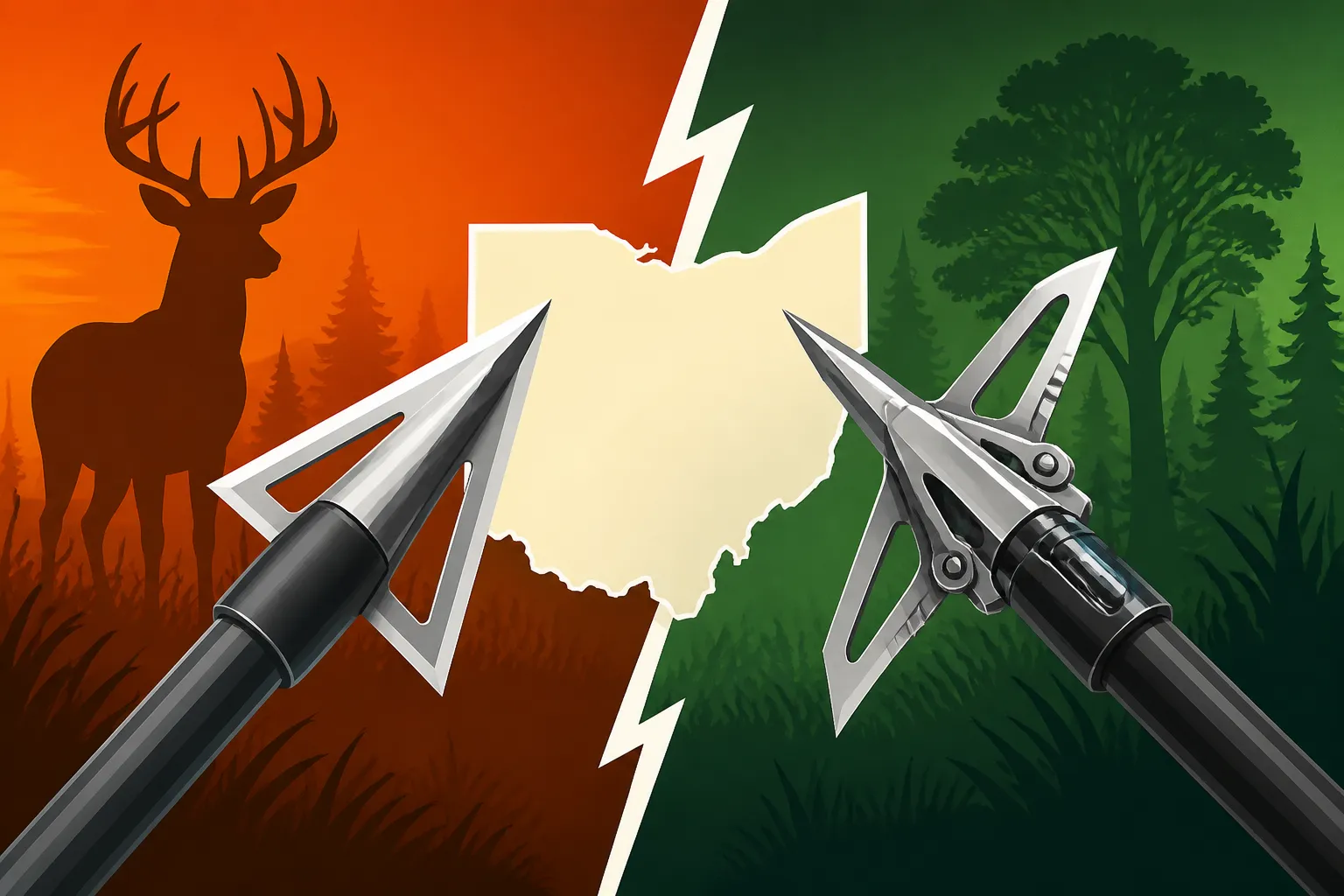
Fixed-blade broadheads are the traditionalists of the archery world, and for good reason. Imagine a miniature hunting knife screwed onto the end of your arrow shaft. That's essentially what you're dealing with. These broadheads feature blades that are rigidly attached to the ferrule (the body of the broadhead) and do not move or deploy. They are always in their "open" or cutting position, from the moment you release the string until they hit their target.
Their design is simple, robust, and has been proven over centuries. You'll find them in various configurations, from two-blade designs that look like classic spearheads, to three or four-blade options, and even some hybrid versions that blend aspects of both. Because there are no moving parts, there's less to go wrong. When your arrow flies true, a fixed-blade broadhead delivers all its kinetic energy directly into the target, using its sharp edges to slice through hide, muscle, and often bone. This makes them a reliable choice for the dense cover we often encounter when Bowhunting Ohio's Long Archery Season, especially in our state forests and thick creek bottoms.
What is a Mechanical Broadhead?
Mechanical broadheads, often called "expandable" broadheads, represent a more modern innovation in archery hunting. Unlike their fixed-blade counterparts, mechanicals are designed with blades that remain folded or tucked close to the ferrule during flight. This creates a much smaller profile, mimicking the aerodynamic properties of a field point. The magic happens upon impact: kinetic energy from the arrow drives a mechanism, causing the blades to deploy or "expand" outward, creating a significantly larger cutting diameter than the broadhead had in flight.
This design was born from a desire to achieve field-point accuracy, especially with faster modern bows and crossbows that sometimes struggle to tune with fixed blades. The idea is that a smaller profile in flight means less wind resistance and less influence from fletching, leading to more consistent flight patterns. Once deployed, these broadheads are designed to create massive wound channels, which theoretically lead to quicker kills and more profuse blood trails, making recovery easier. They've become incredibly popular for their ease of tuning and the dramatic impact they can have, particularly when you're making longer shots across open fields, like when Hunting a Standing Soybean Field in the flatter parts of the state.
The Pros and Cons of Fixed-Blade Broadheads for Ohio Hunting
Choosing a broadhead can feel like a game of trade-offs, and fixed blades are no exception. While they are a time-tested tool, they come with their own set of advantages and challenges when you consider the varied terrain and hunting styles we employ across Ohio.
Advantages of Fixed Blades
One of the biggest selling points for fixed-blade broadheads is their unwavering reliability. With no moving parts to deploy or malfunction, what you see is what you get. When that arrow leaves your bowstring, those blades are already open and ready to do their job. This means you don't have to worry about blades failing to open on impact, or partially opening and creating a glancing blow rather than a devastating cut. This peace of mind is invaluable, especially when that moment of truth arrives after hours of patient waiting.
Their design also excels in penetration. Because all the arrow's kinetic energy is concentrated on driving those blades straight through the target, fixed blades are incredibly efficient at slicing through hide, muscle, and even bone. If you hit a shoulder blade or a rib, a quality fixed blade has a much better chance of pushing through to vital organs compared to some mechanicals. This characteristic is particularly important in Ohio's thick, unforgiving woods, especially when you're hunting tight to bedding areas or in dense Appalachian timber. If you're using a lower Bow Draw Weight for Ohio Whitetails or hunting with traditional archery gear, fixed blades often offer superior penetration simply because they don't expend energy deploying blades.
Fixed blades are also often more durable. The robust construction means they can often be resharpened or have their blades replaced, extending their life. After a successful harvest, you might be able to clean and resharpen the same broadhead for another hunt. This durability is a factor to consider for any hunter. When you're making a tough shot through thick brush in a place like Treestand Setups in Appalachian Ohio Hardwoods, you need a broadhead that can withstand a little abuse and still perform when it hits the deer. Plus, for crossbow hunters, understanding options like Crossbow Versus Vertical Bow in Ohio can clarify how fixed blades fit into the picture, as crossbows often generate enough power to make tuning less of a concern for many fixed designs.
Disadvantages of Fixed Blades
While their reliability and penetration are huge boons, fixed-blade broadheads aren't without their drawbacks. The most common complaint among archers, especially those shooting faster modern compound bows, is their flight characteristics. Because the blades are always exposed, they act like mini-wings. This can cause the broadhead to "plane" or steer in flight, making it difficult to achieve the same consistent point-of-impact as a field point. Tuning your bow to shoot fixed blades accurately often requires more time and effort, sometimes involving paper tuning, walk-back tuning, and meticulous fletching adjustments. For some, it's a frustration they don't want to deal with.
This exposed blade design also makes fixed blades more susceptible to wind drift. On a blustery day, especially if you're set up on a high ridge or an open field edge, that extra surface area can catch the wind and push your arrow off course more significantly than a compact mechanical or field point would. For a precise shot on a wary Ohio whitetail, every little variable matters.
Lastly, fixed blades generally offer a smaller cutting diameter compared to mechanicals. While they are excellent at penetrating, the initial wound channel might not be as wide as a mechanical that deploys to a 1.5 or 2-inch cut. This means that a shot that is slightly off-center, or doesn't perfectly hit a vital area, might result in a less profuse blood trail or a longer tracking job. While a good fixed blade will always get the job done with a well-placed shot, there's less margin for error in terms of initial wound size. For hunters focused on ensuring the best possible blood trail to recover game, especially during something like Hunting the Late-Season Rut Lull when deer can be tough to track in varying conditions, this is a valid consideration.
The Pros and Cons of Mechanical Broadheads for Ohio Hunting
Mechanical broadheads burst onto the scene promising revolutionary accuracy and massive wound channels, and they've certainly delivered on many fronts. However, like any piece of hunting gear, they come with their own set of considerations that Ohio hunters need to weigh.
Advantages of Mechanical Broadheads
The primary advantage that draws so many archers to mechanical broadheads is their field-point accuracy. Because the blades are tucked away during flight, mechanicals present a much smaller profile to the wind and allow your fletchings to steer the arrow more efficiently. This often means that a well-tuned bow shooting field points will shoot mechanical broadheads to the exact same point of impact, or very close to it. This makes tuning significantly easier and boosts a hunter's confidence, especially when facing a critical shot. Many archers find this aspect liberating, allowing them to focus more on shot execution than on complex bow tuning. For those newer to archery or just looking for a simpler setup, this is a massive benefit.
Once deployed, mechanical broadheads create large cutting diameters. It's not uncommon for mechanicals to open up to 1.5, 2, or even 2.5 inches. This massive cutting surface creates a much wider wound channel than most fixed blades. A wider cut means more tissue damage, more blood loss, and ultimately, a quicker, more ethical kill. Furthermore, a wider wound channel typically leads to a more profuse and easier-to-follow blood trail. This can be a game-changer when you're tracking a deer through dense briars or across agricultural fields, making recovery far less challenging. When you're dealing with conditions where Reading Ohio Snow for Fresh Deer Movement might reveal a faint trail, a gushing blood trail from a mechanical can be a huge advantage.
Some hunters also find mechanicals more forgiving for less-than-perfect shots – within reason, of course. While no broadhead can compensate for a truly bad shot, the larger cutting diameter can sometimes nick a vital organ that a smaller fixed blade might have just missed, leading to a quicker recovery. This isn't an excuse for poor shooting, but it's a factor that some archers appreciate. The GoHunt app, for instance, can help you scout potential shot distances and obstacles, which might influence your broadhead choice if you anticipate more open shots where mechanicals excel.
Disadvantages of Mechanical Broadheads
Despite their compelling advantages, mechanical broadheads also have potential downsides that dedicated Ohio hunters should be aware of. The biggest concern often cited is the potential for failure. Since mechanicals rely on moving parts to deploy, there's always a slight chance that the blades might not open fully, or at all. This can happen if the broadhead hits a very dense bone, or if the mechanism is fouled by mud, debris, or a manufacturing defect. A broadhead that doesn't open becomes essentially a field point, dramatically reducing its effectiveness as a hunting tool. While modern mechanicals are incredibly reliable, that potential for failure is enough to keep some traditionalists sticking with fixed blades.
Another consideration is reduced penetration. While mechanicals create a large cutting diameter, the act of deploying the blades and then cutting a wider path consumes some of the arrow's kinetic energy. This means that, all else being equal, a mechanical broadhead will typically penetrate less deeply than a fixed blade. For bows with lower kinetic energy, like some traditional setups or youth bows, this can be a significant factor. If you anticipate a shot that might hit a large bone, or if you're taking a sharp quartering-away shot where maximum penetration is needed to reach the opposite shoulder, a fixed blade might offer a better chance of a pass-through. Similarly, hunters focused on Arrow Weight for Short Shots to maximize penetration might find that a heavier arrow combined with a fixed blade gives them ultimate confidence.
Finally, while generally legal, it's always wise to be aware of the rules. For example, specific rules regarding Ohio Crossbow Rules During Archery Season might impact broadhead considerations, though most mechanicals are widely accepted. Mechanicals can also be more costly than some fixed blades, and their blades are often designed for single-use or require replacement after an impact, even if not on an animal. This can add up over time, especially if you practice extensively with your broadheads.
Making the Right Choice for Your Ohio Hunt
Deciding between fixed-blade and mechanical broadheads isn't about one being inherently "better" than the other. It's about finding the best fit for your specific hunting style, your equipment, and the conditions you expect to encounter in the Ohio woods. Think of it as tailoring your gear to maximize your ethical hunting success.
Matching Broadhead to Bow Setup and Hunting Style
Your bow setup plays a huge role in this decision. If you're shooting a slower bow with lower kinetic energy, such as a traditional recurve or longbow, a compound bow with a light draw weight, or even some youth setups, fixed blades often provide superior penetration. Since they don't expend any energy on blade deployment, all of your arrow's momentum goes directly into cutting. This can be crucial for achieving pass-throughs and reaching vital organs.
On the other hand, if you're flinging arrows with a faster compound bow or a crossbow, which generate significant kinetic energy, mechanical broadheads can really shine. The enhanced accuracy due to their field-point-like flight characteristics can be a massive advantage, especially if your bow is notoriously finicky to tune with fixed blades. The larger cutting diameter ensures a good wound channel even with the slightly reduced penetration. When considering options for Crossbow Versus Vertical Bow in Ohio, many crossbow users gravitate towards mechanicals for their ease of tuning and consistent flight.
Consider your hunting style and the terrain. Are you hunting dense, thick cover where shots are likely to be close, and you might encounter small twigs or brush? A robust fixed blade might be your choice, as it's less likely to deflect or have blades damaged on minor impacts before reaching the target. Broadheads for Timber Shots often emphasizes designs that can withstand minor obstructions. Are you primarily hunting open field edges or food plots, anticipating longer shots where pinpoint accuracy is paramount, and there's little chance of hitting obstructions? A mechanical could give you the confidence you need for those longer range ethical shots.
The GoHunt app can be an incredible tool here. By studying aerial photos and topographic maps, you can get a better sense of the cover density, typical shot distances, and potential obstacles in your chosen hunting area, whether it's public land or a private farm. This foresight can help you anticipate the kind of shot you're likely to take and, in turn, which broadhead might be best suited.
Practice, Practice, Practice!
Regardless of which broadhead you ultimately choose, one truth remains absolute: practice is paramount. You absolutely must shoot your chosen broadheads with your hunting setup before you head to the woods. It's a common misconception that if your field points fly true, your broadheads will too, especially with mechanicals. While mechanicals are designed to fly like field points, slight variations in manufacturing or your bow's tuning can still cause differences.
Shoot your broadheads at various distances you expect to encounter in the field. Pay close attention to how they group compared to your field points. If there's a difference, you'll need to make adjustments to your sight, arrow rest, or even your form. Tuning your bow with broadheads can sometimes involve minute adjustments to arrow rest position, nocking point, or even fletching helical. Don't wait until opening morning to discover your broadheads are flying erratically. Practice builds confidence, and confidence is a huge component of making an ethical shot. This is especially true when you've put in the work to match your Bow Draw Weight for Ohio Whitetails to your arrow and broadhead combination, ensuring optimal performance.
Legal Considerations in Ohio
When it comes to broadheads, Ohio's regulations are generally pretty straightforward and accommodating. Both fixed-blade and mechanical broadheads are legal for hunting big game, provided they meet certain criteria: they must have at least two cutting edges and be at least 7/8 inches wide. Most commercially available broadheads on the market, whether fixed or mechanical, will easily meet these requirements.
However, it's always a good habit to consult the current Ohio hunting regulations each year, as laws can occasionally be updated. This guide provides general information, but the official regulations are your definitive source. You don't want any surprises when you're out there, especially after all the time and effort you've put into preparing for your hunt.
Ultimately, the best broadhead is the one that you shoot most accurately, that penetrates effectively, and that gives you the utmost confidence in your ability to make a clean, ethical kill. Experiment, practice, and choose wisely, and you'll be well on your way to a successful Ohio archery season.
| Feature | Fixed-Blade Broadheads | Mechanical Broadheads |
|---|---|---|
| Blade Deployment | Fixed, always open | Blades deploy on impact |
| Flight Accuracy | Can require more tuning, some wind sensitivity | Often flies like a field point, very accurate |
| Penetration | Excellent, all energy forward | Good, but some energy used in deployment/cutting |
| Cutting Diameter | Generally smaller (e.g., 1-1.25 inches) | Generally larger (e.g., 1.5-2.5 inches) |
| Reliability | Very high (no moving parts) | High, but slight risk of mechanical failure |
| Durability | Very durable, blades often reusable | Blades can break or bend, often replaceable |
| Wound Channel | Clean, deep | Wide, often leads to better blood trails |
| Cost | Varies, often similar per head, but reusable | Varies, often more expensive per head |
Disclaimer
This article is for general informational purposes only and does not constitute professional advice. Laws, prices and regulations vary by location and change over time. Consult a qualified professional for guidance on your specific situation.