Shotgun Slugs for Ohio Deer
For a long time in Ohio, if you were heading into the deer woods with a firearm, a shotgun was often your only legal option, and that meant mastering the art of the slug. Even with the introduction of straight-wall rifle cartridges, many hunters still swear by their trusted slug guns. This guide will help you understand the nuances of choosing and using shotgun slugs effectively for deer hunting in the Buckeye State, ensuring you're well-equipped whether you're sticking with tradition or exploring new options.
The Enduring Role of Shotgun Slugs in Ohio Deer Hunting
Hunting deer in Ohio has a rich history, and for decades, the shotgun slug was practically synonymous with firearm deer season. While the landscape of legal firearms has broadened significantly in recent years, allowing for straight-wall cartridges that offer different ballistic properties, the trusty slug gun still holds a special place in many hunters' hearts and arsenals. Understanding this evolution helps to appreciate why slugs remain a viable and often excellent choice for Ohio whitetails.
A Nod to Tradition: Why Shotguns Were King
Before the straight-wall revolution, Ohio was largely a "shotgun-only" state for deer hunting with firearms. This wasn't unique to Ohio; many states with higher population densities and smaller, fragmented woodlots adopted similar regulations, often out of safety concerns to limit the range of projectiles. Hunters grew up learning to shoot their smoothbore 12-gauges and 20-gauges, sighting them in with a variety of slugs to find what grouped best. It was a rite of passage, patterning your shotgun and understanding its limitations. Many hunters became incredibly proficient, taking deer year after year within the effective range of a slug. This tradition forged a deep connection between the hunter, their shotgun, and the Ohio deer woods. While some areas are still restricted, most of Ohio now allows more flexible options, yet the fundamental skills learned with a slug gun are still highly applicable and valuable. You can delve deeper into the historical context by looking into Why Ohio Once Required Shotguns for Deer.
Navigating the Straight-Wall Era: Do Slugs Still Matter?
With the advent of legal straight-wall cartridges like the .450 Bushmaster, .350 Legend, and .44 Magnum, many hunters flocked to rifles, seeking greater accuracy and extended range. There's no denying that these cartridges offer a different shooting experience, often feeling more like a traditional rifle than a shotgun. However, this doesn't diminish the effectiveness or relevance of shotgun slugs. For one, many hunters already own a shotgun and are comfortable with it. The cost of a new rifle, scope, and ammunition can be a barrier for some, making a slug gun a perfectly economical and capable choice.
Beyond cost, slugs excel in certain situations. In thick cover, where shots are typically close and fast, the sheer energy and stopping power of a well-placed slug can be devastating. Many of Ohio's wildlife areas and state forests, particularly in the Appalachian foothills, consist of dense timber and brush, where long-range shots are rare anyway. A slug gun, especially one with a rifled barrel, can still provide accuracy out to 100-150 yards, which is more than sufficient for the vast majority of deer encounters in such terrain. Furthermore, some hunters prefer the heavier impact and larger wound channel slugs can create, often leading to shorter blood trails. So, while the straight-wall options are popular, slugs absolutely still matter and are a potent tool in the Ohio deer hunter's arsenal, especially when you consider Ohio Legal Firearms for Deer Hunting regulations.
Understanding Your Slug Options: Rifled vs. Sabot
When you walk into a sporting goods store, you'll see a dizzying array of shotgun slugs. It can be confusing trying to figure out which one is right for your shotgun and your hunting style. Fundamentally, slugs fall into two main categories: rifled slugs (often called Foster slugs) and sabot slugs. Each is designed for a different type of shotgun barrel and offers distinct performance characteristics.
Rifled Slugs for Smoothbore Barrels: The Classic Choice
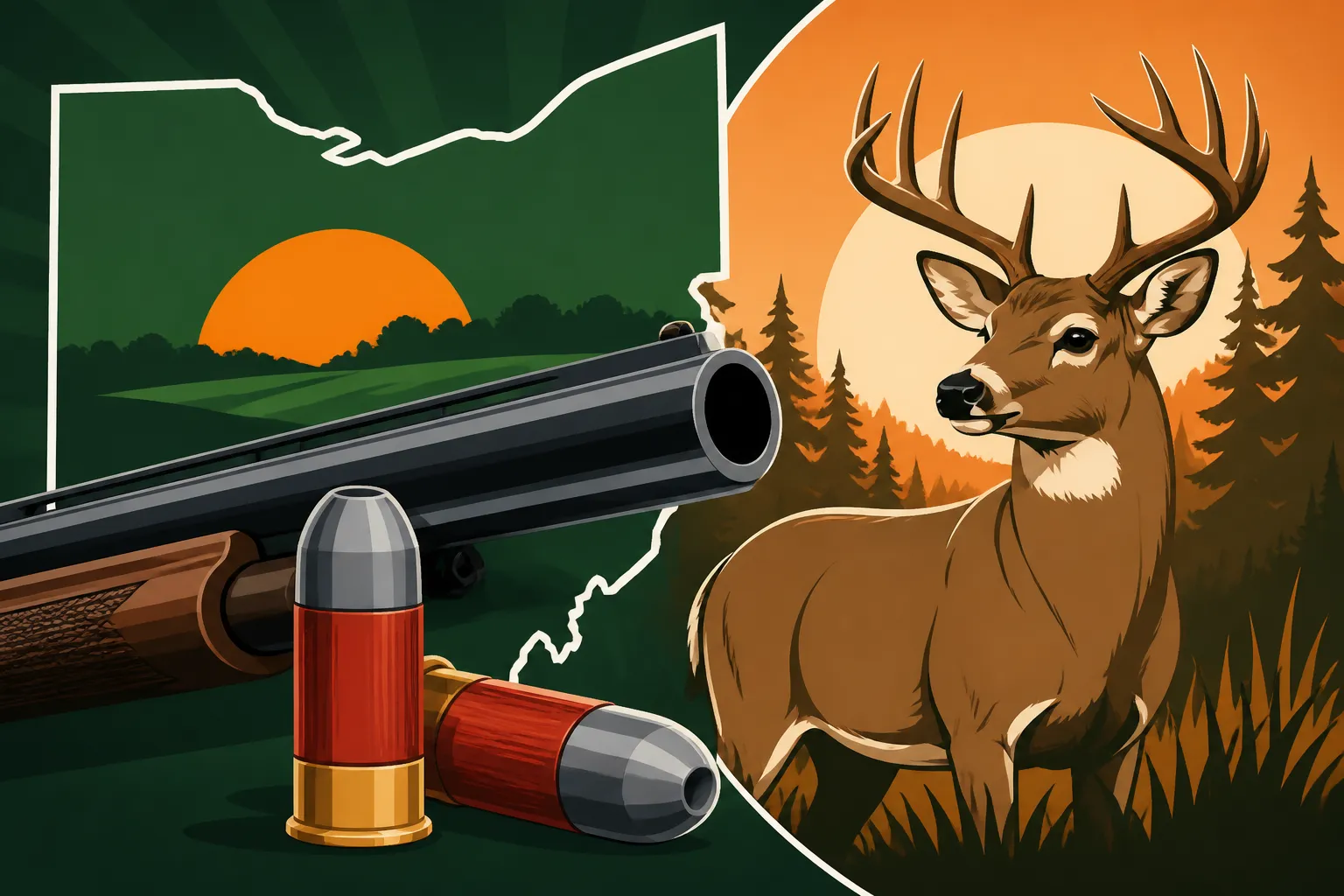
Rifled slugs are perhaps what most hunters picture when they think of a shotgun slug. These are typically lead projectiles with angled "rifling" grooves on their exterior. Don't be fooled by the name; these grooves are not meant to impart spin like a rifle barrel's rifling. Instead, they are designed to allow the soft lead slug to be safely swaged down as it passes through various choke constrictions in a smoothbore barrel without damaging the barrel. They also help reduce the surface area contact, allowing the slug to potentially fly a bit truer due to less friction.
Rifled slugs are best suited for smoothbore shotgun barrels, which are the standard barrels found on most field and sporting shotguns. They are generally less accurate than sabot slugs fired from a rifled barrel, but they can still be surprisingly effective within their intended range, usually 50-75 yards. Many hunters achieve acceptable accuracy out to 100 yards with proper sighting and practice. The key is to find the specific brand and weight of rifled slug that your particular smoothbore barrel "likes." Different barrels, even from the same manufacturer, can show a strong preference for one type of slug over another. When you're patterning your smoothbore, you might be surprised at how much difference a specific brand or grain weight makes. For instance, my old Mossberg 500 always preferred a certain 2 ¾-inch slug over all others, grouping them consistently at 70 yards, which was plenty for the thick creek bottoms I hunted.
Sabot Slugs and Rifled Barrels: Maximizing Modern Performance
Sabot slugs represent the cutting edge of shotgun slug technology and are designed exclusively for use in fully rifled shotgun barrels. Unlike rifled slugs, the sabot slug itself is typically a smaller, aerodynamic bullet (often copper or a copper alloy) encased in a plastic sleeve, or "sabot." This sabot engages the rifling in the barrel, imparting a spin to the projectile, much like a rifle bullet. Once the slug exits the muzzle, the sabot peels away, allowing the aerodynamic slug to continue on a much flatter, more accurate trajectory.
When paired with a dedicated rifled slug barrel and a good optic, sabot slugs can deliver rifle-like accuracy, often capable of consistent groups out to 150-200 yards, sometimes even further depending on the setup and shooter. This makes them incredibly versatile for varied Ohio terrain, from open field edges in northwest Ohio farmland to longer shots across clearings in Wayne National Forest Hunting. The precision offered by sabot slugs and rifled barrels has truly transformed what a shotgun can do in the deer woods. If you're looking to stretch your shotgun's effective range and demand maximum accuracy, a rifled barrel and sabot slugs are the way to go. Consider how this combination compares to other options when researching Rifled Versus Smoothbore Slug Barrels.
Optimizing Your Shotgun Setup for Deer
Getting the most out of your shotgun for deer hunting, whether you're using a smoothbore or a rifled barrel, comes down to proper setup and practice. It’s not just about slapping some slugs in and heading out; a thoughtful approach to sighting and accessory choice can make all the difference when that trophy buck steps out.
Smoothbore Tactics: Improving Accuracy with Rifled Slugs
Hunting with a smoothbore shotgun and rifled slugs is a time-honored tradition, and with the right approach, it can be incredibly effective. The key challenge is maximizing accuracy from a barrel not designed to spin a projectile.
Sighting Systems: Forget the bead sight that came on your bird gun for deer hunting. At a minimum, you'll want to invest in a set of adjustable rifle sights. These consist of a front blade and an adjustable rear sight, allowing you to fine-tune your point of impact for different slugs and ranges. Even better, consider adding a red dot sight. These non-magnifying electronic sights provide a fast, intuitive aiming point (a red dot or reticle) that is very effective for quick target acquisition in dense cover and greatly improves accuracy over open sights. They're fantastic for low-light conditions and for hunters who struggle with aligning traditional iron sights.
Patterning Your Shotgun: This is perhaps the most crucial step. You must pattern your smoothbore with various brands and weights of rifled slugs to find what shoots best. Buy several different boxes and head to the range. Shoot from a solid rest at 25, 50, and 75 yards. You'll quickly discover that your shotgun has a favorite slug. Once you've identified that, sight in your chosen optic or iron sights. My old hunting buddy, Frank, would spend an entire afternoon every fall, trying five different boxes of slugs through his Remington 870, meticulously recording group sizes. It always paid off. Don't assume all slugs are the same; they are not.
Choke Considerations: For rifled slugs in a smoothbore, it's generally recommended to use an improved cylinder or cylinder choke. Tighter chokes like modified or full can deform the slug as it passes, negatively impacting accuracy and potentially stressing the barrel. Some slugs even recommend specific chokes or state to avoid tight chokes. Always read the manufacturer's recommendations on the slug box.
The Rifled Barrel Advantage: Precision with Sabots
If you've opted for a dedicated rifled slug barrel, you've already committed to maximizing your shotgun's accuracy potential. This setup, especially with quality sabot slugs, can rival the performance of many centerfire rifles within typical deer hunting ranges.
Scopes are Essential: Unlike smoothbores, a rifled slug barrel truly shines with a magnified optic. A low-power variable scope (e.g., 1-4x, 2-7x, or 3-9x) is ideal. The magnification helps with precise aiming at longer distances, and the larger objective lens gathers more light for those critical dawn and dusk hours. Look for scopes designed to withstand the heavy recoil of a slug gun, as it can be quite punishing on optics not built for it. When evaluating different options, a quick search on a hunting platform like GoHunt can often bring up reviews or comparisons of popular slug gun scopes.
Zeroing for Range: With a rifled barrel and sabot slugs, you can confidently zero your setup for longer distances. Many hunters will zero at 100 yards, which provides a relatively flat trajectory out to 150 yards or more, depending on the specific slug and caliber. Practice at various distances (50, 100, 150 yards) to understand your slug's trajectory. Knowing your holdovers (how much to aim high or low) at different ranges is critical for making ethical shots. For example, a 100-yard zero might mean you're only a couple of inches high at 50 yards and perhaps 6-8 inches low at 150 yards. Understanding these ballistic nuances is key to success in areas like the mixed forests and fields of Hunting Northwest Ohio Farmland Deer.
Recoil Management: Let's be honest, shooting slugs from any shotgun generates significant recoil. With a rifled barrel and powerful sabot slugs, it can be quite stout. Invest in a good recoil pad for your stock, wear a padded shoulder vest at the range, and practice good shooting fundamentals to manage it. Proper form, including a firm shoulder mount and forward lean, can help mitigate felt recoil. Don't let recoil deter you from practicing, as consistent practice is the only way to become proficient.
Choosing the Right Slug and Caliber for Ohio Deer
The final piece of the puzzle is selecting the right slug and caliber for your specific hunting needs. It's not a one-size-fits-all situation, and what works best for one hunter or one type of terrain might not be ideal for another.
Caliber Considerations: 12-Gauge vs. 20-Gauge
The two most common shotgun gauges for deer hunting are 12-gauge and 20-gauge. Both are perfectly capable of cleanly harvesting a whitetail, but they have distinct differences.
12-Gauge: The 12-gauge is the traditional workhorse for slug hunting. It fires a heavier slug (often around 1 ounce or more) at significant velocity, delivering a substantial amount of kinetic energy and a larger diameter projectile. This means excellent stopping power and a broad wound channel. For many, the 12-gauge offers the confidence of overwhelming force. The downside? Recoil. A 12-gauge slug gun can kick like a mule, especially with magnum loads. If you're recoil-sensitive, or if younger hunters are involved, this can be a deterrent to consistent practice. However, if you can handle the recoil, the 12-gauge is a supremely effective deer medicine.
20-Gauge: In recent years, the 20-gauge has gained immense popularity as a deer slug gun, and for good reason. Modern 20-gauge sabot slugs, fired from a rifled barrel, offer ballistic performance that often rivals, and sometimes even exceeds, older 12-gauge smoothbore setups. The slugs are typically lighter but often more aerodynamic, achieving impressive velocities and flatter trajectories. The most significant advantage of the 20-gauge is its significantly reduced recoil compared to the 12-gauge. This makes it much more pleasant to shoot, encouraging more practice and potentially leading to better accuracy, especially on follow-up shots. For many Ohio hunters, particularly those using rifled barrels, the 20-gauge sabot gun is an outstanding choice that offers a potent combination of power and shootability. If you are comparing performance, consider researching Best Straight-Wall Caliber for Ohio Deer and see how slugs stack up.
Matching Slugs to Your Hunting Style and Terrain
Your choice of slug should also align with the type of hunting you do and the specific terrain you'll be navigating in Ohio.
Close-Range, Thick Cover (0-75 yards): If you primarily hunt dense woods, creek bottoms, or heavy brush, where shots are almost always close and fast, a smoothbore shotgun with rifled slugs in either 12-gauge or 20-gauge is a perfectly viable and economical choice. The heavy impact of these slugs at close range is undeniable, and the slightly less precise accuracy isn't a major hindrance when deer are at spitting distance. Consider areas like river bottomlands or sections of Shawnee State Forest Hunting where visibility is limited.
Medium-Range, Mixed Terrain (75-125 yards): For hunters in areas with a mix of woods and smaller fields, or those hunting hill country with occasional longer shots across ravines, a rifled 20-gauge shotgun with quality sabot slugs is an excellent option. The flatter trajectory and improved accuracy will give you confidence for those slightly longer shots while still offering ample power. This setup is versatile and handles both the quick snap shot in the timber and the more deliberate shot across a clearing. Many find this to be a fantastic all-around choice for most Ohio public land hunting. The Ohio HuntFish App can be a great resource for understanding terrain features on public ground and planning your approach.
Longer-Range, Open Fields (125-200 yards): While traditional slug guns aren't typically associated with long-range shooting, a properly equipped 12-gauge rifled slug gun with premium sabot slugs can certainly perform out to 150-200 yards. However, at these distances, the advantages of a straight-wall rifle become more pronounced in terms of trajectory and ease of shot placement. If you're consistently making shots beyond 125 yards, you'll need to be absolutely dialed in with your sabot slug choice and scope. For instance, hunting the sprawling farmlands of Hunting Northwest Ohio Farmland Deer where deer cross vast open spaces, knowing your ballistic drops precisely is paramount. Still, with diligent practice and the right setup, a slug gun can surprise you with its capabilities, especially if you're using a tool like GoHunt to analyze land features for longer shooting lanes.
Ultimately, the best shotgun slug for Ohio deer hunting is the one you are most comfortable and proficient with. Whether you prefer the traditional thump of a 12-gauge rifled slug or the modern precision of a 20-gauge sabot, dedication to practice, proper sighting, and understanding your equipment's limitations will lead to success in the field.
Disclaimer
This article is for general informational purposes only and does not constitute professional advice. Laws, prices and regulations vary by location and change over time. Consult a qualified professional for guidance on your specific situation.