Vehicle Rules on Ohio Public Land
It's a familiar scenario for many Ohio hunters: you've finally pinpointed that perfect ridge or secluded marsh on public land, dreaming of a deep woods experience, only to realize you're unsure if you can even drive your truck, let alone an ATV, close enough to make it practical. The patchwork of rules regarding vehicles on our public hunting grounds can be incredibly confusing, leading to frustration, potential fines, or even ruining a planned hunt. This guide aims to clear up that confusion, offering a realistic look at how to navigate Ohio's diverse public land vehicle regulations so you can focus on the hunt, not the parking ticket.
Understanding the Basics: What's Generally Allowed and Not
Navigating Ohio's public lands can feel like a maze, especially when you factor in vehicle access. The general rule of thumb for most state-managed hunting areas is pretty straightforward: if it's not a designated public road, an established parking lot, or a clearly marked administrative lane, chances are your vehicle isn't allowed. This isn't just about preserving the natural habitat; it's also about managing hunter access, preventing deep-woods damage, and ensuring safety for everyone out there.
Passenger Vehicles on Public Roads and Parking Lots
When we talk about "public roads" on state land, we're usually referring to paved or well-maintained gravel roads that are open to general public use, much like county roads. These are the arteries that get you to the general vicinity of your hunting spot. Once you're off these main thoroughfares, vehicle access becomes much more restricted. You're expected to park in designated parking areas, which are often clearly signed at trailheads, wildlife area entrances, or along forest roads. Trying to sneak your truck down a two-track path that looks like it might have been a road once upon a time is a surefire way to run into trouble. These unmarked paths are usually for administrative use only or are simply old logging trails not intended for public vehicle access. Always assume a road is closed to public vehicular traffic unless it is explicitly marked as open. This conservative approach will save you a lot of headaches.
Think about a crisp October morning when you're headed to a spot in, say, Wayne National Forest Hunting. You'll drive the main county roads, then transition onto a forest road. You'll likely see a small gravel lot or a wide spot on the shoulder marked for parking. That's your cue. Don't be tempted by the overgrown two-track leading deeper into the woods, no matter how much it seems to cut off a mile of walking. That's precisely where you'll find enforcement, especially during peak seasons like deer gun week.
No Motorized Travel Beyond Designated Areas
This is where many hunters get tripped up, especially those new to public land hunting or coming from states with more lenient rules. Once you've left your vehicle in a legal parking spot, your motorized journey ends. This means no driving down old logging roads that aren't marked for public vehicle access, no taking your ATV down a hiking trail, and certainly no off-roading through the timber. The only exceptions are specific, well-marked administrative roads or trails explicitly opened for certain purposes, which are rare and usually temporary.
It’s easy to get frustrated when you see an old road stretching for miles into what looks like prime habitat. You think, "Man, if I could just drive another mile or two, I'd be right there!" But those roads are often gated, bermed, or signed as "No Motorized Vehicles Beyond This Point." The intent is to create a more primitive hunting experience and protect the sensitive forest floor and wildlife from disturbance. If you’re caught beyond these points, even if you’re "just going a little further," the penalties can be steep. You might be looking at fines, vehicle towing, and even revocation of hunting privileges. It's simply not worth the risk. Instead, focus on scouting efficient walking routes using tools like Scouting With the Ohio HuntFish App to identify potential bottlenecks or easy terrain.
Beyond the Pavement: ATVs, E-Bikes, and Specialized Vehicles
Ohio's public land system is a diverse tapestry, from the rugged hills of the Appalachian foothills to the flat farmlands of the northwest, and each area might have nuanced rules for specialized vehicles. This is where understanding the specifics becomes critical, as assuming one rule applies everywhere can lead to problems.
ATV and UTV Rules on Ohio Public Lands
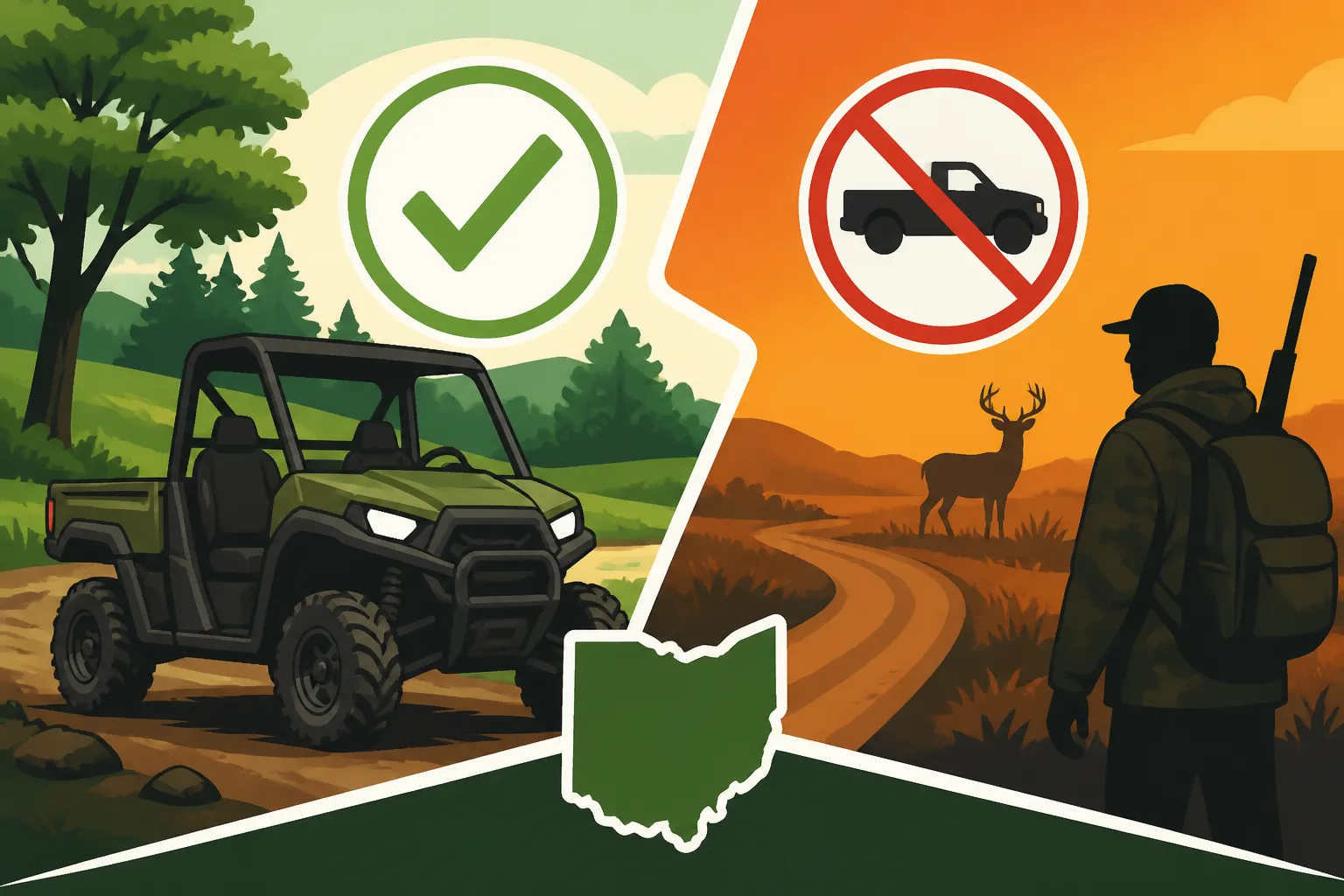
ATVs (All-Terrain Vehicles) and UTVs (Utility Terrain Vehicles) are a topic that generates a lot of discussion and, frankly, confusion among hunters. Generally speaking, ATVs and UTVs are not permitted on most Ohio Wildlife Areas or State Forests for recreational riding, especially not for hunting access beyond designated parking areas. The biggest exception to this general rule is often found within the Wayne National Forest. Here, there are designated ATV trail systems, but these are for recreational riding only, not for hunting access. You cannot ride your ATV from a trail system to an off-trail hunting spot. The rules are clear: if you are using an ATV, you must stay on designated ATV trails, and your hunting gear usually has to be transported separately, often on foot, to your hunting location. This distinction is vital for anyone planning to hunt in areas like Hunting Southeast Ohio Appalachian Foothills where the Wayne National Forest is a major player.
Even in areas like Wayne, access to the ATV trail system itself often requires specific permits or fees, separate from your hunting license. And even if you have the permit, remember that these trails are for recreation, not an express lane to your deer stand. You still have to park your ATV in a designated area and proceed on foot. This often means hauling your gear much further than you'd like, which is a common complaint among hunters who feel these vehicles should be allowed for retrieving game. Unfortunately, the current regulations prioritize ecological impact and non-motorized recreation.
E-Bike and Mountain Bike Considerations
E-bikes, or electric bicycles, have become increasingly popular, offering hunters a way to cover more ground quietly than walking, especially with heavy packs. However, their status on public lands is a gray area in some places and explicitly defined in others. Most Ohio public lands categorize e-bikes similarly to other motorized vehicles. This means if motorized vehicles aren't allowed on a specific trail or road, neither is an e-bike, even if it's pedal-assist. Traditional mountain bikes are generally permitted on trails designated for non-motorized use, like hiking or mountain biking trails, but again, this doesn't grant you access to off-trail areas for hunting.
Always check the specific regulations for the public land you intend to hunt. For instance, some forest systems or wildlife areas might have specific rules for "Class 1" e-bikes (pedal-assist only, no throttle, limited speed), while others blanket them with all other motorized vehicles. It’s always safer to assume an e-bike is treated like a motorized vehicle unless you find explicit language to the contrary from the land management agency. Many hunters find traditional mountain bikes a great way to access areas deeper than they'd typically walk, but the same rules apply: stay on designated trails and park it when you reach the boundaries of a non-motorized zone. A mapping app like onX Hunt can often show designated trail systems and helps you stay on the right side of the rules.
Navigating Different Public Land Types: A Closer Look
Ohio's public hunting lands are managed by various agencies, and each can have its own specific nuances when it comes to vehicle rules. What applies in a State Forest might be different in a Wildlife Area, and both can differ from federal lands like the Wayne National Forest. It's this patchwork that often causes the most confusion for hunters.
Ohio Wildlife Areas (Managed by ODNR Division of Wildlife)
The Ohio Department of Natural Resources (ODNR) Division of Wildlife manages over 150 Ohio Wildlife Areas across the state. For the most part, vehicle access on these lands is strictly limited to marked public roads and designated parking lots. You won't find ATV trail systems here, nor are you generally permitted to drive off the main access roads, even if they look like old farm lanes. The philosophy behind wildlife area management often emphasizes habitat preservation and quiet recreation, which includes restricting motorized vehicle use to prevent disturbance to wildlife and degradation of sensitive ecosystems.
For example, if you're hunting deer at a popular spot like Killdeer Plains Wildlife Area, you'll drive in on well-maintained gravel roads and park in one of the many designated lots. From there, it's strictly foot traffic. Don't even think about driving your truck down one of the grassy dikes that crisscross the marshes, no matter how convenient it might seem for setting up decoys during waterfowl season. Those are for maintenance crews and official use only. This consistency across the state's wildlife areas makes it a bit easier to anticipate the rules once you understand the core principle: if it's not a paved or gravel road explicitly open to public vehicular traffic, or a designated parking area, assume it's off-limits.
Ohio State Forests (Managed by ODNR Division of Forestry)
Ohio State Forests, such as Shawnee, Zaleski, or Tar Hollow, offer a slightly different scenario compared to wildlife areas, though the core principle of staying on designated roads remains. While these forests are managed primarily for timber production and recreation, including hunting, vehicle access is still restricted. You'll find a network of forest roads, many of which are gravel and open to public vehicle traffic, allowing you to get deeper into the expansive timber. However, just like with wildlife areas, these roads are marked, and you must stay on them. Driving off a forest road, even to reach a more "hidden" hunting spot, is not permitted.
Consider Shawnee State Forest Hunting in southern Ohio. It's a vast wilderness, and there are plenty of gravel roads you can use to access different sections. But the minute you see a berm or a "No Entry" sign on an old logging spur, you must respect it. The Division of Forestry works hard to manage these lands, and unauthorized vehicle use can quickly degrade logging roads, damage sensitive areas, and interfere with timber operations. Always look for signage. If a road is open, it will usually be clear. If it's closed or restricted, there will be a sign, gate, or physical barrier. When you're using a mapping tool like GoHunt, pay close attention to the layers that delineate public access roads from administrative or closed routes; these tools can be invaluable for staying compliant.
Wayne National Forest (Federal Land)
The Wayne National Forest, Ohio's only national forest, adds another layer of complexity. As mentioned earlier, it's the primary location in Ohio with designated ATV/UTV trails. However, it's crucial to distinguish between these recreational trails and hunting access roads. The ATV trails are specifically for riding and require permits. Hunting access, for the most part, still relies on the same principles as state forests: stick to designated public roads and parking areas. There are many forest roads within the Wayne that are open to vehicles, allowing hunters to access vast tracts of timber. But, like all public lands, these roads are clearly marked.
The Wayne National Forest can be confusing because of its sheer size and the overlay of various uses. You might be driving on a county road that transitions into a forest road, then see a sign for an ATV trail. It's easy to get lost or confused about where you can and can't go with your vehicle. This is where detailed topographic maps and digital mapping apps like onX Hunt truly shine. They can show you public roads, the boundaries of the ATV trail system, and public property lines, which are all critical for understanding your options. Remember, even if you’re driving on an open forest road, pulling off into the ditch or driving into the woods to unload gear is still a violation. Park in designated pull-offs or parking lots. ATV Rules on Ohio Forest Roads are quite specific and demand careful attention from anyone planning to hunt these areas.
| Public Land Type | Passenger Vehicles on Designated Roads/Parking | ATVs/UTVs on Designated Trails | E-Bikes on Non-Motorized Trails (Generally) | Retrieving Game with Motorized Vehicle |
|---|---|---|---|---|
| Ohio Wildlife Areas | Yes | No | No | No |
| Ohio State Forests | Yes | No | No | No |
| Wayne National Forest | Yes | Yes (with permit, rec use only) | Generally No | No |
The Consequences: Avoiding Fines and Frustration
Ignoring vehicle rules on Ohio public lands isn't just a minor inconvenience; it can lead to serious consequences, from hefty fines to having your vehicle towed, and even jeopardize your hunting privileges. Beyond the legal ramifications, it can create a lot of frustration, waste valuable hunting time, and damage the positive image of hunters.
Penalties for Vehicle Violations
Driving off-road, blocking an access gate, or parking illegally on public land can result in a range of penalties. Fines for such violations can be substantial, often hundreds of dollars, and accumulate quickly if your vehicle needs to be towed out of a remote location. Imagine successfully bagging a nice buck deep in Hunting the Ohio River Backwaters, only to find your truck has been towed because you parked half on the main road and half in the ditch, blocking a maintenance gate. The cost of retrieving your vehicle, plus the fine, could easily outweigh the cost of your entire hunting trip, not to mention the immense headache.
Beyond monetary fines, repeated or severe violations can lead to suspension or revocation of your hunting license. Land management agencies take these rules seriously because unauthorized vehicle use causes erosion, disturbs wildlife, damages vegetation, and interferes with management operations. It's a matter of responsible land stewardship, and hunters are expected to be leaders in that effort. If you're unsure about a specific area, it's always best to err on the side of caution. Contact the local wildlife area manager or forest ranger, or consult the ODNR website's interactive map for public lands and their specific regulations.
Planning for Foot Travel and Game Retrieval
Since motorized vehicle access is so restricted, especially beyond main roads, planning for extensive foot travel and manual game retrieval is an essential part of hunting Ohio's public lands. This means thinking about how you'll get your gear in and, more importantly, how you'll get your game out. If you're hunting deep in Hunting Shawnee State Forest Ridges and drop a deer two miles from the nearest parking spot, you need a plan.
This might involve investing in a good game cart, a deer sled for snow, or even learning how to quarter a deer in the field to pack it out more easily. Many successful public land hunters embrace the "walk-in" mentality, understanding that the effort of getting away from vehicle access points often leads to less pressured game. Using tools like onX Hunt or GoHunt isn't just for finding your stand location; it's also crucial for identifying the most efficient, least strenuous path back to your vehicle with a loaded game cart. Think about terrain, elevation changes, and natural funnels that can ease the burden of a long drag. Preparing for the walk out is just as important as preparing for the walk in, and it's a reality of public land hunting that every Ohio hunter needs to embrace.
Disclaimer
This article is for general informational purposes only and does not constitute professional advice. Laws, prices and regulations vary by location and change over time. Consult a qualified professional for guidance on your specific situation.