Turkey Shotguns and Chokes
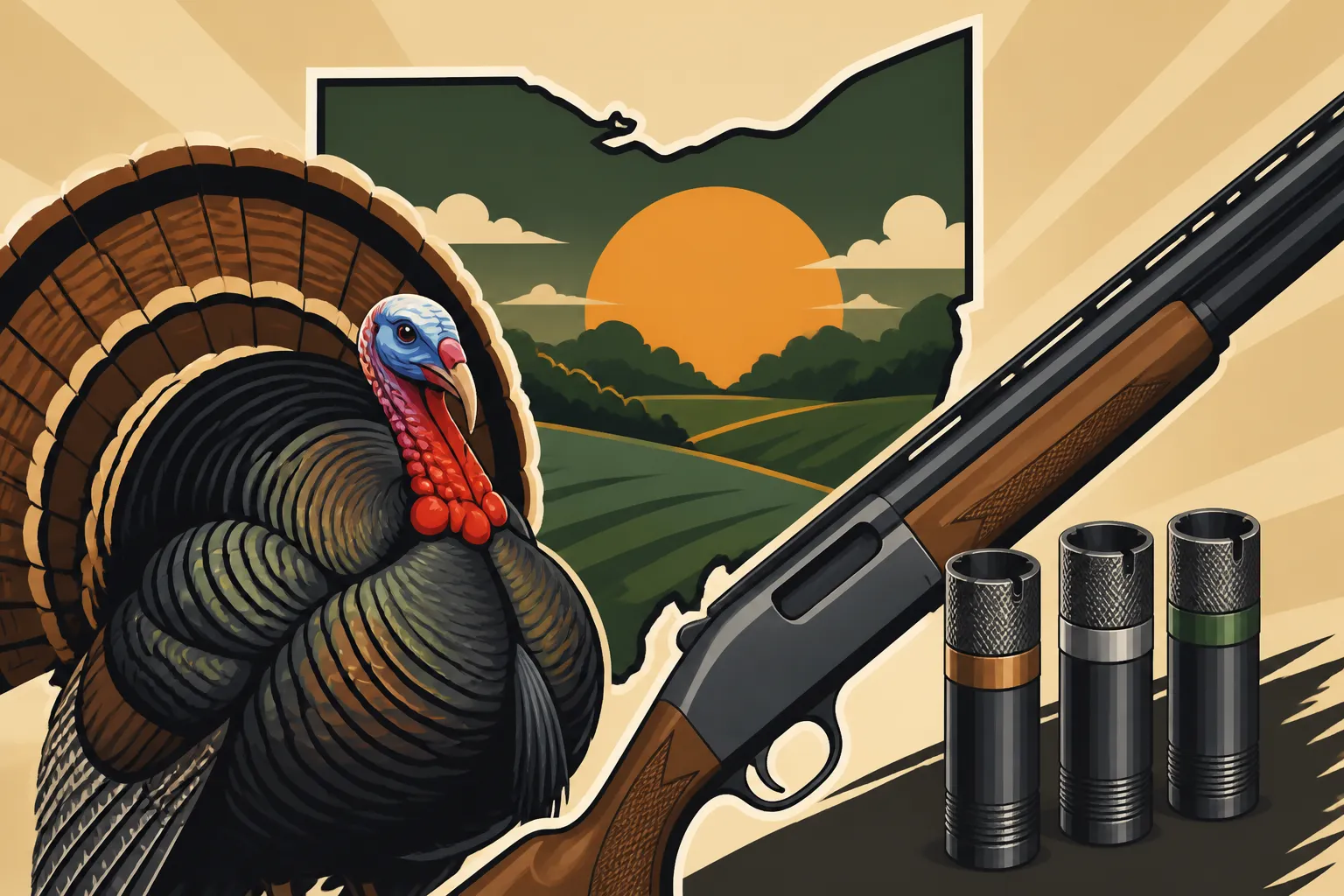
One of the most common frustrations for Ohio turkey hunters is the sheer amount of conflicting information out there about shotguns and chokes. It can feel like you need a different setup for every field and every gobbler, and the sheer cost of experimenting with different loads and choke tubes can quickly empty your wallet. This guide is here to cut through the noise, helping you understand the fundamentals of turkey shotguns and chokes so you can build a reliable, devastatingly effective setup that gives you confidence when that longbeard finally steps into range.
Understanding the Turkey Shotgun: Why a Dedicated Setup Matters
For many of us, our first turkey hunt might have been with the same shotgun we used for ducks or pheasants. And hey, sometimes it works out! But as you spend more time chasing longbeards across Ohio's rolling hills or listening for distant gobbles in the farmlands, you quickly realize that turkey hunting presents some unique challenges that a general-purpose shotgun just isn't optimized for. We're talking about precision at slightly longer ranges than typical bird hunting, and the need for a dense, consistent pattern to cleanly dispatch a tough bird like a wild turkey.
Specialized vs. All-Around Shotguns: The Compromise
A truly specialized turkey shotgun is designed from the ground up for one purpose: putting as many pellets as possible into a turkey's head and neck at typical hunting distances, often out to 40 or even 50 yards. This usually means a shorter barrel for maneuverability in thick cover, specialized sights, and most importantly, a bore designed to handle extra-tight choke tubes and heavy loads. On the other hand, your do-it-all waterfowl or upland gun needs to spread pellets effectively over a wider area for moving targets, and might not handle the tight constriction and powerful recoil of turkey loads as efficiently or comfortably.
Trying to make one gun do everything often leads to compromises. You might end up with a pattern that's too sparse for turkeys at 30 yards, or a gun that's just too heavy and long to swing effectively when a gobbler circles your setup in tight woods. If you're serious about turkey hunting, investing in a dedicated setup or at least optimizing one of your existing shotguns for this specific pursuit will dramatically increase your chances of success and, more importantly, ensure ethical, clean kills. It's about setting yourself up for success, not just hoping for the best.
Key Features for Turkey Hunting: What to Look For
When you're looking at a shotgun primarily for turkey hunting, there are a few features that really make a difference. First off, a shorter barrel, typically in the 20 to 24-inch range, is a huge advantage. It makes the gun much easier to handle in thick timber, navigate brush, and maneuver quickly in a ground blind. Longer barrels might give a slight theoretical velocity boost, but the practical gains in maneuverability far outweigh that for turkey hunting where shots are usually static.
Another critical feature is the sighting system. Unlike wing shooting, where you're often instinctively pointing, turkey hunting is a precision shot. Many dedicated turkey guns come with rifle-style sights, fiber-optic sights, or are drilled and tapped for an optic like a red dot or a low-power scope. This allows for much more precise aim at the small target area of a turkey's head and neck. Additionally, recoil management can be a big deal with heavy turkey loads. Features like recoil pads, heavier gun weights, or even gas-operated semi-automatics can make patterning sessions and actual hunting more comfortable. Don't forget the finish either; a non-glare, camouflage, or matte black finish helps you blend into the Ohio woods.
Gauge Matters: Matching Power to Purpose
When it comes to turkey hunting, the gauge of your shotgun is one of the foundational decisions you'll make. It directly impacts the amount of shot you can deliver, the recoil you'll manage, and ultimately, the effective range of your setup. While many gauges can take a turkey, some are undeniably better suited for the task, offering a more robust and forgiving pattern.
The Enduring Popularity of 12 Gauge: Power and Options
The 12 gauge remains the king of turkey hunting for very good reasons. It offers the best balance of payload, effective range, and ammunition availability. With a 12 gauge, you can throw a significant amount of shot, from 1 ¾ ounce to a whopping 2 ¼ ounce or more in some super-magnum loads, creating dense patterns even at extended distances. This larger payload increases the number of pellets impacting the target, dramatically improving your chances of hitting the vital head and neck region.
Furthermore, the 12 gauge platform provides an immense variety of ammunition options, from traditional lead to high-density tungsten alloys, and a wide array of specialized turkey choke tubes. This versatility allows you to fine-tune your pattern to an extreme degree. While recoil can be stout with heavy turkey loads, many modern 12-gauge shotguns are designed with recoil-absorbing features, making them manageable for most hunters. For reliability and sheer stopping power when chasing gobblers, especially on larger public lands like Wayne National Forest, the 12 gauge is consistently the top choice. You can find detailed tips on patterning these powerful loads in our article Patterning a Turkey Gun at 40 Yards.
10, 20, and .410: Niche Roles and Advantages
While the 12 gauge dominates, other gauges certainly have their place. The 10 gauge, though less common today, was once considered the ultimate turkey slayer. It can throw even heavier payloads than a 12 gauge, extending effective range even further. However, the trade-off is significantly increased recoil, heavier guns, and less ammunition availability. For hunters prioritizing maximum range and pattern density above all else, and who are willing to manage the heavy kick, a 10 gauge can still be a formidable tool.
The 20 gauge has seen a resurgence in popularity, especially with advancements in high-density tungsten super shot (TSS) loads. With TSS, a 20 gauge can often rival or even exceed the terminal performance of traditional lead 12-gauge loads, but with significantly less recoil and a lighter, more maneuverable shotgun. This makes the 20 gauge an excellent choice for youth hunters, those sensitive to recoil, or anyone wanting a lighter setup for long walks through the woods. It's a fantastic option for a run-and-gun approach on public land.
Finally, the .410 bore, once considered a novelty for turkey hunting, has also been transformed by TSS. A .410 loaded with TSS can deliver a surprising number of small, dense pellets, making it viable for close-range turkey hunting, typically inside 30 yards. It's incredibly light and has negligible recoil, making it ideal for young hunters or those seeking the ultimate challenge. However, the margin for error is much smaller, demanding precise shot placement and impeccable calling skills to bring birds in close. Choosing the right gauge for your hunting style is a key consideration when setting up for Spring Turkey Hunting in Ohio.
Choke Tube Deep Dive: The Heart of Your Pattern
If the shotgun is the engine, the choke tube is the precision-tuned fuel injector. This small, removable constriction at the end of your barrel has an outsized impact on how your pellets fly and, critically, how many of them hit the target. Understanding chokes is perhaps the most important aspect of setting up a successful turkey gun. Without the right choke, even the best shotgun and ammunition combination will underperform.
Understanding Constriction: How Chokes Work
At its most basic, a choke tube works by constricting the shotgun bore just before the pellets exit the barrel. This constriction forces the shot column into a tighter group, reducing spread and extending the effective range of your shotgun. The degree of constriction determines how "tight" or "open" your pattern will be. More constriction means a tighter pattern and typically a longer effective range, while less constriction results in a wider, more spread-out pattern, generally favored for closer, fast-moving targets like upland birds.
Turkey hunting demands the tightest possible patterns because the target area – a turkey's head and neck – is remarkably small, only about the size of a golf ball. A pattern that might be perfect for ducks or pheasants would be far too open for turkeys, leading to missed birds or, worse, wounded ones. The goal is to deliver enough pellets with sufficient energy into that small kill zone to instantly incapacitate the bird. This precision is why turkey hunters obsess over their choke and load combinations.
Common Choke Designations: From Improved Cylinder to Extra Full
Chokes are typically labeled with designations that indicate their degree of constriction. Here's a quick rundown of common types and their general applications:
- Cylinder (CYL): No constriction. Widest pattern, very short range. Rare for turkey hunting unless you're shooting slugs.
- Skeet (SKT): Very light constriction. Wider patterns for close-range clay target shooting.
- Improved Cylinder (IC): Light constriction. Good for close-range upland birds or doves. Still too open for turkeys.
- Modified (MOD): Moderate constriction. A good all-around choke for various types of bird hunting, offering a balance of spread and range.
- Improved Modified (IM): Tighter than modified, often used for longer-range pheasants or ducks.
- Full (FULL): Significant constriction. Delivers a tighter pattern for longer shots. A good starting point for traditional lead turkey loads, but often still not enough for optimal turkey performance.
- Extra Full (XF): Even tighter than full, designed specifically for turkey hunting. These are often labeled as "Turkey" chokes.
When you start venturing into the "Turkey" or "Extra Full" realm, the amount of constriction becomes very significant, often requiring specialized tooling for manufacturing and demanding precise ammunition pairings.
Here's a quick comparison of common choke types:
| Choke Type | Constriction Level | Typical Shot Pattern at 40 Yards (Lead) | Best Use Cases |
|---|---|---|---|
| Cylinder | None | ~60-inch diameter | Very close range, slugs, large shot |
| Improved Cylinder | Light | ~45-inch diameter | Close-range upland, steel shot close range |
| Modified | Medium | ~30-inch diameter | All-around bird hunting, medium range |
| Full | Heavy | ~20-inch diameter | Long-range waterfowl, some turkey with specific loads |
| Extra Full (Turkey) | Very Heavy | ~10-15 inch diameter (depending on load) | Dedicated turkey hunting, maximum pattern density |
Specialty Turkey Chokes: The Ultra-Tight Advantage
For serious turkey hunters, simply a "Full" or "Extra Full" choke often isn't enough. This is where specialty turkey chokes come into play. These chokes are precisely engineered to squeeze the shot column more aggressively and often incorporate internal features like longer parallel sections or specific porting to strip wad petals, further stabilizing the shot column and creating incredibly dense patterns. Brands like Carlson's, Indian Creek, and Trulock are well-known for their dedicated turkey chokes, which often have unique constriction values beyond standard designations.
When selecting a specialty choke, it's crucial to understand that they are designed to work in conjunction with specific ammunition types and shot sizes. A choke that patterns beautifully with lead #5 shot might perform poorly with TSS #9 shot, and vice-versa. You might find a choke that is described as a .655 constriction, or a .665, rather than just "Extra Full." These tiny differences in thousandths of an inch can have a huge impact on your pattern. The key is to test, test, and test again. Many hunters buy a few different specialty chokes and a variety of turkey loads, then spend time at the range patterning each combination to find the one that produces the most consistent, dense pattern with the fewest fliers. Our guide on Turkey Chokes and Patterning delves even deeper into this critical process.
Ammunition Considerations: Making Your Pattern Shine
A choke tube might tighten your pattern, but the ammunition itself is what delivers the punch. Modern turkey loads are a marvel of ballistic engineering, designed to maximize pellet count, energy, and penetration. Simply grabbing any box of shells won't cut it for turkey hunting; you need to understand how different components of the load contribute to your overall pattern and effectiveness.
Shot Size and Material: Lead vs. Tungsten Alloys
The choice of shot size and material is paramount for turkey hunting. Traditionally, lead shot in sizes #4, #5, or #6 has been the standard. Lead is heavy and relatively inexpensive, delivering good energy. #5 shot is a popular all-around choice, offering a good balance of pellet count and individual pellet energy. For instance, when hunting Ohio's farmland birds that might hold up in a woodlot edge, a dense pattern of lead #5s can be very effective.
However, the game has been completely changed by high-density non-toxic materials, most notably Tungsten Super Shot (TSS). TSS is significantly denser than lead, meaning a smaller TSS pellet retains more energy and penetrates deeper than a larger lead pellet. This allows hunters to use much smaller shot sizes (e.g., #7, #9, or even #10 TSS) which drastically increases the pellet count within a given shell weight. More pellets in the pattern mean a higher probability of hitting the small kill zone. For example, a 3-inch 20-gauge shell loaded with TSS #9s can often put more lethal pellets on target than a 3-inch 12-gauge shell with traditional lead #5s. This is why the .410 gauge has become a viable turkey gun with TSS. If you're looking to push your effective range or lighten your gun, investigating TSS is a must. Many online hunting retailers and resources like GoHunt offer detailed comparisons of these advanced loads.
Payload and Velocity: What Drives Performance
Beyond shot size and material, the overall payload (weight of the shot charge) and the velocity of the ammunition are key factors. A heavier payload means more pellets, which generally translates to a denser pattern. This is why 3-inch and 3 ½-inch magnum shells are so popular for turkey hunting, particularly in 12 gauge, as they can carry significantly more shot than standard 2 ¾-inch loads. However, be aware that heavier payloads also mean more recoil, which can impact your ability to shoot accurately.
Velocity, or how fast the pellets are traveling, is also important. Higher velocity generally translates to more kinetic energy downrange and flatter trajectories over typical turkey hunting distances. However, there's a point of diminishing returns. Excessively high velocities can sometimes deform pellets as they travel down the barrel and through the choke, leading to "fliers" and less consistent patterns. Manufacturers carefully balance these factors to create optimal turkey loads. It's not always about the fastest or heaviest load; it's about the combination that produces the most consistent pattern for your specific gun and choke.
Matching Ammo to Choke: The Critical Pairing
This is where all the pieces come together, and it's perhaps the most critical part of achieving an effective turkey setup. A choke tube is designed to constrict a column of shot, and different shot materials and sizes behave differently under that constriction. For example, very hard, dense TSS pellets might withstand extreme constriction better than softer lead pellets, which could deform and create a blown-out, inconsistent pattern.
It's not uncommon for a hunter to try several different brands, shot sizes, and even shell lengths (e.g., 3-inch vs. 3 ½-inch in a 12 gauge) with two or three different choke tubes before finding the "perfect" combination. This trial and error is frustrating but essential. A choke that performs incredibly well with a specific load of lead #5s might utterly fail to pattern with TSS #9s, and vice versa. There are many fantastic resources online, including articles and user reviews on GoHunt, where hunters share their experiences with specific choke and ammo pairings. Don't skip this step; your success in the field, especially when trying to call in a wary gobbler in the Shawnee State Forest, truly depends on it. You can learn more about this by reading Tungsten Turkey Loads Worth the Price.
Patterning Your Turkey Gun: The Non-Negotiable Step
I can't stress this enough: you must pattern your turkey gun. Every single year, before hunting season, you need to take your shotgun, your chosen choke, and your specific ammunition to the range and see exactly what it's doing. Skipping this step is like hunting with a blindfold on – you simply won't know where your gun is really shooting or how dense your pattern is. This isn't just about accuracy; it's about ethical hunting and ensuring a clean, humane kill.
The Setup: Range, Targets, and Rest
To pattern your gun effectively, you need a controlled environment. Find a shooting range where you can shoot at 40 yards (a common maximum ethical range for turkeys) and ideally 20 or 30 yards as well. You'll need specific turkey patterning targets, which typically have a life-sized turkey head and neck silhouette with a clear aim point. These targets help you visualize the crucial kill zone.
A solid rest is absolutely essential. You want to eliminate as much human error as possible from the equation. Use a sturdy bench rest with sandbags for both the forend and the stock, or a specialized shooting vice. This isn't about simulating an offhand shot; it's about evaluating the gun's inherent pattern. You need to be able to hold the gun perfectly still and aim precisely at the center of the turkey's head. Remember to bring eye and ear protection, especially with those heavy turkey loads!
Analyzing Your Pattern: Hot Spots and Flaws
Once you've set up and taken a few shots, it's time for critical analysis. Don't just look for "pellets in the head." You're looking for consistency and density.
- Pellet Count in the Kill Zone: Count how many pellets hit the brain/spinal column area of the turkey head. For a clean kill, most experts recommend at least 10-15 pellets in this critical zone at your maximum ethical range.
- Pattern Density: Is the pattern evenly distributed, or are there "holes" where a turkey could slip through without enough pellets? A dense, consistent pattern is what you're after.
- Point of Impact: Is your pattern centered where you aimed? If not, you might need to adjust your sights or optic. Even a slight shift can mean the difference between a clean kill and a miss or, worse, a wounded bird.
- "Hot Spots" and "Doughnuts": Sometimes a pattern will have a super dense "hot spot" with few pellets around it, or even a "doughnut" pattern with a hole in the very center. These are undesirable. You want an even, consistent spread.
Take photos of your best patterns for future reference. This detailed analysis will reveal the true performance of your choke and ammunition combination. You might even find that your setup performs better at 30 yards than at 40, which helps you define your personal ethical range.
Fine-Tuning for Success: Adjustments and Alternatives
If your initial patterns aren't satisfactory, don't despair! This is the whole point of patterning. Here's a troubleshooting checklist:
- Adjust Sights/Optics: If the pattern isn't centered, make sight adjustments. This is often the easiest fix.
- Try Different Ammunition: As discussed, a different brand, shot size, or shot material can dramatically change your pattern. This is often the most impactful change you can make. What works for one person's gun on GoHunt forums might not work for yours.
- Experiment with Choke Tubes: If you have access to other specialty turkey chokes, try them. A slightly tighter or looser constriction can make a world of difference. Sometimes a slightly less constricted choke will perform better with certain loads by reducing pellet deformation.
- Consider Different Brands: Sometimes, the gun itself just doesn't like a particular brand of choke or ammo. Don't be afraid to try different manufacturers.
It takes time, effort, and a bit of money, but patterning your gun is an investment in successful and ethical hunting. It builds confidence, and that confidence is priceless when a big gobbler steps into your shooting lane. You'll thank yourself for putting in the work when you're admiring a magnificent Ohio longbeard. You can refer to our article on Hunting Ohio's South Zone Spring Opener for more regional specific tips.
Beyond the Basics: Accessories and Advanced Tips
Once you've got your shotgun, choke, and ammunition dialed in, there are still a few extra touches that can make your turkey hunting experience more comfortable and effective. These aren't necessarily about improving your pattern, but rather about enhancing your ability to make that critical shot when the moment arrives.
Sights and Optics: Enhancing Aim
While many turkey shotguns come with basic fiber-optic or rifle sights, adding a dedicated optic can significantly improve your precision and target acquisition. Red dot sights are incredibly popular for turkey hunting, and for good reason. They are fast, intuitive, and allow you to keep both eyes open, which can be a huge advantage when a gobbler suddenly appears. The single illuminated dot is easy to see in various light conditions and precisely covers the small target area of a turkey's head. Brands like Bushnell, Vortex, and Holosun offer excellent red dot options that are rugged enough for field use.
Low-power scopes (e.g., 1-4x or fixed 2.5x) are another option, particularly if you anticipate shots out to the absolute limits of your gun's effective range, or if you have vision challenges. A scope offers magnification, allowing you to clearly see the target. However, they can be slower to acquire a target at very close range and add more weight and bulk to the shotgun. The most important thing is to choose an optic that is robust, holds its zero, and that you are comfortable and proficient using. No matter your choice, ensure it's properly mounted and patterned with your chosen load.
Comfort and Carrying: Slings and Vests
Turkey hunting often involves a lot of walking, especially when you're covering ground on public areas or trying to Run-and-Gun Turkey Tactics on Public Land. A comfortable sling for your shotgun is absolutely essential to free up your hands for calls, binoculars, or trekking poles. Look for a sling that is padded, adjustable, and has non-slip gripping so your gun stays put on your shoulder as you navigate uneven terrain.
Equally important is a good turkey vest. A well-designed vest is more than just a place to carry your calls; it's a mobile command center. It should have ample pockets for all your essentials – various calls (slate, box, mouth, locator), spare shells, water, snacks, rangefinder, and maybe a small first-aid kit. Many vests also feature a comfortable, integrated cushion that folds down to provide a dry, padded seat against a tree, allowing you to remain still and comfortable for extended periods. This is a game-changer when you're trying to outwait a wary longbeard. Some vests even include a blaze orange safety flag that can be deployed when moving through the woods, which is a smart safety feature to consider. Hunting vests and other specialized gear can often be researched on sites like GoHunt, giving you an idea of what other hunters find useful.
By paying attention to these details, from your shotgun's setup to the gear you carry, you're not just preparing for the shot, but for the entire immersive experience of turkey hunting in Ohio.
Disclaimer
This article is for general informational purposes only and does not constitute professional advice. Laws, prices and regulations vary by location and change over time. Consult a qualified professional for guidance on your specific situation.