Breaking Up a Fall Turkey Flock
There's nothing quite as frustrating in the fall woods as spotting a big flock of turkeys, only for them to scatter in a million different directions before you can even shoulder your shotgun. You spend hours scouting, finally locate the birds, and then they just vanish. But what if there was a tried-and-true method to turn that initial scatter into a genuine hunting opportunity? This guide is all about mastering the art of breaking up a fall turkey flock in Ohio, setting yourself up for success, and calling those birds back to your setup.
Understanding Fall Turkey Behavior in Ohio
Before you can effectively break up a turkey flock, you've got to understand why they act the way they do in the fall. It’s a completely different game than the strutting and gobbling frenzy of spring.
The Dynamics of Fall Flocks
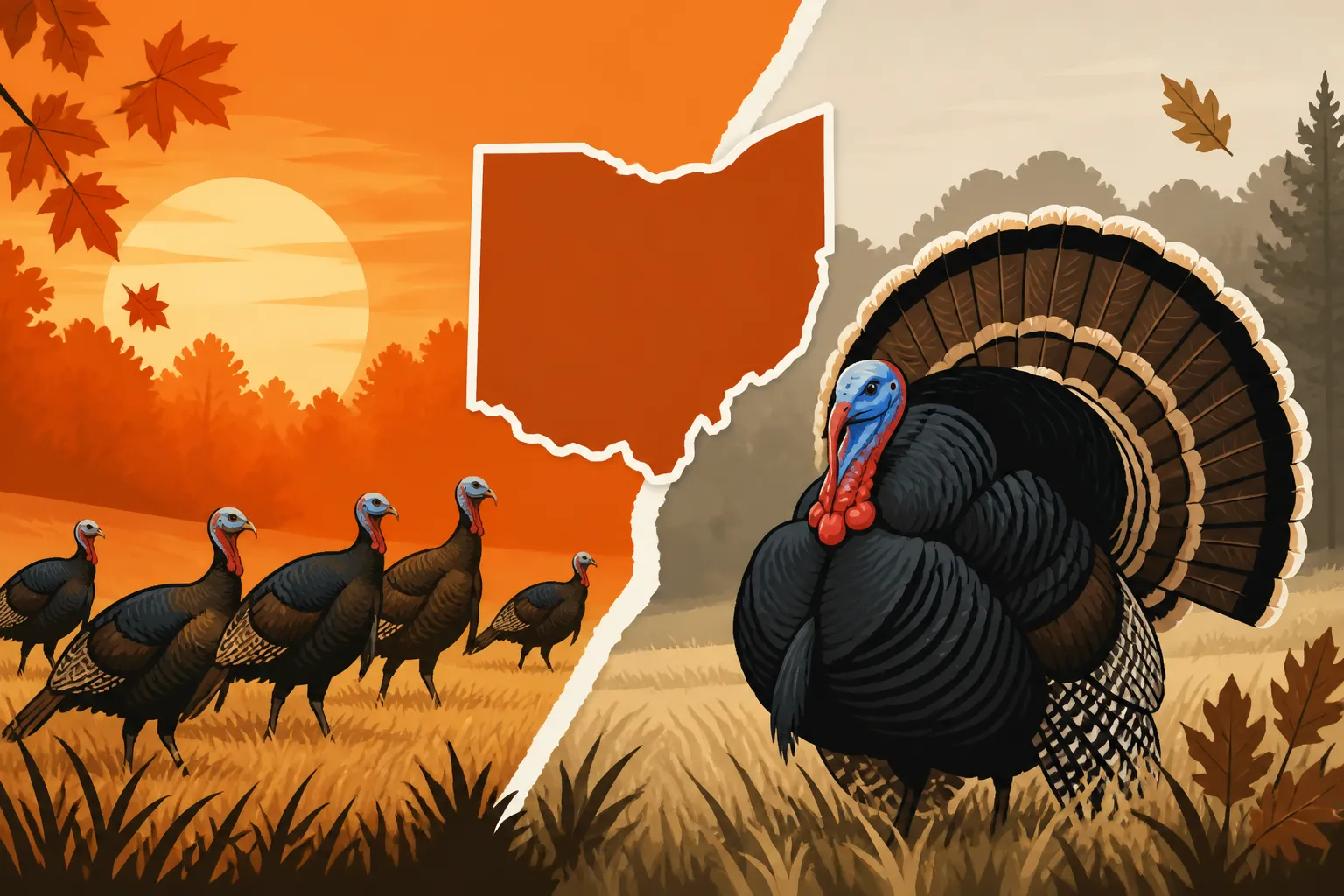
In the spring, it's all about breeding, and turkeys are driven by the urge to mate. But come fall, that instinct takes a backseat to survival, food, and safety. This is why you see those massive "super-flocks" that can sometimes number 50 or even 100 birds, especially in areas with abundant food. These are often made up of multiple hen-and-poult groups that have banded together for the cooler months. The more eyes and ears, the safer they feel from predators like coyotes, bobcats, and even domestic dogs.
These family groups, sometimes with a few jakes mixed in, stick together like glue. They forage, roost, and travel as a unit. You might also encounter smaller bachelor groups of gobblers, mature birds that have little interest in the bigger family flocks until the spring breeding season approaches. Understanding this social dynamic is crucial because it informs how they react when separated and how you’ll need to call them back. Their primary driver when scattered is to re-establish contact and regroup with their family.
Key Seasonal Changes Affecting Flocks
Ohio's fall turkey season runs from early October through late November, a period of significant change in the woods. Early fall sees turkeys heavily focused on prime mast crops like acorns, especially in the state's abundant oak forests in places like the Wayne National Forest or Shawnee State Forest. If it’s been a good acorn year, you’ll find birds gorging themselves in these areas.
As the season progresses, and particularly if mast crops become scarce or covered by snow, turkeys will shift their focus to agricultural fields. Cut corn and bean fields become magnets, offering easy calories when natural forage is harder to come down. You’ll often find them working field edges in the early morning or late afternoon. Knowing these patterns helps you narrow down your scouting efforts. A helpful tool like GoHunt can provide satellite imagery to pinpoint prime agricultural areas adjacent to timber or areas with significant oak stands, helping you predict turkey movement before you even step foot in the woods.
Weather also plays a role. Cooler temperatures in late fall mean turkeys need more calories, driving them to reliable food sources. Leaf drop significantly impacts visibility, sometimes making it easier to spot birds from a distance, but also making it harder to approach them undetected through open timber. Understanding these changes allows you to adapt your scouting and hunting strategies throughout the diverse landscapes of Ohio, from the rolling hills of the Southeast to the flat farmlands of the Northwest.
The Art of Breaking Up a Flock
Successfully breaking up a fall turkey flock isn't about quietly creeping into a setup and hoping they walk by. It's often about aggressive, controlled chaos.
Locating and Approaching the Flock
Your first step, of course, is finding the birds. In the fall, turkeys aren't as vocal as they are in the spring, so you can't rely on gobbling. Instead, it’s a lot more like deer hunting, focusing on sign and observation. Spend time glassing open fields and clearings at dawn and dusk, looking for dark shapes moving. Listen intently for subtle yelps, clucks, and the distinctive "putt" of an alarmed turkey. You can often hear them scratching in the leaves as they forage, especially on calm mornings. Dusting bowls, tracks, and droppings are also key indicators of their presence. Many hunters find success by reviewing aerial photos for southeast Ohio deer and similar techniques for turkey, using mapping tools to identify potential roosting areas or travel corridors.
Once you’ve located a flock, the approach is critical. You want to get as close as possible without being detected, using terrain to your advantage. Ridges, creek bottoms, and thick stands of pines can provide excellent cover. However, getting too close can sometimes result in them seeing you and simply walking away as a cohesive unit. The goal is to surprise them, not just spook them gently.
The Actual Break: Tactics and Timing
This is where the excitement – and the effort – comes in. The most effective way to break up a fall flock is to charge them. Yes, you read that right: charge. Once you’re within a reasonable distance (say, 50-100 yards, depending on cover), pick your moment and run at them, making as much noise as possible. Yell, wave your arms, crash through brush, stomp your feet – whatever it takes to create a sudden, terrifying disturbance. The aim is to make them panic and fly or run in every conceivable direction, breaking up their social structure.
The key here is speed and surprise. Don't hesitate. Don't try to be quiet. You want to send birds flying over ridges, through thickets, and across draws. The more disoriented they are, the better your chances of calling them back. If you can only get a few birds to scatter, it’s not as effective as getting the entire group to go in different directions. Think about how to use the terrain: if you can get between the birds and their preferred escape route, you can often push them into less familiar territory, making them even more eager to regroup. For example, if they're feeding in a draw, charge them from the ridge above, forcing them to fly out and away. This aggressive tactic might seem counterintuitive, but for fall turkeys, it’s often the best path to success.
Calling Them Back: The Setup and Strategy
Once the dust settles from your charge, the real hunt begins. The critical period immediately following the break is when you can capitalize on the turkeys' natural instinct to re-flock.
Immediate Setup After the Break
As soon as the last turkey has flown or run out of sight, your next move needs to be fast and quiet. Do not chase them further. Instead, find the quickest, most strategic place to set up within 50-100 yards of where the flock scattered. Look for good cover that conceals your outline, like the base of a large tree, a thick brush pile, or a natural blind. You need clear shooting lanes in multiple directions, as you don't know exactly where the birds will return from. Remember, in Ohio, the fall turkey season is shotgun-only, so prepare for close-range shots. For more specific advice on gear, check out our guide on Fall Turkey Tactics With a Shotgun Only.
Avoid setting up in an open area, no matter how good the visibility seems. Turkeys have exceptional eyesight, and they'll spot any unnatural movement. Pay attention to the wind direction. While not as critical as with deer, you don't want your scent blowing directly into an area where birds might be regrouping. Patience is paramount here; it might feel like an eternity, but usually, the first calls will come within 10-20 minutes, sometimes sooner.
The Calling Sequence: Lost Calls and Kee-Kees
This is the heart of fall turkey hunting after a break. When a turkey flock is busted, the birds become incredibly vulnerable and anxious. Their immediate instinct is to locate their companions. This creates a powerful window of opportunity for you to mimic those "lost" calls.
Start with soft, pleading "lost yelps" or "assembly calls." These are typically a series of soft, nasal yelps, often with a rising inflection, expressing distress and a desire to regroup. The "kee-kee run" is perhaps the most iconic fall turkey call. It starts with several high-pitched "kee-kee" notes, often made by young birds, followed by soft yelps. This call perfectly imitates a lost poult desperately trying to find its family. Many hunters find mouth calls (diaphragm calls) excellent for producing kee-kees, allowing for hands-free operation when a bird is coming in. Slate and box calls can also be effective for these sequences.
Begin with conservative calling, perhaps just a few kee-kees and soft yelps every 5-10 minutes. Listen intently between calling sequences. Often, a scattered bird will respond with its own lost calls, letting you know it’s in the area. Once you hear a response, you can become a bit more aggressive, mimicking the urgency of a turkey that wants to find its flock. If a bird is coming in, resist the urge to over-call. Just enough to keep it interested. Sometimes, a silent approach after an initial response is all it takes. Remember, the goal is to sound like a lost turkey, not a calling contest.
| Call Type | Description | When to Use |
|---|---|---|
| Lost Yelp | A series of soft, pleading yelps, often with a rising tone, signaling distress. | Immediately after scattering a flock, to mimic a confused bird trying to find its companions. Use softly and infrequently at first. |
| Kee-Kee Run | High-pitched "kee-kee" notes followed by yelps, typically from young birds. | The primary fall calling sound after a break. Very effective at sounding like a lost poult. Start soft, increase urgency if responded to. |
| Assembly Call | A louder, more drawn-out series of yelps, meant to bring a flock back together. | If birds are hesitant to commit or seem distant. Can be used after initial lost yelps and kee-kees to show a stronger presence, similar to a dominant hen calling her poults. |
| Cluck | A sharp, single note, often used for contentment or soft communication. | Sparingly, to add realism or when a bird is very close and you need to stop it for a shot. Avoid over-clucking as it can sound unnatural. |
| Purr | A soft, rolling murmur, indicating contentment. | Very rarely, and only if a bird is extremely close and calm. Use with caution as it can make birds uneasy if they don't perceive a flock. |
As birds start to get closer, they become very wary. They’ll expect to see other turkeys. Keep your movements minimal and be ready. If you see movement, be patient. Let them get into good range, and if they stop, take the shot. Don’t be afraid to make a soft "cluck" or "putt" to stop a bird if it’s walking through your shooting lane.
Common Challenges and Troubleshooting
Hunting fall turkeys in Ohio isn't always a textbook affair. There will be times when things don't go according to plan, and knowing how to adapt can save your hunt.
Dealing With Stubborn Flocks and "Hung Up" Birds
Sometimes, despite your best efforts, a flock won't scatter well. Maybe they just run off together, or only a few birds fly, leaving the majority intact. If this happens, you have a couple of options. If you know where the main group went, and the terrain allows, you can try to re-break them. This requires another aggressive charge, often from a different angle. It can be exhausting, but a good break is crucial for success. If the birds have covered a lot of ground, it might be better to move on and try to locate another flock or come back to that area on another day after they’ve settled. Remember, scouting with tools like the Ohio HuntFish App can help you quickly identify new potential areas.
Then there are the "hung up" birds. This is a classic turkey hunting frustration in any season. You're calling beautifully, they're responding, getting closer, but then they stop just out of range. This is often a dominant hen, or even a wise gobbler, that expects the "lost" bird (you) to come to them. Or, they might see something they don't like – a flash of movement, an unnatural shape, or just a gut feeling that something isn't right. This is where patience is truly tested.
Resist the urge to call too aggressively. Sometimes, going silent for 10-15 minutes can make them nervous enough to come searching. If they still won't commit, a subtle shift in position can sometimes work, but this is risky as it can reveal your location. If you’re hunting with a partner, one person can try to circle around, being extremely cautious, to get ahead of the hung-up bird, but this requires coordination and precise movement, especially in thick Ohio timber. Often, the best bet is to remain motionless, call minimally, and hope their desire to regroup overcomes their caution.
Adapting to Ohio's Diverse Terrain
Ohio offers a wide variety of landscapes, and your fall turkey tactics need to adapt accordingly. Hunting in the open farmlands of Northwest Ohio, where field edges and small woodlots dominate, presents different challenges than the steep, thick Appalachian foothills of Southeast Ohio.
In the farmlands, turkeys often roost in the scattered woodlots and then spend their days feeding in cut corn or soybean fields. Breaking a flock here might mean charging them as they cross a field, forcing them to fly into a different woodlot or across a road. Your calling setup might be along a fencerow or in a ground blind brushed into a field edge. For specific tactics in this region, check out our guide on Hunting Northwest Ohio Farmland Deer, as some of the principles of understanding field movement apply. Visibility is often greater, meaning you'll need to be extra cautious with your approach and setup.
Conversely, in the rugged terrain of Southeast Ohio, particularly in areas like Zaleski State Forest or Tar Hollow State Forest, turkeys will be heavily reliant on acorns and often hold tight to the steep ridges and hollows. Breaking a flock in thick timber might be harder, but the broken terrain also provides more cover for your approach and subsequent setup. Birds scattered over a steep ridge might struggle to regain contact quickly, making them more responsive to calls. Understanding how to use the natural contours of the land, as outlined in articles like Hunting Southeast Ohio Appalachian Foothills, becomes paramount. Additionally, wind and thermals on an Appalachian ridge can play a significant role in how sound carries and how birds approach, so always be mindful of those natural elements.
Legalities and Safety Considerations
Always, always double-check the current Ohio hunting regulations. For fall turkeys in Ohio, the season is typically shotgun-only. This means no archery equipment is permitted. Make sure you're using legal shot sizes (typically 4, 5, or 6, but verify current regulations) and that your shotgun is patterned correctly for turkey hunting. Our article on Ohio's Shotgun-Only Fall Turkey Season provides all the details you’ll need.
While blaze orange is not required for fall turkey hunting (unless gun deer season is open simultaneously, which it usually isn't), it’s always a good idea to wear it when moving through public lands, especially during other open seasons. Safety is paramount. Always identify your target clearly and know what's beyond it.
Finally, be mindful of public versus private land boundaries. Ohio has strict trespass laws, and you need permission to hunt private land. Use reliable mapping apps like GoHunt or the Ohio HuntFish app to ensure you're always on public land or land where you have explicit permission. This is especially true when a busted flock leads you on a chase. Knowing Ohio Trespass and Permission Law is crucial for any hunter in the state. If you scatter a flock and a bird lands on private property without permission, you cannot pursue it. It’s better to lose a bird than to gain a trespassing charge.
Disclaimer
Please note that hunting regulations, seasons, and licensing requirements can change. Always consult the official Ohio Department of Natural Resources (ODNR) hunting regulations for the current year before planning any hunting activity. This content is for informational purposes only and does not constitute legal advice.