Best Ohio Counties for Turkeys
There's nothing quite like the sound of a spring gobbler hammering on the roost, making the hair on your neck stand up before dawn. But let's be honest, finding consistent turkey action in Ohio can feel like a guessing game, especially with populations ebbing and flowing in different regions over the years. This guide is here to cut through the uncertainty, pinpointing the best Ohio counties for turkeys and explaining why they hold these elusive birds, giving you a real advantage this spring.
Understanding Ohio's Turkey Comeback and Distribution
For many Ohio hunters, wild turkeys weren't even a possibility for a long time. The thought of chasing gobblers through hardwood forests was a dream of the past, something only heard in old stories. But thanks to incredible conservation efforts, that dream became a reality, and understanding this journey is key to knowing where to find them today.
The Historical Journey of Ohio's Wild Turkeys
It's a bittersweet tale, really. By the early 1900s, wild turkeys were completely gone from Ohio, victims of deforestation and unregulated hunting that pretty much wiped them off the map here. Imagine a state as wild and rich in game as Ohio, without its signature big game bird. It's almost unthinkable now, but that was our reality. Thankfully, dedicated wildlife biologists and passionate hunters worked tirelessly to bring them back. Through trap-and-transfer programs starting in the 1950s, turkeys from other states were released into suitable Ohio habitats, primarily in the rugged, forested areas of southern and eastern Ohio. These initial populations thrived, and over decades, birds were trapped from these successful populations and moved to other parts of the state.
This reintroduction was a monumental success, truly a testament to what focused conservation can achieve. The Ohio Turkey Population Estimate shows just how far we've come. What started as a handful of birds eventually led to established flocks across all 88 counties. It's a comeback story that every Ohio hunter should appreciate, and it directly influences where you'll find the densest populations today. If you want to dive deeper into this amazing journey, check out the full story of How Turkeys Were Restored to Ohio.
Key Factors Influencing Turkey Hotspots
So, why do some counties consistently produce more turkeys than others, even after such widespread reintroduction? It boils down to habitat, plain and simple. Wild turkeys are particular about where they live. They need a mosaic of mature timber for roosting and foraging, interspersed with open fields or clearings for feeding, strutting, and brood rearing. Water sources, of course, are also crucial.
In Ohio, this ideal habitat is most prevalent in the unglaciated Appalachian plateau of the southeastern part of the state. Here, you find expansive tracts of oak and hickory forests covering rolling hills and deep hollows. These hardwoods provide critical mast crops – acorns, hickory nuts, beech nuts – which are vital food sources, especially heading into winter. When a severe winter or a poor mast crop hits, turkey populations can take a beating, which in turn affects the following spring's hunting. Additionally, factors like weather during nesting season and the presence of predators can really impact a hatch. It’s a delicate balance, and understanding Nest Predation and Ohio Turkey Hatches helps explain why some years are tougher than others, even in traditionally strong areas.
Top Counties for Spring Turkey Hunting in Ohio
When spring rolls around and that undeniable urge to chase gobblers hits, knowing where to focus your efforts can make all the difference. While turkeys are found statewide, certain counties stand out year after year for their consistent populations and quality hunting opportunities.
Southeast Ohio's Appalachian Strongholds
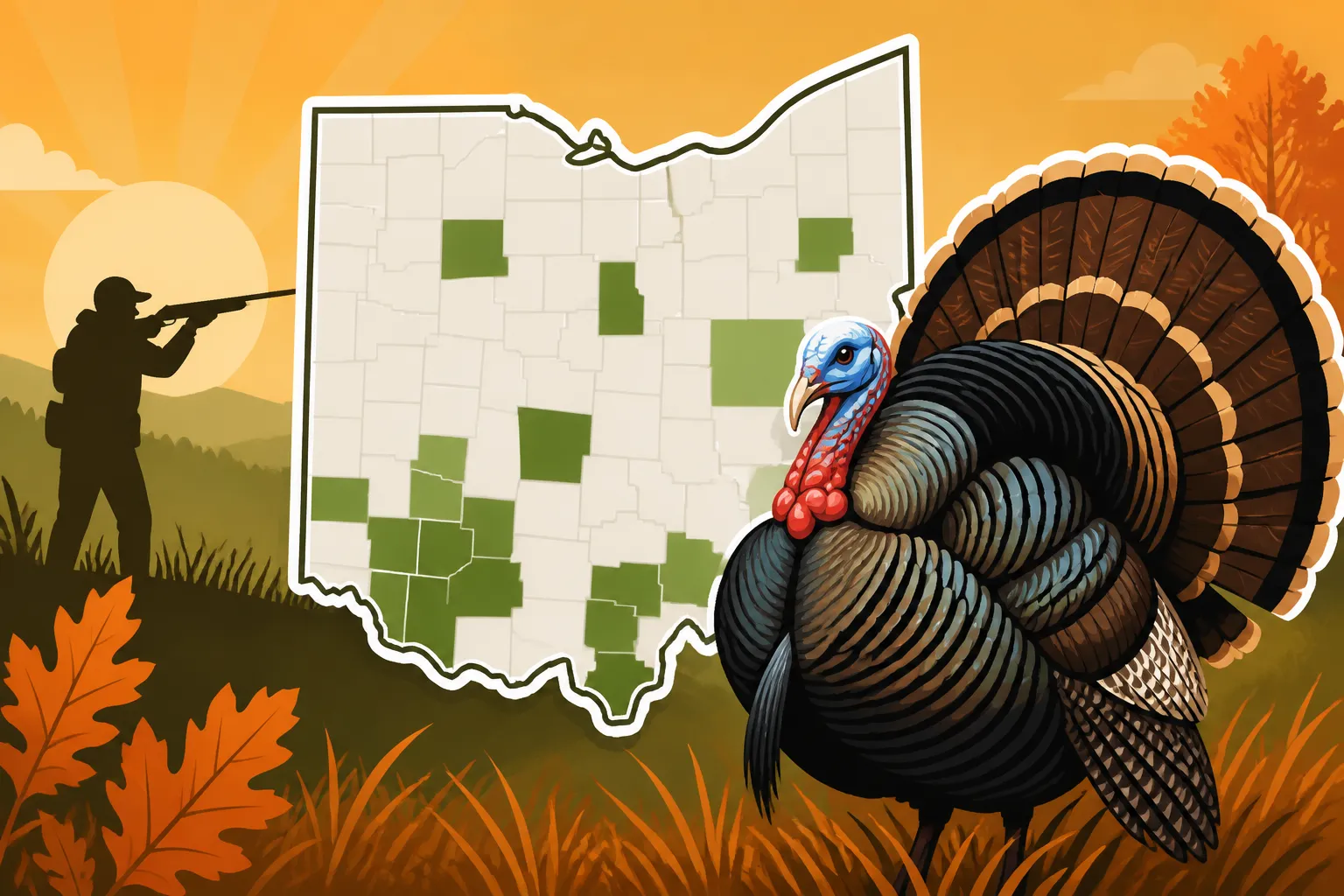
This is arguably the heart of Ohio's turkey country. The rugged, heavily forested terrain of southeastern Ohio, stretching through the Appalachian foothills, offers everything a wild turkey could ever want. We're talking about counties like Athens, Meigs, Gallia, Jackson, Vinton, Scioto, and Monroe. Here, you'll find vast expanses of big timber, steep ridges, and deep hollows that provide excellent roosting sites and abundant food sources. The continuous tracts of forest allow turkeys to thrive with less disturbance than in more fragmented agricultural landscapes.
Imagine yourself perched on a ridge in the Wayne National Forest, the first hints of pre-dawn light painting the sky, and hearing multiple gobblers erupt from the deep hollows below. That's the typical experience here. Public lands like Wayne National Forest, Shawnee State Forest, and Zaleski State Forest are scattered throughout these counties, offering hundreds of thousands of acres for hunters. These public lands are often surrounded by private timber, creating a large, contiguous habitat that sustains strong turkey numbers. This region offers some of the best opportunities for Hunting Southeast Ohio Appalachian Foothills. You can find dense populations here, especially in areas with a good mix of mature oak stands and regeneration that provides dense cover for poults. For many, these are hands-down the Best Ohio Counties for Turkeys that offer a truly immersive big woods turkey hunting experience.
Central and Northeastern Ridge Country
Moving north and east, away from the core Appalachian region but still within the unglaciated or transition zones, you'll find another excellent tier of turkey hunting counties. Think Coshocton, Guernsey, Tuscarawas, and Belmont. These counties often feature a blend of timbered ridges, agricultural fields, and river bottoms, creating a diverse habitat that can hold impressive numbers of birds.
While perhaps not as continuously forested as the deep southeast, these areas offer excellent edge habitat where turkeys can feed in fields and quickly retreat to the safety of the woods. Public hunting areas, often in the form of Wildlife Areas, are present but might be smaller and more spread out compared to the vast state forests. However, the private lands in these counties can be exceptionally productive, especially where landowners manage for wildlife or simply leave significant timber blocks. Don't overlook the potential for great turkey hunting along the Ohio River Valley, where steep bluffs and river bottom forests provide excellent turkey habitat. This is a great region for those who enjoy a mix of timber and open ground, where calling birds off a field edge can be just as exciting as a deep woods encounter.
Unexpected Pockets in the Farm Belt
Now, let's talk about some areas that might surprise you. While the heavily agricultural regions of western and northwestern Ohio aren't typically associated with booming turkey populations, there are definitely pockets where birds thrive. Counties like Muskingum, Holmes, Knox, Licking, and even parts of Wyandot, which has surprisingly high deer numbers, can hold good turkey populations, especially where significant river corridors or large, isolated woodlots exist.
The key here is finding those larger tracts of timber that provide secure roosting and nesting cover, often bordering rivers or large creek systems. These "woodlot islands" within a sea of agriculture act as refuges for turkeys. Hunting these areas often requires a different approach, relying more on scouting for specific roosts or travel corridors between woodlots and fields. While public land access might be limited in some of these counties, savvy hunters who put in the legwork to secure private land permission can find fantastic opportunities. The birds here can be just as challenging and rewarding as their Appalachian cousins. It's a different kind of hunt, perhaps more akin to Hunting Northwest Ohio Farmland Deer, where understanding the specific cover in an otherwise open landscape is paramount.
Strategies for Locating Turkeys in High-Potential Areas
Finding the right county is just the first step. To actually put yourself in a position to fill a tag, you need effective strategies for locating and approaching these wary birds. It's all about preparation, observation, and knowing how to use the tools at your disposal.
The Power of Pre-Season Scouting
Before the season even opens, your boots should be on the ground, or at least your eyes on a map. Pre-season scouting is absolutely critical for turkey hunting, perhaps more so than for any other game animal. You're looking for signs: tracks in muddy logging roads or field edges, droppings at potential roost sites, shed feathers, and strut marks in open fields or clearings. Most importantly, you're trying to locate those key roost trees. Turkeys are creatures of habit, and knowing where they're flying up and down can give you a huge advantage on opening morning.
Spend time listening at dawn and dusk. Roosting birds will often gobble before fly-down or after fly-up, giving away their general location. Use a good mapping application like GoHunt to mark potential roosting areas, strut zones, and access points. Pay attention to topography – turkeys love to roost on high points overlooking hollows, making it easier for them to survey their surroundings. This intense pre-season work is the foundation for success, especially on public ground. Get a head start by learning more about Scouting Ohio Public Land Before Season.
Calling Tactics for Ohio Gobblers
Once you've located some birds, or even if you're blind calling, your calling skills will be put to the test. Ohio gobblers can be pressured, especially on public land, so a nuanced approach is often best. Start soft, mimicking a hen's contented clucks and purrs, and gradually increase volume if you're not getting a response. Locator calls like owl hoots or crow caws can be invaluable for getting a shock gobble without giving away your position too early.
On those steep Appalachian ridges, consider how sound carries. A gobbler on an opposite ridge might sound closer or farther than he actually is. In more open farmland, calling needs to be seen as well as heard, so decoys become more crucial. Remember, turkeys have exceptional eyesight. Sometimes, the best call is no call at all, especially if a bird is already headed your way. If you're struggling to get a response off the roost, sometimes just getting in close and being patient is the best bet. For tips on waking up those sleepy longbeards, check out Calling an Ohio Gobbler Off the Roost.
Leveraging Digital Tools and Local Intel
In today's world, hunters have access to incredible digital resources, and it would be a mistake not to use them. Apps like GoHunt are game-changers. They allow you to overlay private and public land boundaries, view topographic maps to identify ridges, hollows, and access points, and even use satellite imagery to spot potential food sources or clearings. Before you even step foot in a new county, you can do extensive "e-scouting" to narrow down potential hunting spots, saving you valuable time and boot leather. GoHunt can highlight specific types of habitat and elevation changes, giving you an unparalleled view of the landscape.
Beyond the digital realm, don't underestimate the power of local knowledge. Strike up conversations at local diners, gas stations, or hardware stores in your target counties. You'd be surprised how much information you can glean from folks who live there. They might offer insights into recent turkey sightings, local crop rotations, or even point you toward a friendly landowner. Just be respectful and genuine. The Ohio Department of Natural Resources (ODNR) also provides valuable resources through their website and local offices, including maps and harvest reports. Utilizing the Using the Ohio HuntFish Map Tool is another great way to familiarize yourself with public hunting opportunities.
Ohio Turkey Management and Future Outlook
The success of Ohio's wild turkey reintroduction is a story to celebrate, but it's not a static situation. Turkey populations are dynamic, influenced by a multitude of factors, and ongoing management efforts are crucial for ensuring healthy flocks for future generations of hunters.
Factors Affecting Local Turkey Populations
Wild turkeys are truly at the mercy of their environment. Several factors can significantly impact local turkey populations, leading to fluctuations in numbers from year to year and region to region. Weather, particularly during the crucial nesting and brood-rearing periods in spring and early summer, plays a massive role. Cold, wet springs can lead to high poult mortality, meaning fewer young birds survive to adulthood, which can depress populations a couple of years down the line. Droughts can also impact food availability.
Habitat changes are another major influence. While Ohio has seen a resurgence in forested land in some areas, fragmentation due to development, logging practices, or agricultural expansion can limit suitable turkey habitat. Predators, such as coyotes, raccoons, and opossums, also take their toll on eggs and young poults. The ODNR monitors these factors closely, often through brood surveys to determine Poult-to-Hen Ratios and What They Mean, which are key indicators of a population's health and reproductive success. These ratios help biologists understand if a population is growing, stable, or declining, and can inform future hunting regulations.
Ohio's Spring Turkey Zones and Regulations
To manage turkey populations effectively across the state's diverse landscapes, Ohio employs a zone system for spring turkey hunting. The state is divided into a South Zone and a Northeast Zone, each with its own specific opening and closing dates. This allows the ODNR to tailor hunting seasons to regional differences in turkey phenology – when birds begin breeding and nesting. Generally, the South Zone, with its earlier spring, opens a bit sooner than the Northeast Zone.
Understanding these zones and their specific dates is critical before planning your hunt. Always consult the current Ohio hunting regulations to ensure you're compliant. These regulations are designed to provide ample hunting opportunity while safeguarding the long-term health of the turkey population. Knowing the season structure, bag limits, and legal hunting hours within your chosen zone is just as important as knowing where the birds are. You can find all the details on Ohio Spring Turkey Zones and Dates directly from the state's wildlife resources.
Sustainable Hunting and Conservation
As hunters, we have a responsibility to contribute to the conservation of wild turkeys and their habitats. This means adhering to all hunting regulations, accurately reporting our harvests, and practicing ethical hunting methods. When you purchase your hunting license and turkey permit, a portion of those funds goes directly towards habitat improvement projects, research, and law enforcement efforts that benefit wild turkeys and other wildlife.
Consider participating in voluntary programs or supporting organizations dedicated to wildlife habitat restoration. Every bit helps to ensure that Ohio remains a vibrant place for wild turkeys and for those of us who cherish the challenge and reward of pursuing them. By being responsible stewards of the resource, we can all play a part in writing the next chapter of Ohio's turkey comeback story, ensuring future generations can experience the thrill of a gobbler ringing in the spring woods. The continued success of the Ohio Turkey Population Estimate relies on all of us.
| County (Example) | Primary Habitat Type | Terrain | Public Land Access | Turkey Density Rating | Notes |
|---|---|---|---|---|---|
| Athens | Mixed Hardwood Forest, Agriculture | Rolling Hills, Hollows | Excellent (Wayne NF) | High | Classic Appalachian turkey hunting |
| Meigs | Hardwood Forest, Brush | Rolling, Steep | Good (State Forests, WAs) | High | Known for robust populations |
| Gallia | Mature Oak/Hickory, River Bottoms | Steep Ridges, Valleys | Excellent (Wayne NF) | High | Productive and challenging terrain |
| Coshocton | Timbered Ridges, Cropland | Rolling, Varied | Moderate (WAs) | Medium-High | Good mix of forest and agriculture |
| Muskingum | Woodlots, River Corridors, Farmland | Gently Rolling to Hilly | Moderate (WAs) | Medium | Strong private land potential |
| Scioto | Deep Hardwood Forest, Ravines | Very Steep, Rugged | Excellent (Shawnee SF) | High | Big woods, physically demanding hunt |
Disclaimer
This article is for general informational purposes only and does not constitute professional advice. Laws, prices and regulations vary by location and change over time. Consult a qualified professional for guidance on your specific situation.