How Turkeys Reached Every Ohio County
It's easy to take Ohio's robust wild turkey population for granted today, with their booming gobblers echoing through spring woods and flocks scratching through winter fields in nearly every corner of the state. However, it’s a modern success story that many hunters might not fully appreciate; wild turkeys were once completely extirpated from Ohio, vanishing for over 60 years. This comprehensive guide will trace the incredible journey of how wild turkeys were meticulously reintroduced and ultimately expanded their range to flourish in every single Ohio county.
The Historical Absence: Why Turkeys Vanished from Ohio
To truly understand the remarkable comeback of the wild turkey in Ohio, we first need to confront the devastating conditions that led to their complete disappearance. It wasn't a single event, but a perfect storm of factors that decimated their populations, leaving the Buckeye State silent of gobblers for decades.
Habitat Destruction and Logging
One of the primary culprits in the demise of Ohio's wild turkeys was the rampant habitat destruction that began in earnest with European settlement and intensified through the 18th and 19th centuries. Ohio, once covered in vast, unbroken forests, underwent a dramatic transformation. Early settlers, driven by the need for farmland and timber, embarked on extensive logging operations.
Imagine standing in what is now a thriving forest, full of towering oaks and hickories, and picturing it as it would have looked in the mid-1800s: immense tracts of mature hardwoods clear-cut to make way for agriculture. This wasn't just small-scale clearing; it was an industrial-level deforestation that fundamentally altered the landscape. Miles upon miles of prime turkey habitat, replete with acorn-producing trees and dense cover, were systematically removed. The remaining woodlands became fragmented, isolated islands too small and disconnected to support viable turkey populations. Turkeys need large, contiguous blocks of forest for nesting, roosting, and foraging, especially during harsh winters. When these blocks were broken up by farms and settlements, their essential resources dwindled.
Unregulated Hunting Pressure
Compounding the loss of habitat was the intense and unregulated hunting pressure of the era. Unlike today, there were no established hunting seasons, bag limits, or wildlife management agencies to oversee game populations. Subsistence hunting, where families relied on wild game for survival, was common, but it was market hunting that truly wreaked havoc.
Picture a time when wild game was harvested without restriction and sold to burgeoning city markets. Professional hunters would kill dozens, sometimes hundreds, of birds to meet demand. They weren't just taking a few for the pot; they were systematically clearing entire areas of game. Turkeys, being large, relatively easy to locate due to their communal roosting, and excellent sources of meat, were prime targets. There was no concept of conservation or sustainability. Every turkey taken was one less bird contributing to the next generation, and with no legal framework to protect them, their numbers plummeted at an alarming rate. It was a tragedy of the commons, where a valuable resource was exploited to exhaustion because no one was responsible for its long-term health. By the early 1900s, wild turkeys were completely gone from Ohio's landscape.
The Comeback Story: Ohio's Restoration Efforts
The silence of Ohio's woods, once filled with the calls of wild turkeys, prompted a desire for their return. However, the path to restoration was not straightforward, beginning with some valiant but ultimately flawed attempts before hitting on the strategy that would prove revolutionary.
Early Unsuccessful Attempts
When conservation efforts first began in the mid-20th century, the prevailing thought was to simply breed turkeys in captivity and release them into the wild. After all, it seemed logical: if there weren't enough wild turkeys, you could just make more. Various well-meaning individuals and organizations tried to reintroduce pen-raised birds. These birds, often domestic or semi-domesticated strains, were raised in controlled environments, fed by humans, and had little to no experience surviving in a natural ecosystem.
The results were consistently dismal. These captive-bred turkeys lacked the crucial survival instincts of their wild cousins. They didn't know how to forage efficiently for natural foods, how to evade predators, or how to navigate the complex social structures of a wild flock. Many succumbed to disease, starvation, or became easy prey for foxes, coyotes, and hawks. It was a harsh lesson, but a necessary one: you couldn't simply "farm" wild turkeys back into existence. The wildness, the genetic hardiness forged over millennia of natural selection, was indispensable.
Trap-and-Transfer: The Game Changer
The turning point in turkey restoration, not just in Ohio but across North America, came with the development and widespread adoption of the "trap-and-transfer" method. This technique involved capturing genuinely wild turkeys from areas with healthy, thriving populations and relocating them to suitable new habitats where turkeys had been extirpated. It was a revolutionary approach that capitalized on the innate survival skills of truly wild birds.
The process often involved "rocket netting" or "cannon netting," where specialized nets were launched over feeding flocks of turkeys, temporarily capturing them. Biologists and wildlife technicians would then carefully examine, band, and load these precious birds into specially designed transport crates. These wild-trapped birds, genetically programmed for survival, were then released into carefully selected habitats in Ohio. These initial release sites were often in robust, unbroken forest tracts, far from human disturbance, providing the best chance for the birds to establish themselves. The success of this method quickly became apparent; these relocated birds thrived, established breeding populations, and began to naturally expand their range.
The Ohio Department of Natural Resources (ODNR) spearheaded these efforts, collaborating with other states and conservation groups. ODNR's data shows the incredible progress, offering an accurate Ohio Turkey Population Estimate and explaining How Turkeys Were Restored to Ohio. For anyone interested in the nitty-gritty of how conservation biologists planned these operations, tools like GoHunt’s detailed mapping features, while modern, illustrate the kind of precise land analysis that would have been invaluable for scouting ideal release sites and understanding potential turkey movements in a new landscape. It truly was a monumental undertaking, requiring dedication, scientific understanding, and a willingness to learn from past failures.
Spreading Across the Buckeye State
With the trap-and-transfer method proving successful, the next phase was to ensure the wild turkey populations not only survived but also spread, gradually reclaiming their ancestral lands across Ohio. This required careful planning and an understanding of turkey ecology.
Identifying Suitable Release Sites
The initial success of the trap-and-transfer program hinged on the meticulous selection of release sites. Biologists didn't just drop birds anywhere; they identified specific areas within Ohio that offered the best chances for long-term survival and reproduction. These sites typically boasted ample mature timber, particularly mast-producing trees like oaks and hickories, which provide critical food sources. A diverse understory, offering dense cover for nesting hens and protection from predators, was also crucial.
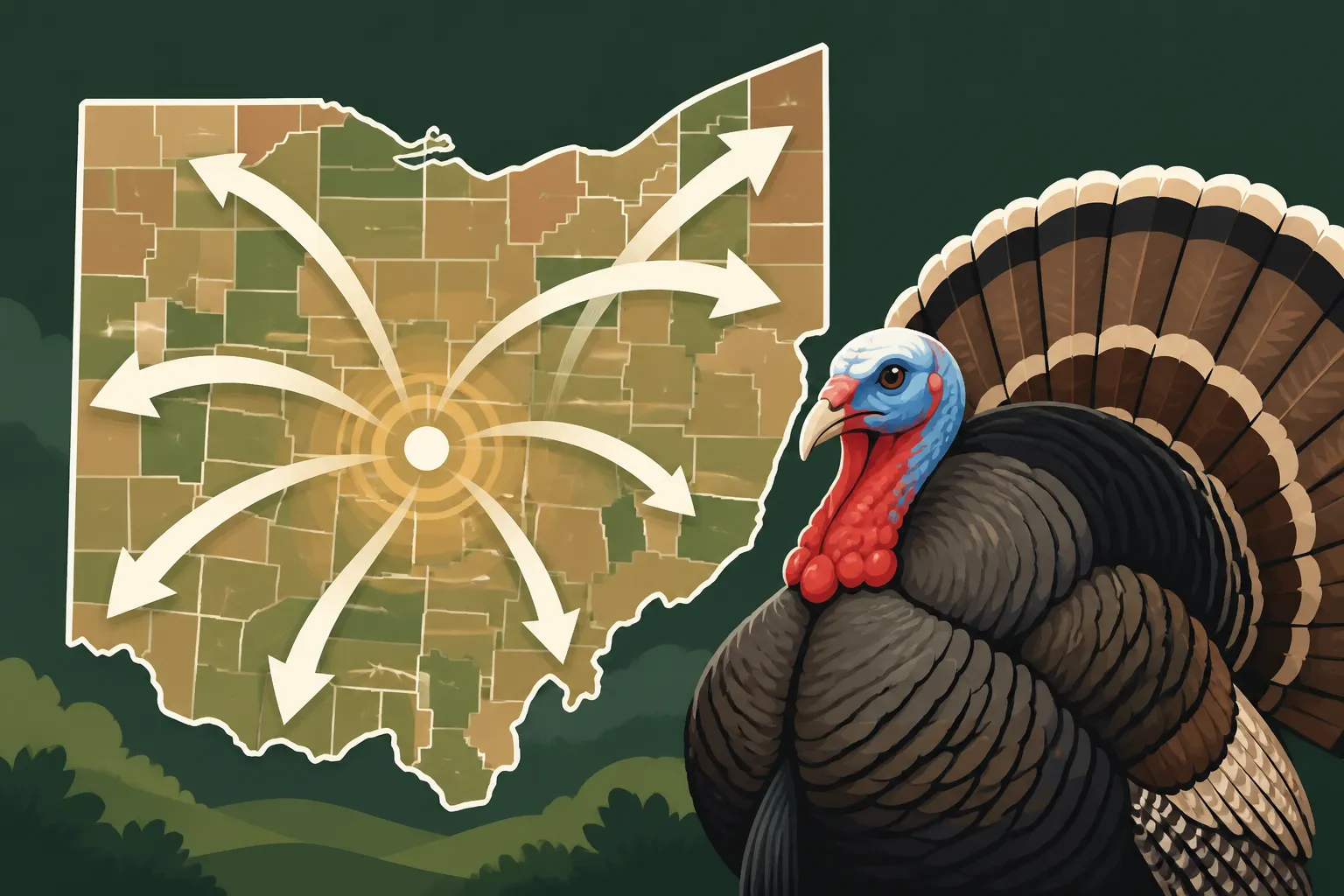
Furthermore, water sources and areas with limited human disturbance were prioritized to give the newly released birds the peace and quiet they needed to acclimate and reproduce. These strategically chosen pockets became the epicenters from which turkey populations radiated outwards. Consider the rugged, dense woodlands of places like Wayne National Forest Hunting in southeastern Ohio or the vast, protected expanses of Shawnee State Forest Hunting in the south-central part of the state. These areas, with their unbroken forest canopy and diverse ecosystems, provided the perfect "nurseries" for the fledgling turkey populations to grow and thrive. GoHunt's mapping capabilities, if they had existed then, would have been invaluable for identifying these pristine, remote locations with ideal habitat structure. The careful thought put into these early releases laid the groundwork for statewide recolonization.
Natural Expansion and Adaptation
Once established in these initial strongholds, the wild turkeys began their natural expansion, demonstrating an impressive adaptability that surprised even some biologists. From the primary release sites, flocks naturally dispersed, following river corridors, wooded stream bottoms, and continuous tracts of woodlands. As populations grew, younger birds would venture further afield, seeking out new territories.
This gradual, organic spread allowed turkeys to adapt to the varied landscapes of Ohio. While they thrived in the deep forests of the Appalachian foothills, they also demonstrated a remarkable ability to colonize woodlots and fencerows within the state's more agricultural regions. This included areas like Hunting Northwest Ohio Farmland Deer, where fragmented forests and smaller woodlots interspersed with vast fields now provide sufficient habitat for turkeys. The resilience of these wild birds meant they could utilize a mosaic of habitat types, as long as essential components like roosting trees, foraging areas, and nesting cover were present. It was truly a testament to their inherent robustness and the effectiveness of reintroducing truly wild stock. Witnessing these flocks gradually appear in counties where they hadn't been seen for well over a century was a powerful sign of success. This natural spread, meticulously tracked by ODNR, has been instrumental in shaping Ohio Turkey Population Trends and understanding Where Ohio Turkeys Are Densest today.
The Role of Habitat Management and Modern Hunting Regulations
The successful reintroduction and spread of wild turkeys across Ohio wasn't a one-and-done project. It required ongoing commitment to habitat health and the establishment of sustainable hunting practices, ensuring that the mistakes of the past would not be repeated.
Continued Habitat Improvement
While the trap-and-transfer program brought turkeys back, it's the continuous, proactive habitat management that has sustained their growth and presence in every county. The Ohio Department of Natural Resources, along with private landowners and conservation organizations, consistently works to maintain and enhance turkey habitat. This isn't about letting forests simply grow wild; it's about active management.
Practices include selective timber harvesting, which creates a mosaic of different forest ages and structures, providing both mature mast-producing trees and dense young growth for nesting and cover. Prescribed burns are often used to remove overgrown underbrush, encourage new plant growth, and improve foraging conditions. Landowners are encouraged and supported in creating diverse understory vegetation, planting native trees and shrubs, and protecting riparian corridors. This integrated approach ensures that the landscape provides a continuous supply of food, water, and shelter throughout the year, crucial for robust turkey populations. A hunter planning their property management or scouting new public land for turkeys might turn to detailed mapping applications, just as they might use GoHunt to assess terrain and vegetation types, to identify areas ripe for habitat improvement or those already offering prime turkey opportunities.
Sustainable Hunting Seasons
Crucially, the return of wild turkeys coincided with the advent of modern wildlife management and the implementation of regulated hunting seasons. Unlike the unregulated slaughter that led to their extirpation, today's hunting seasons are carefully crafted to be sustainable, ensuring that harvest levels do not negatively impact the overall population.
This includes setting specific season dates, such as those outlined in Ohio Spring Turkey Zones and Dates, and establishing bag limits, like the Ohio Spring Turkey Bag Limit. These regulations are based on scientific data, population surveys, and reproductive success, allowing hunters to enjoy the resource while ensuring its long-term health. The revenue generated from hunting licenses and turkey permits, in turn, helps fund further conservation efforts, habitat acquisition, and wildlife research. Hunters, through their participation and adherence to regulations, have become an integral part of the conservation solution. Without their support and the financial contributions through license purchases, many of these programs would not be possible. Understanding Ohio Turkey Harvest Numbers is vital for adjusting these regulations, maintaining a healthy balance between opportunity and conservation. Hunters are also required to meet Ohio Hunter Education Requirements to ensure safe and ethical participation. Furthermore, scouting techniques, like those detailed in Scouting Ohio Public Land Before Season, emphasize ethical practices and understanding the landscape, aligning with responsible hunting and conservation.
Ohio's Wild Turkey Journey: Key Milestones
To summarize the incredible journey of Ohio's wild turkeys, let's look at the contrast between their historical decline and their modern success:
| Feature | Pre-1900s (Decline/Extirpation) | Post-1950s (Restoration/Current) |
|---|---|---|
| Habitat | Widespread deforestation, fragmented forests, minimal cover. | Forest regeneration, active habitat management, diverse ecosystems. |
| Hunting Regulations | Unregulated market hunting, no seasons or bag limits. | Scientific management, specific seasons, strict bag limits. |
| Reintroduction Method | Unsuccessful pen-raised bird releases. | Highly successful wild trap-and-transfer program. |
| Population Status | Extirpated (completely gone by early 1900s). | Thriving, widespread, established in every Ohio county. |
| Conservation Funding | None. | Funded by hunting licenses and conservation groups. |
The journey of the wild turkey in Ohio is a powerful testament to what dedicated conservation efforts, scientific management, and the support of hunters can achieve. From a state completely devoid of these magnificent birds, Ohio now boasts a robust and healthy turkey population, a source of pride and a challenging pursuit for sportsmen across the Buckeye State.
Disclaimer
This article is for general informational purposes only and does not constitute professional advice. Laws, prices and regulations vary by location and change over time. Consult a qualified professional for guidance on your specific situation.