Thermal and Night Vision Rules in Ohio
It's incredibly frustrating when you're trying to embrace new hunting technology, like thermal or night vision devices, but feel like you're navigating a minefield of regulations. The last thing any ethical hunter wants is to accidentally break a rule, especially when these tools can be a real game-changer for scouting, recovery, and hunting specific nuisance animals. There's a lot of hearsay and misunderstanding out there, and it leaves many folks scratching their heads, wondering what's truly permissible. This comprehensive guide is here to cut through that confusion, clarifying the specific rules and legal applications for thermal and night vision gear when you're out in the Ohio woods.
Understanding Ohio's General Night Hunting Regulations
Before we even dive into the specifics of thermal and night vision, it’s crucial to understand the foundational rules about hunting after dark in Ohio. Unlike some states with more liberal night hunting provisions, Ohio has historically maintained strict controls, primarily to manage its robust deer herd and ensure fair chase. These regulations often dictate not just what you can hunt, but when you can pursue them, and the type of equipment you're allowed to use. Getting a handle on these basic parameters is your first step to staying on the right side of the law.
Legal Shooting Hours: When Hunting is Generally Allowed
For most game animals in Ohio, hunting is permitted only during specific legal shooting hours. Typically, this means from a half-hour before sunrise until a half-hour after sunset. This timeframe is designed to ensure visibility for hunters and to prevent undue pressure on game animals during their most vulnerable nocturnal periods. Imagine trying to identify a target clearly in the deep twilight or pitch black with traditional optics – it’s a recipe for misidentification and unsafe shots, which is exactly what these regulations aim to prevent.
These established hours apply across the board for popular species like deer, wild turkeys, and most small game. Any deviation from these times is usually a specific exception, not the rule. It's why you see so many deer hunters heading out to their stands well before dawn, waiting for that legal light to break, and then packing up as soon as the half-hour after sunset window closes. It’s a core principle of ethical and safe hunting that’s deeply ingrained in Ohio’s hunting culture.
Species-Specific Rules: Which Animals Can Be Hunted at Night
While most game animals are restricted to daytime hunting hours, Ohio does make exceptions for certain species, primarily those classified as furbearers or nuisance animals. This is where the landscape for night hunting, and consequently the use of thermal and night vision, starts to open up. Think about animals like raccoons and coyotes; their behavior is predominantly nocturnal, and managing their populations often necessitates hunting them after dark.
Raccoon hunting, for example, is a rich tradition in Ohio, often involving hounds and dedicated night hunts. Similarly, coyotes, which can be a significant concern for livestock owners and even deer fawn populations, are a prime target for night hunting. The specific rules for these species, including season dates and methods, are laid out clearly by the state's wildlife agency. It’s critical to remember that these species-specific allowances are precisely that – specific. They don't automatically extend to deer or other traditional game animals. You can find more details on these specialized hunts in articles like Raccoon Hunting at Night in Ohio and Coyote and Predator Hunting in Ohio.
Thermal and Night Vision: The Ohio Deer Hunting Context
This is often the core question for many Ohio hunters: can I use thermal or night vision to hunt deer? The short answer for most typical hunting scenarios is generally "no," and it's a rule that causes a fair bit of discussion among hunters. The rationale behind these restrictions for deer hunting is rooted in principles of fair chase, conservation, and public perception.
Deer Hunting Restrictions: Why Thermal/Night Vision is Typically Restricted for Deer
Ohio law prohibits the use of any artificial light, thermal, or night vision device to spot, locate, or take deer. This means that if you're out pursuing whitetails, even during legal shooting hours, you cannot use these technologies to gain an advantage. The intention is to maintain a level playing field between the hunter and the deer, ensuring that the animal has a reasonable chance to escape based on its natural senses. Imagine a deer in a dark woodlot, relying on its keen sense of smell and hearing, only to be effortlessly located by a device that turns night into day. This would fundamentally alter the challenge and spirit of deer hunting as many know it.
The restriction isn't just about the moment of the shot; it extends to the entire act of hunting. You can't use a thermal scanner to find deer bedding areas before dawn or locate deer moving through heavy cover in low light, even if you plan to shoot them legally with traditional optics during the day. The devices themselves are the prohibited tool when it comes to deer. This regulation is a direct reflection of long-standing hunting ethics that prioritize a challenging and respectful pursuit of game. Understanding Ohio Deer Season Structure Explained can help put these specific equipment rules into broader context.
Exceptions and Special Permits: Are There Any Scenarios for Deer?
While the general rule is no thermal or night vision for deer hunting, specific situations can sometimes create confusion or prompt questions about exceptions. It's important to differentiate between nuisance control permits and general hunting regulations. For the vast majority of deer hunters, the answer remains a firm "no." There are no statewide provisions that permit the use of thermal or night vision devices for harvesting antlered or antlerless deer during the regular archery, gun, or muzzleloader seasons.
However, in extremely rare and highly regulated situations, such as severe crop damage or specific urban deer management programs, wildlife authorities might issue special permits to landowners or designated agents that could include unconventional methods. These are not standard hunting permits, are highly site-specific, and would come with explicit instructions and limitations. They are designed for control purposes, not recreational hunting, and would require direct authorization from the Ohio wildlife division. For the everyday hunter planning their season, assume thermal and night vision are off-limits for deer.
Legal Use Cases for Thermal and Night Vision in Ohio
Now, let's talk about where thermal and night vision are explicitly permitted and incredibly effective in Ohio. This is where these technologies truly shine, offering hunters invaluable tools for managing predator populations, dealing with nuisance animals, and enhancing safety during non-hunting activities. Understanding these legal applications allows you to invest in and use these devices with confidence.
Coyote and Predator Hunting: The Primary Legal Application
This is the big one! Ohio does allow the use of thermal and night vision equipment for hunting coyotes, as well as other unprotected furbearers, during their respective open seasons. Coyotes are considered a nuisance species in many parts of the state due to their impact on livestock and sometimes even smaller game populations. Because coyotes are primarily nocturnal, allowing these advanced optics levels the playing field for hunters trying to manage their numbers. You're free to use thermal scopes on your rifle or thermal handheld scanners to locate and engage coyotes after dark. This has opened up a whole new world for predator hunters in Ohio.
Many hunters dedicate significant time to calling coyotes, especially in the winter months when their fur is prime and visibility in the fields is reduced. Thermal optics provide a distinct advantage, allowing you to spot coyotes approaching your setup from hundreds of yards away, long before they might appear to the naked eye or even traditional night vision. This makes for a much more effective and, frankly, safer hunt. Hunters should always review Night Hunting Rules for Ohio Coyotes and Ohio Coyote Hunting Season Rules to ensure they are compliant with all other aspects of the hunt, such as firearm restrictions and land permission. Many users of platforms like GoHunt appreciate the ability to check public land boundaries even in remote areas, which is vital when pursuing these elusive canids at night.
Other Nuisance Animals: Discussing Feral Hogs or Other Authorized Species
Beyond coyotes, thermal and night vision can also be legally applied to other nuisance animals as defined by Ohio law, if those animals are allowed to be hunted at night. While feral hogs are not widespread in Ohio compared to some southern states, they do pop up occasionally, and if present and authorized for removal, thermal optics would be an invaluable tool for control given their nocturnal habits. Similarly, if there were any specific local depredation permits issued for other animals where night removal was deemed necessary, thermal or night vision could be part of the authorized equipment.
It's always essential to consult the most current Ohio hunting and trapping regulations or directly contact the Ohio Department of Natural Resources (ODNR) for clarification on specific species or unusual circumstances. The key takeaway is that for nocturnal animals explicitly designated as furbearers or nuisance species, and for which night hunting is permitted, thermal and night vision are generally accepted tools. This is distinctly different from their prohibition for deer.
Retrieval and Scouting: Non-Hunting Uses
Even when not used for the act of hunting itself, thermal and night vision devices can be incredibly beneficial and legal for other hunting-related activities.
Game Recovery: One of the most common and widely accepted non-hunting uses for thermal technology is tracking and recovering wounded game, particularly deer. Imagine you've made a shot on a deer during legal shooting hours, but the deer runs into thick cover as darkness falls. Using a thermal scanner, you can often pick up the heat signature of the animal, or even a blood trail that's still radiating residual body heat, making recovery much more efficient and humane. This use is generally permitted because you are not hunting the animal with the device; you are recovering it after a legal shot. It’s a tool for ethical recovery, preventing lost game.
Scouting and Surveillance: Thermal and night vision can also be fantastic tools for scouting property and observing wildlife without the intent to harvest. Want to see what's really moving through that woodlot at 2 AM? A thermal handheld can show you deer, coyotes, or even raccoons traversing your property, giving you valuable intelligence on movement patterns without ever pointing a weapon. This is also completely legal, as you are not actively hunting. Many hunters use tools like GoHunt to mark potential travel corridors they discover during these nocturnal scouting sessions, which can then inform their treestand setups for legal hunting hours. Seeing a deer's heat signature against a cold field or through dense fog provides insights that traditional trail cameras simply can't always capture, helping you understand nocturnal patterns and where deer might be bedding down.
Choosing and Using Thermal/Night Vision Legally and Ethically
So, you're convinced that thermal or night vision has a place in your Ohio hunting toolkit, especially for coyote hunting or ethical game recovery. Now, how do you choose the right gear and ensure you're always operating within the bounds of both the law and good ethical practice?
Understanding Device Capabilities: Thermal vs. Night Vision
It’s important to distinguish between thermal and traditional night vision, as their technologies and applications differ.
-
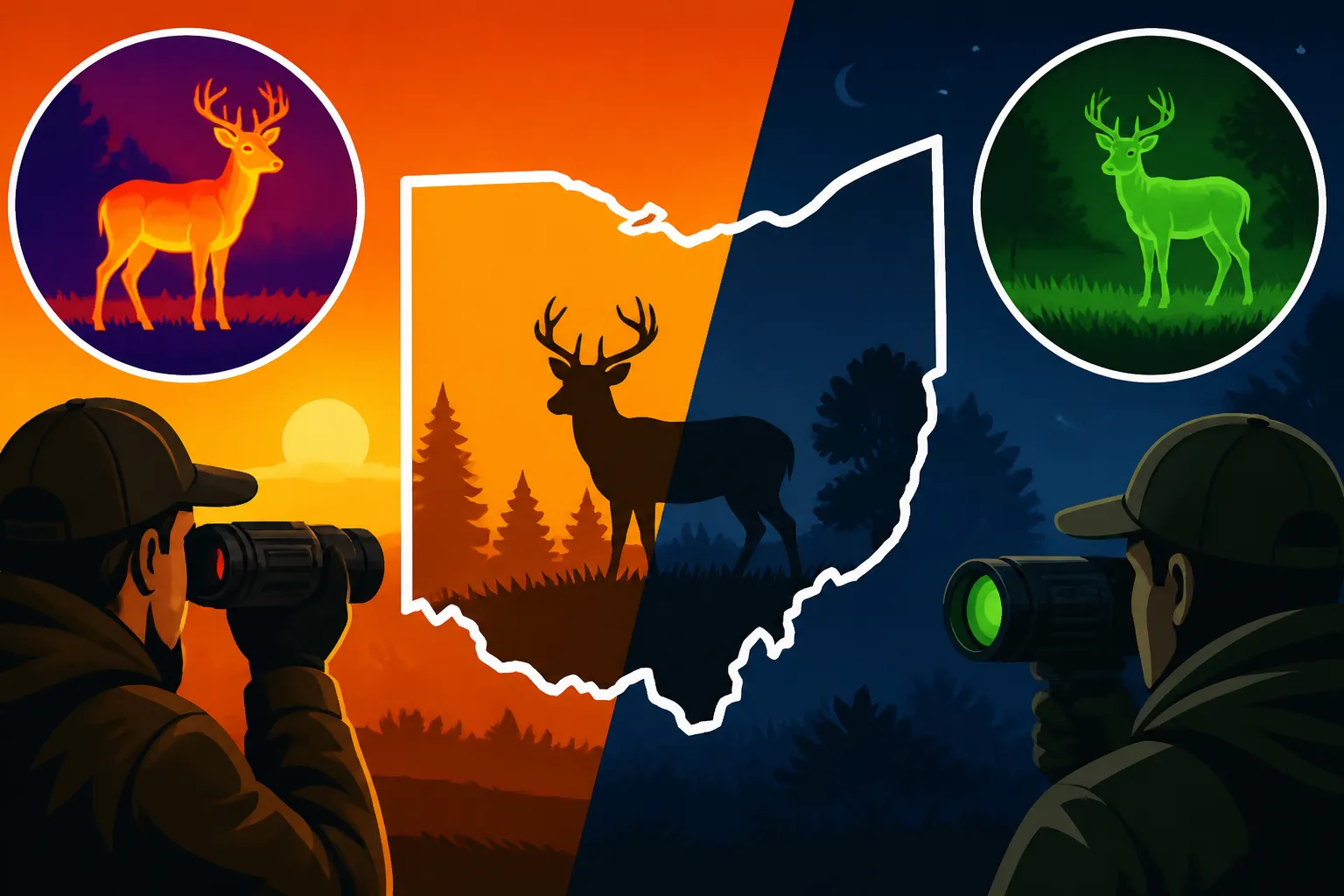
Thermal Imaging: These devices detect infrared radiation (heat signatures) emitted by objects. They don't require any ambient light to function. Animals, being warm-blooded, stand out vividly against cooler backgrounds, making them exceptional for spotting game in complete darkness, heavy fog, or thick brush. They're excellent for detection and distinguishing living creatures from the environment. GoHunt users often combine thermal scouting data with their mapping tools to identify active areas.
-
Traditional Night Vision: These devices amplify existing ambient light (starlight, moonlight). They provide a green-tinted image that allows you to see in low-light conditions, but they need some light to work. They are generally better for target identification once an animal is detected, as they offer more detail than many thermal units. For predator hunting, some hunters prefer a thermal scanner for initial detection and then transition to a night vision scope for the shot if precise identification is needed in very dim conditions where thermal might not provide enough detail to distinguish a specific target.
Both technologies have their strengths, and the best choice often depends on your primary use case and budget. For pure detection and recovery in any conditions, thermal is usually superior. For identifying specific details in very low light, night vision can sometimes offer a clearer picture if there's some ambient light available.
Staying Compliant: Double-Checking Regulations, Using Tools like GoHunt
The regulations around thermal and night vision can sometimes change or be interpreted differently, which is why your ongoing diligence is key. Never assume that what was legal last year, or what's legal in another state, is automatically permissible in Ohio.
- Annual Regulation Review: Always, always read the current Ohio Hunting and Trapping Regulations digest before each season. These are published annually and are the definitive source for what's allowed. Changes can occur, and it's your responsibility to be informed.
- ODNR Contact: If you have any doubts whatsoever, contact the Ohio Department of Natural Resources (ODNR) directly. Their wildlife officers are the experts and can provide clear, official guidance. It’s far better to ask than to inadvertently violate a regulation.
- Utilizing Mapping Apps: Tools like GoHunt can be invaluable resources. While they won't tell you the legality of thermal use, they can show you public land boundaries, property ownership, and regulations specific to certain wildlife areas. This helps ensure you're hunting on legal ground and within authorized zones, which is especially important when pursuing nocturnal predators that might cross property lines. When planning a night hunt for coyotes, knowing your exact position and property lines is paramount to avoid trespassing. You can't just be out calling in the dark without knowing precisely where you stand.
Ethical Considerations: Beyond Just Legal, What's Good Practice
Beyond the letter of the law, there are ethical considerations that every hunter should reflect on when using advanced optics like thermal and night vision.
- Fair Chase: While thermal is legal for coyotes, remember the spirit of fair chase. Are you still giving the animal a reasonable chance? Most predator hunters would argue that for nocturnal, intelligent animals like coyotes, thermal simply levels the playing field rather than creating an unfair advantage. However, maintaining good judgment and shot selection is always critical.
- Target Identification: With thermal, distinguishing between species can sometimes be tricky, especially at longer ranges or in areas with varied wildlife. Always be 100% certain of your target before you take a shot. Is it definitely a coyote, or could it be a fox, or even a dog? A thermal scanner might show you a heat signature, but a quick confirmation with traditional optics or even a red-light spotlight (where legal for the species) might be prudent before committing to a shot. This is especially true if you are hunting near populated areas, or somewhere you might encounter domestic animals.
- Public Perception: The hunting community faces constant scrutiny. Using advanced technology responsibly and ethically helps maintain a positive image of hunting. Avoid any actions that could be perceived as unsporting or give hunting a bad name. This means using thermal for its intended, legal purposes, and never for something like poaching deer under the cover of darkness.
Using thermal and night vision in Ohio can dramatically enhance your hunting experiences, especially for predator control and game recovery. Just remember to stay informed, prioritize safety, and always adhere to both the written laws and the unwritten code of ethics that guide responsible hunting.
Disclaimer
This article is for general informational purposes only and does not constitute professional advice. Laws, prices and regulations vary by location and change over time. Consult a qualified professional for guidance on your specific situation.