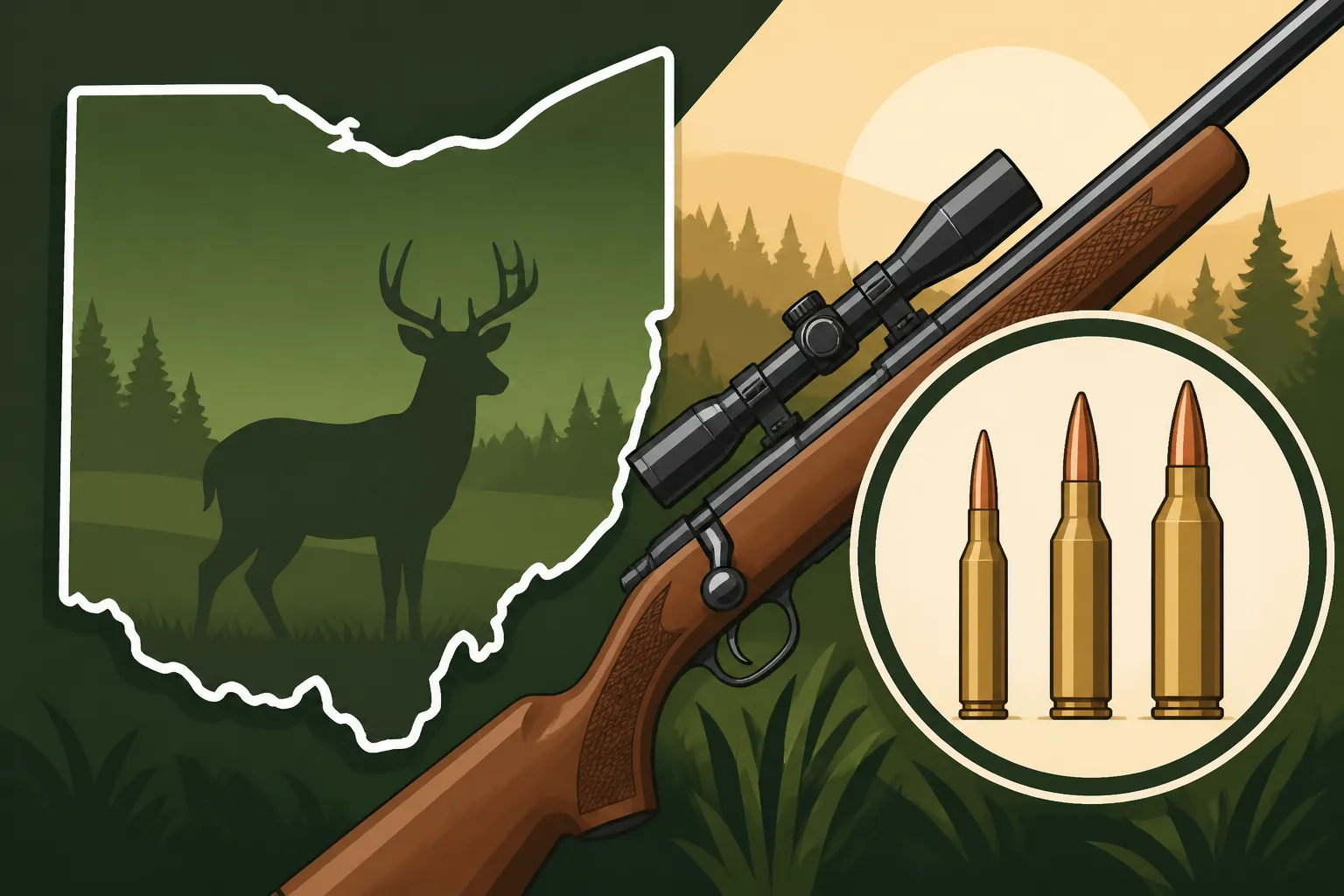
Ohio Minimum Rifle Caliber Rules
It's no secret that Ohio's firearm regulations for deer hunting can feel like navigating a dense thicket after a fresh snow. Just when you think you've got a handle on what's legal, something shifts, or a new cartridge comes out, leaving you scratching your head at the sporting goods counter. For years, deer hunters in Ohio's shotgun zones were restricted to shotguns, muzzleloaders, and handguns, leading to a lot of frustration. But with the introduction of straight-wall cartridge rifles, things changed, though not without their own set of specific rules. This guide is here to untangle the confusion surrounding Ohio's minimum rifle caliber rules, ensuring you're confidently and legally equipped for your next deer hunt.
Understanding Ohio's Straight-Wall Cartridge Regulations
Before 2014, if you were hunting deer in Ohio's traditional shotgun zones, your options were pretty limited. We're talking shotguns loaded with slugs, muzzleloaders, and certain handguns. It made sense in some ways – the idea was to limit the range of firearms in more populated areas, minimizing the risk of a projectile traveling too far. But for many hunters, it felt like a handicap, especially when compared to states that allowed centerfire rifles across the board. The good news is, Ohio embraced progress, and now we have the option of straight-wall cartridge rifles, which has been a game-changer for countless deer hunters across the state.
Why Straight-Wall? A Look at the History and Purpose
The transition to allowing straight-wall cartridge rifles in Ohio's traditional shotgun-only zones came from a growing recognition that technology had advanced, and there were rifle calibers that offered better accuracy and ethical performance than traditional slug guns, all while adhering to similar safety parameters. Shotgun slugs, while effective at close range, often lose significant energy and accuracy past 100 yards, and let's be honest, getting consistent groups with a smoothbore slug gun beyond that can be a real challenge.
Hunters consistently voiced their desire for a more effective tool within the confines of existing safety concerns. The "straight-wall" designation was the solution. It refers to cartridges where the casing walls are essentially straight from the base to the mouth, without the characteristic "bottleneck" shoulder found on many high-powered, long-range rifle cartridges like a .30-06 or .270 Winchester. The idea is that these straight-wall cartridges, while certainly more accurate than slugs, typically have a ballistic trajectory and effective range more akin to shotgun slugs, making them safer for use in areas with higher population densities or smaller woodlots. It was a compromise that gave hunters a much-needed boost in confidence and capability without sacrificing public safety. You can dive deeper into the historical context by looking into articles like Why Ohio Once Required Shotguns for Deer.
The Specifics: Caliber and Case Length Requirements
Ohio's regulations for straight-wall cartridge rifles are quite specific, and it's crucial to know these details before you head to the woods. The Ohio Department of Natural Resources (ODNR) sets clear guidelines for what constitutes a legal straight-wall cartridge for deer hunting.
Here’s the breakdown:
- Minimum Caliber: The cartridge must have a caliber of at least .357 inches. This means anything smaller, like a .223 Remington (which is a bottleneck cartridge anyway) or even a .30-30 Winchester (which is straight-walled but typically considered bottlenecked by ODNR for these rules due to its rimmed case and projectile design), is out.
- Maximum Caliber: The cartridge cannot exceed a caliber of .50 inches. This leaves out some of the truly massive big-bore options.
- Minimum Case Length: The case length must be at least 1.16 inches. This is important because it rules out shorter handgun cartridges that might otherwise meet the caliber requirement, like a standard .38 Special, which typically has a case length of around 1.15 inches or less, though a .357 Magnum (1.29 inches) would easily qualify.
- Maximum Case Length: The case length cannot exceed 1.80 inches. This prevents the use of longer, more powerful straight-wall cartridges that might stretch the "limited range" intent, such as some of the larger black powder express cartridges.
So, when you're looking at ammunition boxes or rifle specifications, these are the numbers you need to keep in mind. The rules explicitly refer to Ohio Straight-Wall Cartridge Rules, which are designed to offer a balance between hunter effectiveness and public safety.
Common Compliant Straight-Wall Calibers for Ohio Deer
With the regulations laid out, let's talk about the calibers that actually fit the bill. There's a reason why some cartridges have soared in popularity since these rules were put in place—they simply perform exceptionally well within the Ohio hunting landscape. Knowing your options will help you make an informed decision when you're looking to purchase a new rifle or ammunition for your next season.
Popular Choices and Their Performance
When it comes to straight-wall rifle cartridges for Ohio deer, a few stand out as clear favorites due to their widespread availability, performance, and overall effectiveness.
-
.450 Bushmaster: This caliber has quickly become a powerhouse in Ohio deer camps. It's essentially a .45-caliber bullet in a straight-wall case, delivering significant knockdown power. Many hunters rave about its accuracy and the confidence it inspires when taking shots out to 150-200 yards. The recoil can be stout, especially in lighter rifles, but it's generally manageable for most hunters. It truly shines in open field edges or wider timber clearings. For those hunting in the rugged terrain of Southeast Ohio, the 450 Bushmaster for Appalachian Ohio Ridges offers excellent performance.
-
.350 Legend: Winchester really hit a home run with the .350 Legend, specifically designing it to be compliant with straight-wall regulations in states like Ohio. It's often touted as having less recoil than the .450 Bushmaster, making it a favorite for youth hunters, those sensitive to recoil, or anyone looking for a more comfortable shooting experience. Despite the lighter recoil, it delivers plenty of energy for deer out to similar ranges as the .450 Bushmaster, often with slightly flatter trajectories. If you're wondering if a .350 Legend is Enough for Ohio Whitetails, the answer is a resounding yes.
-
.44 Magnum: While often associated with handguns, the .44 Magnum in a rifle (especially a lever-action) is a fantastic, classic choice. It meets all of Ohio's straight-wall requirements, offering moderate recoil and excellent terminal performance on deer at ranges typically under 125-150 yards. It's a reliable, time-tested cartridge that offers quick follow-up shots in lever guns and often comes with a nostalgic charm. It might not have the reach of the .350 Legend or .450 Bushmaster, but within its effective range, it's deadly accurate.
-
.45-70 Government: For those who appreciate classic cartridges and a bit more punch, the .45-70 Government is a viable option. It's a powerful cartridge that has been taking down big game for well over a century. In modern lever-action rifles, it can be loaded to deliver impressive energy. Recoil can be significant, but its capabilities within Ohio's legal limits are undeniable. It’s particularly effective in thicker timber where shots are closer and heavy brush penetration might be a factor.
Each of these calibers has its loyal following, and all are excellent choices for deer hunting across Ohio's diverse landscapes. For more on selecting the right one, check out Choosing a Straight-Wall Caliber for Ohio Deer.
Less Common but Legal Options
Beyond the popular choices, there are several other straight-wall cartridges that meet Ohio's regulations and can be excellent performers, though you might find fewer rifle options or ammunition varieties on the shelves. These often cater to niche enthusiasts or those looking for something a bit different.
-
.357 Magnum (Rifle): Just like its big brother the .44 Magnum, the .357 Magnum, when chambered in a rifle, gains significant velocity and energy compared to a handgun. It's a light-recoiling, accurate cartridge perfect for deer at closer ranges, typically under 100 yards. It’s a great option for newer hunters or those who prefer a less punishing shooting experience. Popular in lever-action rifles, it offers fast follow-up shots.
-
.38-55 Winchester: This is a classic straight-wall cartridge, predating many of today's modern options. While not widely produced today, rifles chambered in .38-55 are still out there, often in beautiful lever-action platforms. It's a mild-recoiling, accurate cartridge that is perfectly capable of taking deer at moderate ranges, offering a unique historical hunting experience.
-
.375 Winchester: A more powerful, modernized version of the .38-55, the .375 Winchester was designed for lever-action rifles to provide increased performance. It offers good energy and accuracy, making it a solid choice for deer within typical Ohio hunting distances. Like the .38-55, it’s less common but definitely legal and effective.
-
.444 Marlin: Developed to offer greater power than the .44 Magnum in a lever-action rifle, the .444 Marlin is a potent straight-wall cartridge. It delivers heavy bullets with significant energy, making it suitable for larger deer or even potential black bear encounters (though Ohio doesn't have a bear season, it's legal for deer). Recoil is substantial, but so is its authority.
When considering these less common options, it’s always a good idea to double-check the exact case length and caliber specifications against the ODNR regulations, and also consider Ammunition Availability Before Opening Day. Hunting with a legal firearm is paramount, and ensuring your chosen cartridge fits every criterion is your responsibility as a hunter.
What's NOT Legal: Avoiding Common Mistakes
Just as important as knowing what is legal for deer hunting in Ohio is understanding what isn't. The rules are designed to be quite clear, but misconceptions can still arise, leading to potential violations and a ruined hunt. It's crucial to be absolutely certain your chosen firearm and ammunition comply with all Ohio deer hunting laws.
Bottleneck Cartridges and Why They're Prohibited
This is perhaps the biggest and most critical distinction for Ohio deer hunters: bottleneck rifle cartridges are explicitly prohibited for deer hunting statewide. This means that the vast majority of popular centerfire rifle calibers you'll find in gun stores are not legal for deer in Ohio.
What's a bottleneck cartridge? It's a rifle casing that tapers sharply from the main body down to a smaller diameter at the neck, where the bullet is seated. This design is characteristic of cartridges built for high velocity and long-range accuracy. Examples of bottleneck cartridges that are illegal for deer hunting in Ohio include:
- .223 Remington / 5.56 NATO
- .243 Winchester
- .270 Winchester
- .30-06 Springfield
- .308 Winchester
- 6.5 Creedmoor
- 7mm-08 Remington
- Even cartridges like the .30-30 Winchester, which might appear straight-walled to some, are generally considered bottlenecked by ODNR for these regulations due to their specific dimensions and ballistic profile, and are therefore not legal for deer hunting under the straight-wall rule.
The reason for this prohibition, as mentioned earlier, is primarily related to safety and the intended range limitations in a state with diverse landscapes, including significant population centers and relatively small tracts of hunting land. Bottleneck cartridges are designed to propel projectiles at higher velocities, often resulting in much flatter trajectories and significantly greater effective ranges than straight-wall cartridges or shotgun slugs. While perfectly legal and appropriate in many other states, Ohio's regulations err on the side of caution for deer hunting to ensure public safety.
Other Firearm Restrictions and Misconceptions
Beyond bottleneck cartridges, there are other nuances and potential pitfalls concerning legal firearms for deer hunting in Ohio. It's easy to get confused, especially with so many different seasons and regulations for various game species.
-
Shotgun Slugs vs. Straight-Wall Rifles: While straight-wall rifles have taken center stage, traditional shotgun slug guns are still perfectly legal for deer. The barrels for slug guns can be smoothbore or rifled. However, a "rifle" by definition under these regulations means a firearm with a rifled barrel chambered for a straight-wall cartridge. You can find more detail on Ohio Legal Firearms for Deer Hunting.
-
Muzzleloaders: Muzzleloaders have their own dedicated season and specific rules, but they are also legal during the regular gun seasons. They fall into a separate category from straight-wall rifles, and their regulations revolve around bore size, propellant type, and loading method. For those interested, Ohio Muzzleloader Season Structure offers a comprehensive overview.
-
Handguns: Certain handguns are legal for deer hunting, provided they meet specific caliber and barrel length requirements. These often align with some of the straight-wall rifle calibers (like .357 Magnum or .44 Magnum), but their use is typically restricted to pistol cartridges.
-
Small Game Hunting: It’s vital to remember that these "minimum rifle caliber rules" and straight-wall regulations apply specifically to deer hunting. For small game like squirrels or rabbits, you can typically use rimfire rifles (like a .22LR) or shotguns with birdshot, which have entirely different requirements. Don't confuse the rules for different species!
-
Magazine Capacity: Ohio generally permits semi-automatic firearms for hunting deer, provided they adhere to the straight-wall cartridge rule. There are typically no specific magazine capacity restrictions for legal firearms for deer hunting, but always double-check the most current ODNR regulations as these can sometimes change.
The bottom line is to always consult the current Ohio Hunting and Trapping Regulations booklet or the ODNR website directly. Ignorance of the law is not an excuse, and a violation could lead to fines, loss of hunting privileges, and confiscation of your firearm.
Preparing Your Rifle and Ammunition for the Ohio Woods
Having a legal rifle is just the first step; making sure it's accurate and you're proficient with it is equally, if not more, important for an ethical and successful hunt. The Ohio woods, whether you're in the rolling hills of the Appalachian foothills or the flat farmlands of Northwest Ohio, can present a variety of shot opportunities, and you need to be ready for them.
Zeroing for Optimal Performance
Once you've chosen your straight-wall rifle and a suitable caliber, the next critical step is to properly zero it. "Zeroing" means adjusting your rifle's sights or scope so that your bullet hits exactly where you're aiming at a specific distance. For most straight-wall cartridges and typical Ohio hunting scenarios, a 100-yard zero is a great starting point.
Here’s why a proper zero is vital:
- Accuracy: A well-zeroed rifle ensures that when you put your crosshairs on a deer's vitals, your bullet will arrive precisely there. This is paramount for a quick, ethical kill.
- Confidence: Knowing your rifle is dialed in builds immense confidence. When that moment of truth arrives, you want to be focused on the deer, not on second-guessing your equipment.
- Understanding Trajectory: Straight-wall cartridges, while flatter shooting than slugs, still have a noticeable bullet drop beyond 100-150 yards. By zeroing at 100 yards, you can then practice and understand how much your bullet will drop at 150, 200, or even 225 yards, which helps you estimate holdovers or dial in corrections if your scope allows. A resource like Practical Range for an Ohio Straight-Wall Rifle can help you understand these limitations.
When you're at the range, use a solid rest and take your time. Fire multiple shots (a 3-shot group is ideal) to confirm your adjustments. Many hunters like to use tools or apps that provide ballistic data for their specific caliber and bullet weight, helping them calculate drop at various distances. Brands like GoHunt often have excellent resources and calculators that can help you understand your chosen ammunition's trajectory, though you can use any reliable ballistics calculator. Remember, practice is key, and knowing your rifle's capabilities inside and out is crucial. You can learn more about this process in Zeroing a Straight-Wall Rifle for Ohio Ranges.
Ammunition Selection and Ethics
Beyond caliber, the specific ammunition you choose makes a huge difference. Not all bullets are created equal, and selecting the right projectile for deer hunting is an ethical responsibility.
-
Bullet Construction: For deer, you want an expanding bullet. This means the bullet is designed to mushroom upon impact, creating a larger wound channel and transferring maximum energy to the animal, leading to a quick and humane kill. Common types include soft points (SP), bonded soft points, polymer-tipped bullets, and hollow points designed for controlled expansion. Avoid full metal jacket (FMJ) ammunition, which is designed for target practice and typically over-penetrates without sufficient expansion for hunting.
-
Grain Weight: For most straight-wall deer cartridges, you'll find a range of bullet weights. Heavier bullets generally carry more energy and can perform better at slightly longer ranges or in situations where moderate brush might be encountered. Lighter bullets might offer a slightly flatter trajectory but can be more susceptible to wind drift or lose energy faster. Experiment at the range to see what performs best in your rifle.
-
Practice with Hunting Ammo: It's absolutely crucial to zero your rifle and practice with the exact same ammunition you plan to hunt with. Different bullet weights, brands, and even different lots of the same brand can group differently from your barrel. Don't cheap out and practice with one type of ammo only to hunt with another. This is an area where GoHunt emphasizes consistency – use what you practice with!
-
Ethical Shot Placement: Even with the perfect rifle and ammunition, ethical hunting boils down to shot placement. Always strive for a clean, lung-heart shot. Understand the anatomy of a deer and know where to aim. If a clean shot isn't available, wait for one. Patience is a hunter's best friend.
-
Knowing Your Limitations: A straight-wall rifle might extend your effective range compared to a smoothbore slug gun, but it's not a long-range magnum. Understand your personal comfort level and your rifle's capabilities. If you can only consistently hit a pie plate at 150 yards, then 150 yards is your maximum ethical range, regardless of what the ballistics chart says is possible. Push your skills at the range, not in the field on a live animal.
By taking the time to thoroughly prepare your rifle and understand your ammunition, you'll be well-equipped to make a clean, ethical shot when the opportunity arises in the Ohio deer woods.
| Caliber | Minimum Caliber (inches) | Maximum Caliber (inches) | Minimum Case Length (inches) | Maximum Case Length (inches) | Typical Effective Range (yards) | Common Rifle Types |
|---|---|---|---|---|---|---|
| .357 Magnum | .357 | .50 | 1.16 | 1.80 | 75-125 | Lever-action, single-shot |
| .350 Legend | .357 | .50 | 1.16 | 1.80 | 175-225 | Bolt-action, AR, single-shot |
| .44 Magnum | .357 | .50 | 1.16 | 1.80 | 100-150 | Lever-action, single-shot |
| .450 Bushmaster | .357 | .50 | 1.16 | 1.80 | 175-250 | Bolt-action, AR, single-shot |
| .45-70 Government | .357 | .50 | 1.16 | 1.80 | 150-200 | Lever-action, single-shot |
| .444 Marlin | .357 | .50 | 1.16 | 1.80 | 150-200 | Lever-action, single-shot |
| .38-55 Winchester | .357 | .50 | 1.16 | 1.80 | 100-150 | Lever-action, single-shot |
| .375 Winchester | .357 | .50 | 1.16 | 1.80 | 125-175 | Lever-action, single-shot |
Disclaimer
Please remember that hunting regulations can change. While this guide aims to provide accurate and up-to-date information, it is your responsibility to verify all current Ohio hunting laws and regulations with the Ohio Department of Natural Resources (ODNR) before heading into the field. This content is for informational purposes only and should not be considered legal advice.